

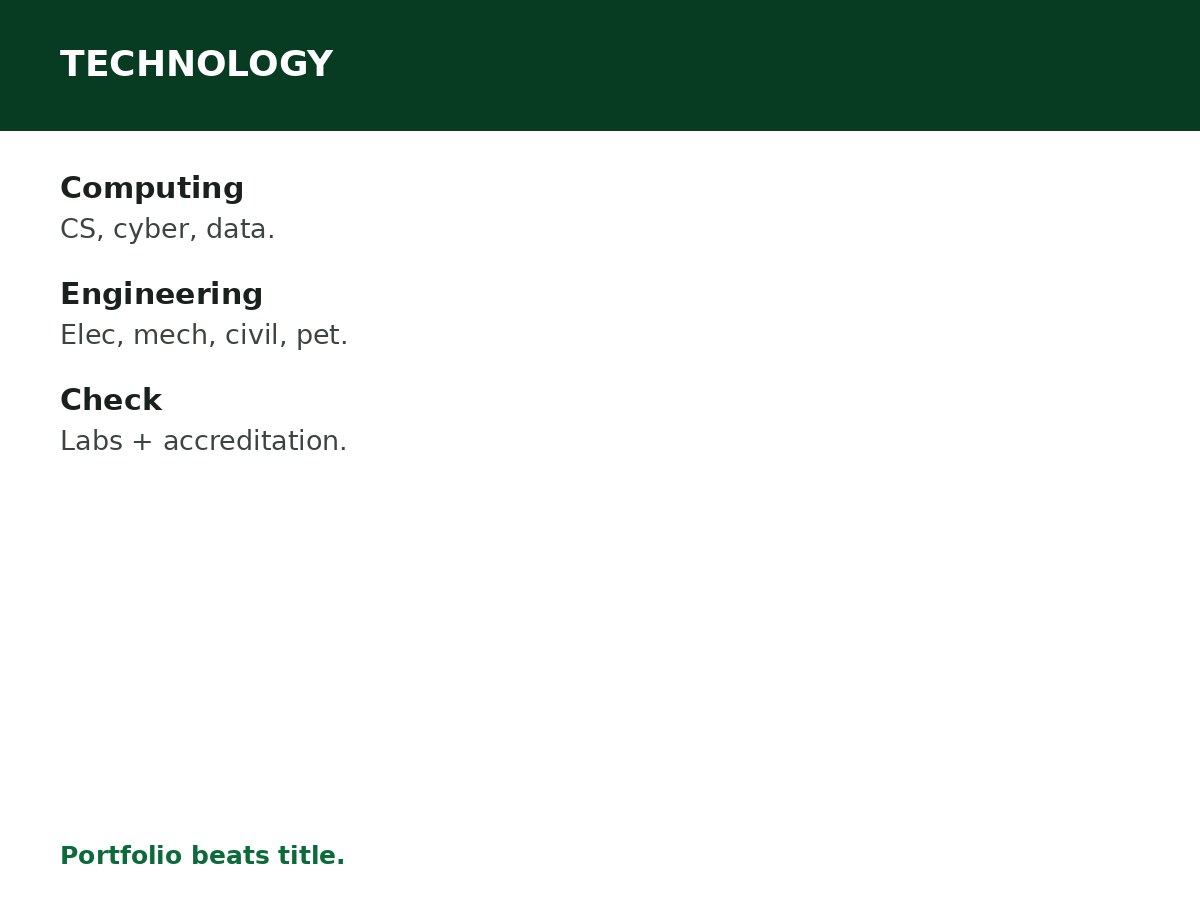
Technology-related courses in Nigeria span computing, engineering, and applied sciences — software, hardware, networks, data, and infrastructure. The courses below are grouped by field, with the degree, duration, and professional or skills route for each. Technology courses share one trait: skills and portfolio matter more than classification, and the field moves faster than any curriculum — so judge programmes by laboratories, faculty currency, and industry links, not by name alone.
Computing (software, data, security)
- Computer Science — BSc 4 years + SIWES. Software, systems, and data. Portfolio (projects, contributions) matters most.
- Cybersecurity — BSc 4 years + SIWES. Security operations, forensics, governance. Certifications matter alongside the degree. Newer programme — verify programme-specific accreditation.
- Data Science — BSc 4 years + SIWES. Analysis, machine learning, data engineering. Portfolio (notebooks, projects) matters most. Newer programme — verify programme-specific accreditation.
- Software Engineering, Information Technology — BSc 4 years + SIWES. As computer science, with role-specific emphasis.
- Information Systems, Information Science — BSc 4 years + SIWES. Systems, data management, and organisational technology.
Engineering (hardware, infrastructure, energy)
- Electrical and Electronics Engineering — BEng 5 years + SIWES. Power, electronics, telecommunications. COREN registration route, per discipline.
- Mechanical Engineering — BEng 5 years + SIWES. Machines, manufacturing, energy systems. COREN route.
- Civil Engineering — BEng 5 years + SIWES. Structures, infrastructure, water. COREN route.
- Computer Engineering — BEng 5 years + SIWES. Hardware, embedded systems, networks. COREN route.
- Petroleum, Chemical, Agricultural, Biomedical Engineering — BEng 5 years + SIWES. Field-specific engineering, COREN route per discipline.
Applied sciences and technology-adjacent
- Mathematics, Statistics — BSc 4 years. Quantitative foundations for computing, data, and engineering-adjacent roles.
- Physics, Electronics (applied) — BSc 4 years. Foundations for hardware, telecommunications, and energy roles.
- Geology, Geophysics — BSc 4 years. Subsurface technology, energy, and environmental roles.
- Architecture, Building Technology, Quantity Surveying — BSc 4–5 years + professional route (ARCON, NIQS). Technology-adjacent built-environment roles.
How to choose among technology courses
- Software vs hardware vs infrastructure: computer science, cybersecurity, and data science are software and data roles; electrical, mechanical, and computer engineering are hardware and infrastructure roles. Choose by the work you want to do daily, not by which field sounds most modern.
- Licensed vs skills routes: engineering offers COREN registration (licensed, structured); computing offers skills and certifications (flexible, competitive). Licensed routes restrict supply and protect demand; skills routes reward portfolio over credentials.
- Laboratories and faculty currency: technology teaching decays fast. Visit laboratories where possible, ask about equipment age, and check whether faculty publish or practise in the field currently — not a decade ago.
- Accreditation per programme, per session: verify NUC accreditation for the specific programme, for the session — a university’s general standing does not confer it, and newer programmes (cybersecurity, data science) vary most.
Related Guides & Next Steps
- Admission Requirements for Nigerian Universities
- How to Choose a Course After JAMB
- How University Admission Works in Nigeria
- Best Universities to Study Medicine in Nigeria
- Courses Related to Healthcare in Nigeria
Frequently asked questions
Which technology course is best? No single course holds that title. Computer science offers the broadest software route; cybersecurity and data science offer the fastest-growing specialist routes; engineering offers the licensed infrastructure route. “Best” depends on your interests, your skills, and your licensing goals.
Do I need a technology degree to work in technology? No — many technology roles are skills- and portfolio-based, and demonstrable skills carry weight. But a degree remains the standard entry route for formal employment and graduate programmes, and it structures the fundamentals that self-study often skips.
Which technology courses are licensed professions? Engineering disciplines (COREN, per discipline) and architecture (ARCON) are licensed. Computing courses (computer science, cybersecurity, data science) are skills routes, not licensed professions — certifications, not licences, signal competence there.
Should I choose a technology course only for job prospects? No — choose by the intersection of prospects, your interests, and your strengths. Technology fields reward sustained practice: a course you cannot sustain for 4–5 years, however high-demand, is a dropout risk.
How do I verify a technology programme’s quality? By NUC accreditation for the specific programme, laboratory quality, faculty currency, SIWES placements, and graduate outcomes where published — not by the university’s general reputation or by marketing claims.
Sources and last update
- Course groupings, durations, and professional/skills routes from the respective course guides (Batches 13–17), summarised here — the course guides govern where they differ in detail.
- Accreditation guidance from NUC programme accreditation, with per-session verification directed.
Last updated: 24 October 2026. Guide — review every 3–6 months and on every JAMB brochure update.

Written by Olaitan Ilori
Olaitan Ilori is the founder and lead researcher at CareerMedal. He provides verified, practical guides on Nigerian tertiary admissions (JAMB, CAPS, Post-UTME), NELFUND student finance, NYSC service-year survival, and early-career job placement.
View all guides by Olaitan Ilori →