

Media- and communication-related courses in Nigeria span journalism, broadcasting, public relations, advertising, film, theatre, and digital media — mass communication, theatre arts, film production, linguistics, and related humanities. The courses below are grouped by field, with the degree, duration, and portfolio route for each. Media courses share one trait: portfolio matters more than classification — published work, broadcasts, campaigns, and showreels decide hiring, not degree titles alone.
Journalism and broadcasting
- Mass Communication — BSc 4 years + SIWES. Journalism, broadcasting, public relations, and advertising, with specialisation by programme. Literature-in-English is a core requirement at most institutions. Portfolio (published work, broadcasts, campaigns) matters most.
- Journalism (where offered as a distinct degree) — BSc 4 years. Reporting, editing, and news production. Portfolio matters entirely.
- Broadcasting (where offered) — BSc 4 years. Radio, television, and digital broadcast production. Showreel matters most.
Public relations, advertising, and digital media
- Public Relations (where offered) — BSc 4 years. Reputation, stakeholder communication, and crisis communication. Campaign portfolio matters most.
- Advertising (where offered) — BSc 4 years. Creative, strategy, and media planning. Campaign portfolio matters most.
- Digital Media, New Media (where offered) — BSc 4 years. Social media, content production, and digital strategy. Published digital work matters most.
Theatre, film, and creative arts
- Theatre Arts, Performing Arts, Drama — BA 4 years. Performance, directing, and production, plus audition or portfolio where required. Literature-in-English is a core requirement at most institutions.
- Film Production, Cinematography (where offered) — BA/BSc 4 years. Directing, cinematography, editing, and production. Showreel matters most.
- Fine and Applied Arts, Graphic Design (where offered) — BA 4 years. Visual design and applied arts. Portfolio matters entirely.
Language and communication foundations
- English Language, English and Literary Studies — BA 4 years. Writing, editing, and literary analysis. Literature-in-English is a core requirement.
- Linguistics — BA 4 years. Language structure, sociolinguistics, and communication science. Literature accepted at many institutions.
- History and International Studies — BA 4 years. Research, writing, and analysis skills that transfer to media, public service, and NGOs.
How to choose among media courses
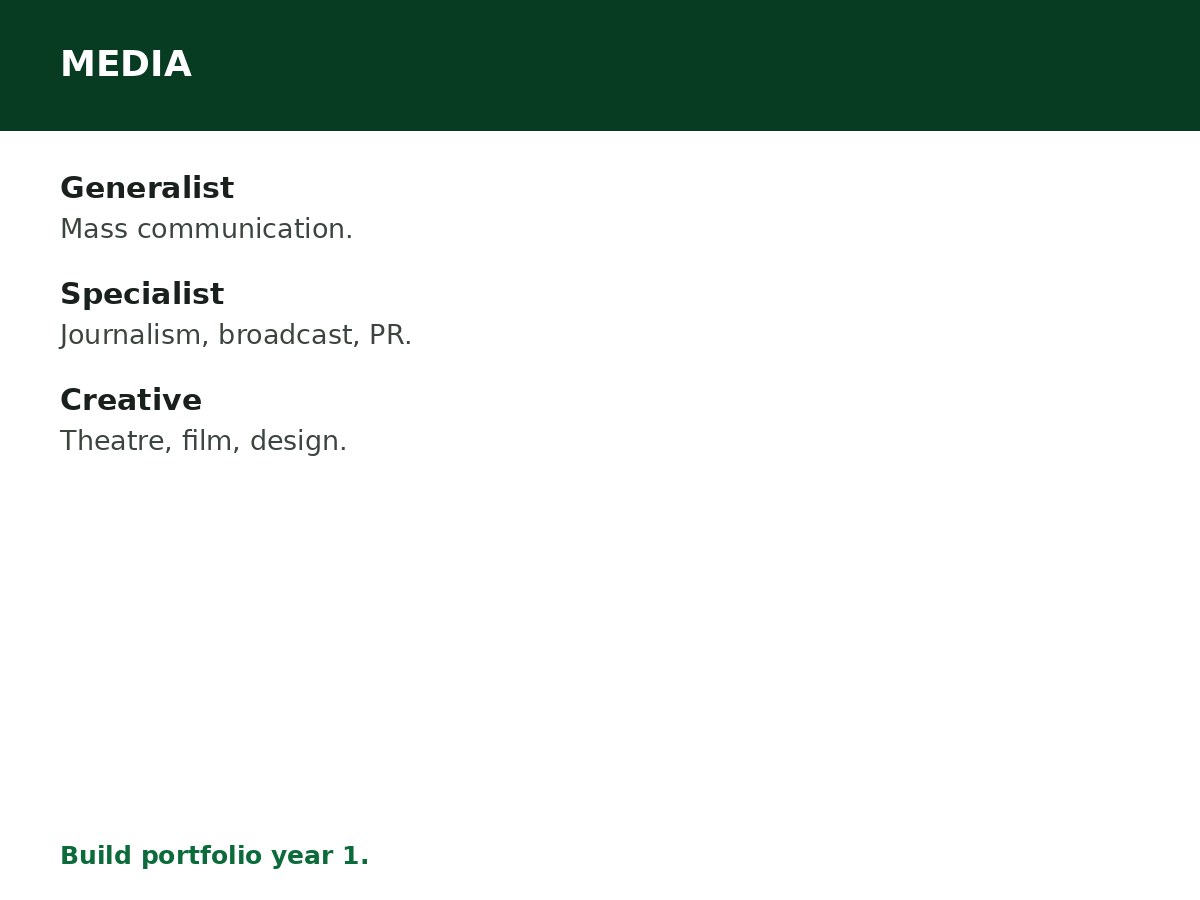
- Generalist vs specialist: mass communication is the generalist media degree (journalism, broadcasting, PR, advertising within one programme); journalism, broadcasting, PR, and advertising are specialist degrees where offered. Choose generalist for breadth, specialist for a focused career.
- Portfolio from first year: media hiring is portfolio-based. Start publishing, broadcasting, or producing from first year — campus media, student publications, and personal projects count, and they compound.
- Literature requirement: mass communication, theatre arts, and English require Literature-in-English at most institutions. If you lack Literature, retaking is the route — no workaround exists for those courses.
- Accreditation per programme, per session: verify NUC accreditation for the specific programme, for the session — a university’s general standing does not confer it, and media programmes vary most in facilities (studios, equipment).
Related Guides & Next Steps
- Admission Requirements for Nigerian Universities
- How to Choose a Course After JAMB
- How University Admission Works in Nigeria
- Best Universities to Study Medicine in Nigeria
- How to Know If a Course Is Accredited in Nigeria
Frequently asked questions
Which media course is best? No single course holds that title. Mass communication offers the broadest media route; journalism and broadcasting offer specialist routes; theatre and film offer performance and production routes. “Best” depends on your interests, your portfolio strengths, and your career goals.
Do I need Literature-in-English for media courses? Yes, at most institutions — Literature is a core requirement for mass communication, theatre arts, and English. Retaking Literature is the route if media is your goal.
Does a media degree guarantee a media job? No — media hiring is portfolio-based. Published work, broadcasts, campaigns, and showreels decide hiring, not degree titles alone. Build the portfolio from first year.
Should I choose mass communication or a specialist media degree? Mass communication for breadth (journalism, broadcasting, PR, advertising within one programme); a specialist degree for a focused career where offered. Choose by the career you want, and check each programme’s facilities before deciding.
Which media course has the best job prospects? No reliable figure exists for any media course, and any guide quoting one is guessing. Judge prospects by portfolio strength, internships, and location (Lagos concentrates media demand) — not by quoted salaries.
Sources and last update
- Course groupings, durations, and portfolio routes from the respective course guides (Batches 13–17), summarised here — the course guides govern where they differ in detail.
- Accreditation guidance from NUC programme accreditation, with per-session verification directed.
Last updated: 24 October 2026. Guide — review every 3–6 months and on every JAMB brochure update.

Written by Olaitan Ilori
Olaitan Ilori is the founder and lead researcher at CareerMedal. He provides verified, practical guides on Nigerian tertiary admissions (JAMB, CAPS, Post-UTME), NELFUND student finance, NYSC service-year survival, and early-career job placement.
View all guides by Olaitan Ilori →