

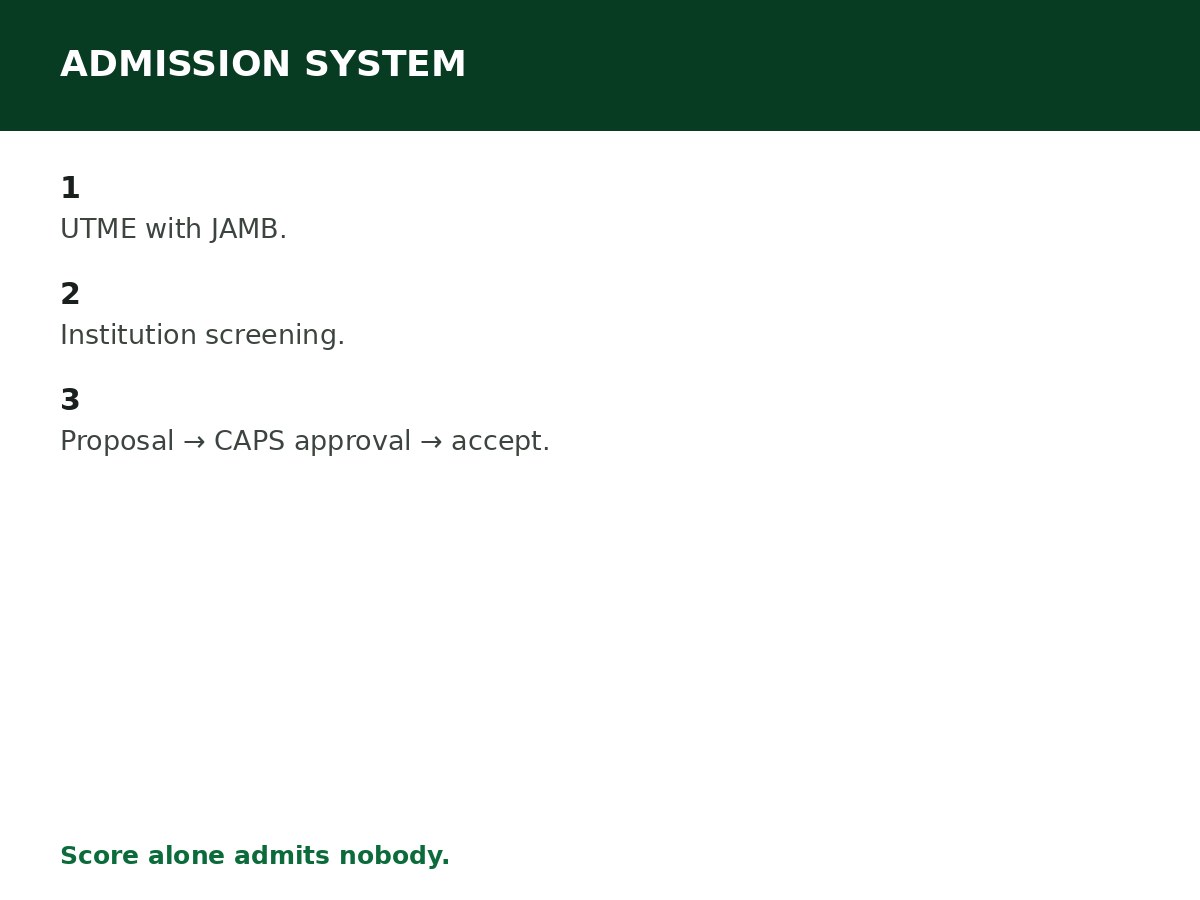
University admission in Nigeria works through a single central system: you write UTME with JAMB, you are screened by the institution(s) you chose, the institution proposes candidates for admission, JAMB approves the proposal on CAPS, and you accept the offer on CAPS. No step outside that system — no agent, no list, no payment — creates an admission.
Understanding the system as a whole prevents the two commonest misunderstandings: that a high UTME score alone guarantees admission (it does not — screening, departmental cut-offs, and available places decide), and that an institution’s list alone is admission (it is not — CAPS acceptance is what finalises it).
The stages, in order
Stage 1: UTME with JAMB. You register with a profile code (NIN SMS to 55019/66019), choose institutions and courses, write the computer-based test in your four subjects, and receive a UTME score out of 400. Your score qualifies you for screening at institutions whose minimum cut-off you meet — it does not admit you anywhere by itself.
Stage 2: Institution screening (Post-UTME). Each institution you chose as first choice (in most cases) runs its own screening: an exam, a screening-only aggregate (UTME + O’Level grades), or physical document screening — or a combination. You buy the screening form on the institution’s official portal, upload your documents, and sit the screening or submit to it, as the institution’s format requires.
Stage 3: Institution proposal. After screening, the institution ranks candidates by department — by aggregate score, against departmental cut-offs and available places — and proposes candidates for admission to JAMB through CAPS. This proposal stage is what “Admission in Progress” on CAPS reflects: proposed or recommended, not yet approved.
Stage 4: JAMB approval on CAPS. JAMB processes the institution’s proposal against admission policy — including merit, catchment-area, and educationally-less-developed-states considerations, as applicable to the institution type — and approves offers. An approved offer appears on CAPS as “Admitted”, with institution and course shown.
Stage 5: Your acceptance on CAPS. You accept (or reject) the offer on CAPS, promptly, before it expires. Acceptance removes you from the pool for other institutions. After acceptance, you print your JAMB admission letter, confirm on the institution’s list, pay the acceptance fee through the official portal, and complete clearance and registration.
What decides admission, in practice
- UTME score vs departmental cut-off — not vs the institutional minimum alone. A department’s cut-off is set by competition for its places, and it moves every session.
- Screening performance — exam score, or O’Level aggregate for screening-only institutions. A strong screening can lift a modest UTME score; a weak one can sink a strong UTME score.
- O’Level requirements — five credits including English (and Mathematics for most courses), in the course-relevant subjects, in not more than two sittings (with course-specific one-sitting exceptions). No O’Level upload on CAPS means no admission, regardless of scores.
- Available places — each department has a quota (carrying capacity, as approved). When places fill, the department’s effective cut-off rises, even mid-process.
- Catchment and ELDS considerations — JAMB’s admission policy includes catchment-area and educationally-less-developed-states considerations alongside merit, as applicable. These affect the order in which candidates are approved, not the basic requirements — you must still meet the cut-off and screening standards.
What admission is not
- Not a UTME score. A 300 without screening, or without O’Level upload, is not an admission.
- Not an institution’s list alone. The list is the institution’s confirmation; CAPS is the authoritative record, and acceptance happens there.
- Not purchasable. No agent, payment, or “connection” creates a CAPS offer. Offers that appear only in screenshots or messages, and never on CAPS, are not offers.
- Not transferable between candidates. An offer is tied to your JAMB number and your records. It cannot be sold, swapped, or reassigned.
Related Guides & Next Steps
- How to Print University Admission Letter
- How to Reduce University Costs in Nigeria
- Late Admission: What Candidates Can Do
- How to Check a University Admission List
- How to Check Admission Status on JAMB CAPS
- Post-UTME Explained: Requirements, Screening and Admission
- 2026/2027 University Admission Guide for Nigerian Students
- University Admission Questions Students Ask Most
Frequently asked questions
How does university admission work in Nigeria, in one sentence? UTME with JAMB, screening by your chosen institution, institution proposal, JAMB approval on CAPS, and your acceptance on CAPS — in that order.
Does a high UTME score guarantee admission? No. Screening performance, departmental cut-off, O’Level requirements, and available places all decide alongside your UTME score.
What is the difference between “Admission in Progress” and “Admitted” on CAPS? “Admission in Progress” means the institution has proposed or recommended you, but JAMB has not finalised the offer. “Admitted” means an approved offer is waiting for your acceptance.
Can an institution admit me without JAMB? For UTME-route admission, no — admission is processed through JAMB CAPS. The exceptions are non-UTME routes (open universities, and Direct Entry via the JAMB DE form), which are different pathways, not bypasses of the same system.
How many institutions can admit me? JAMB processes one admission at a time through CAPS: accepting an offer removes you from the pool for other institutions. You cannot hold multiple accepted offers simultaneously.
Sources and last update
- Admission system stages (UTME → screening → proposal → CAPS approval → acceptance) and decision factors (departmental cut-offs, screening, O’Level, quotas, catchment/ELDS) from JAMB’s admission process and the cluster’s CAPS and screening guides.
- CAPS status meanings from JAMB’s own September 2026 clarification, as established in the CAPS guides.
- No quota percentages are asserted — carrying capacity and catchment/ELDS weightings vary by institution type and session.
Last updated: 24 October 2026. Guide — review every admission session and on every JAMB policy update.

Written by Olaitan Ilori
Olaitan Ilori is the founder and lead researcher at CareerMedal. He provides verified, practical guides on Nigerian tertiary admissions (JAMB, CAPS, Post-UTME), NELFUND student finance, NYSC service-year survival, and early-career job placement.
View all guides by Olaitan Ilori →