

You reduce university costs in Nigeria by attacking the largest costs first — fees, accommodation, food, and transport — and by avoiding the costs that repeat: failed courses, late registration penalties, and duplicate payments. Small savings (data, printing) help, but they do not compensate for a large cost left unexamined.
This guide is CareerMedal’s cost-reduction method, applied to the Nigerian university cost structure. Where a saving depends on your institution’s rules, the guide says so — do not assume a saving that your institution does not offer.
Fees: the largest cost
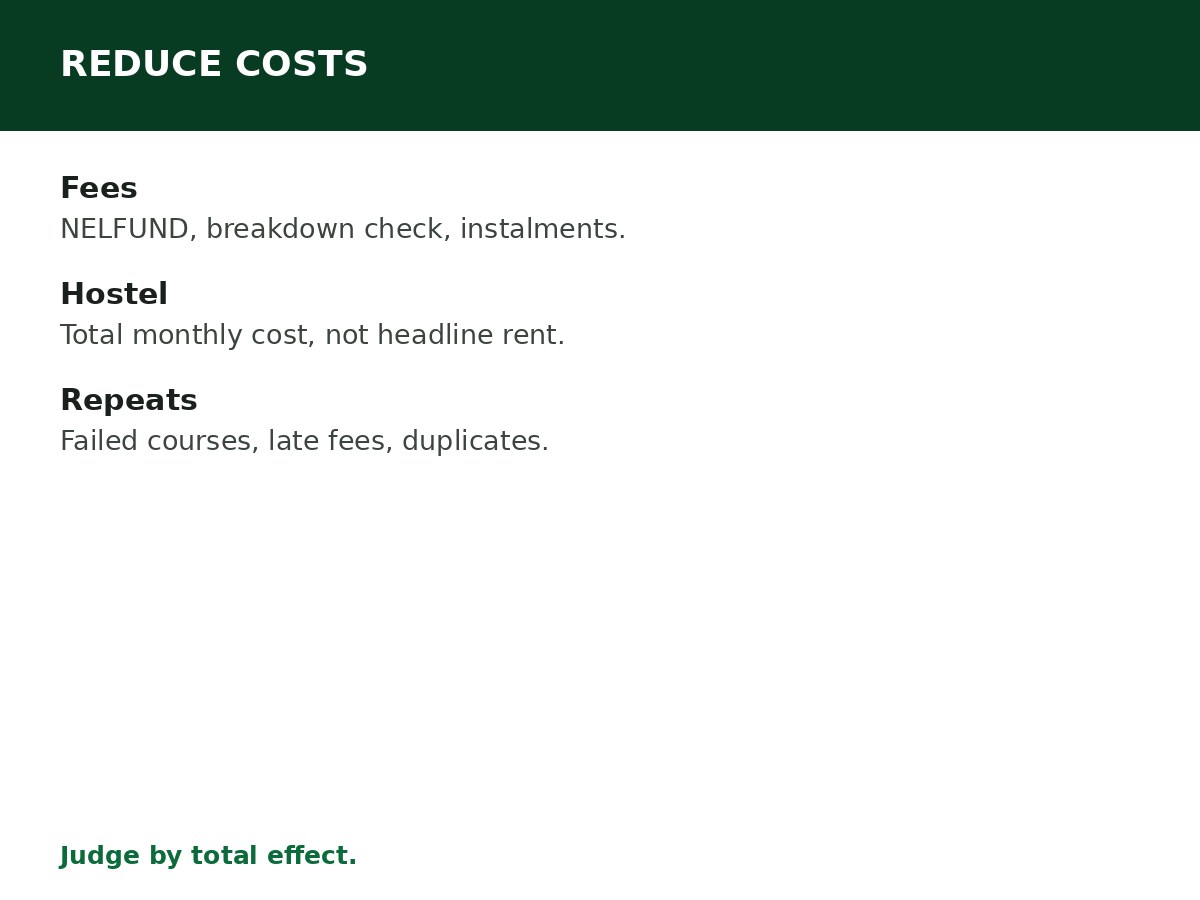
- Use NELFUND for institutional charges if you are eligible (public institutions). A zero-interest loan for verified charges is cheaper than any other borrowing, and it removes the lump-sum timing problem. See the NELFUND complete guide.
- Check your fee breakdown line by line. Institutions input fee schedules into NELFUND’s verification system, and you can see the uploaded amount on your portal and challenge it if it differs from your actual course fee. The same discipline applies to your own payment: check what each line is for, and query lines you do not recognise, before paying.
- Ask about instalment plans. Some institutions allow fee payment in instalments. An instalment plan does not reduce the total, but it spreads the timing — which is often the difference between paying and dropping out.
- Avoid duplicate payments. If NELFUND has paid your fees, do not pay them again yourself without checking your student record — and if you already paid before NELFUND disbursed, pursue the refund or credit route promptly, with receipts and disbursement records.
Accommodation: the second-largest cost
- Compare institution hostel vs off-campus rent honestly. Institution hostels are often cheaper than private rentals, but availability is limited and conditions vary. Off-campus rent looks flexible but adds transport, security, and utility costs that hostel fees may already include. Compare total monthly cost, not headline rent.
- Share, where it is safe and permitted. Sharing a room or flat splits the largest living cost. Share with people you trust, with a written agreement on rent, bills, and exit terms — an informal sharing arrangement that collapses mid-session costs more than it saves.
- Do not sign a rent agreement assuming NELFUND will pay the landlord. No NELFUND payment goes to a landlord. Accommodation funding within NELFUND is only upkeep you spend yourself, or a hostel charge billed in your institution’s verified fee schedule.
Food, transport, and daily costs
- Food: cook where you can, buy staples in bulk with trusted housemates, and price your actual weekly food spend before deciding what “expensive” means. Daily bought meals are the most common budget leak.
- Transport: live as close to campus as your budget allows, walk where it is safe, and use the cheapest reliable route rather than the fastest. Transport costs compound daily — a small daily saving is a large session saving.
- Data and printing: use campus Wi-Fi where available, print only what you need, and share digital materials where your course permits. These are small individually, but they are the costs most students never track.
Avoid repeat costs
- Failed courses cost twice. A carryover means paying for the course again (in fees, materials, and time) and delaying graduation — which delays earning. The cheapest cost reduction is passing first time, and that means attendance, early assignment work, and asking for help before a course is lost, not after.
- Late registration penalties. Register on time, every session. Late fees and blocked access are avoidable costs, and they compound with the stress of catching up.
- Lost documents and re-issues. Keep your admission letter, fee receipts, NIN slip, and JAMB documents safe and backed up (photocopies and phone scans). Re-issue fees and delays are avoidable.
Reduce, do not just shift
A cost reduction that creates a larger cost elsewhere is not a saving: skipping classes to work, skipping meals to save money, or living far from campus to save rent while spending the saving on transport. Judge every saving by its total effect on your session — money, time, health, and grades together.
Related Guides & Next Steps
- Can NELFUND Pay for Accommodation?
- Can You Apply for NELFUND After Paying School Fees?
- NELFUND Student Loan 2026/2027: Complete Guide
- NELFUND Student Loan Requirements
- NELFUND Frequently Asked Questions
Frequently asked questions
What is the biggest way to reduce university costs in Nigeria? Use NELFUND for institutional charges if you are eligible, and attack fees and accommodation first — they dwarf daily costs.
Is institution hostel cheaper than off-campus rent? Often, but not always. Compare total monthly cost (rent + transport + security + utilities) rather than headline rent, and factor in availability.
How do I avoid paying fees twice? Check your student record before paying, and if NELFUND has paid fees you already paid yourself, pursue the refund or credit route promptly with receipts and disbursement records.
Does reducing costs mean lowering my standard of living? No — it means spending deliberately on the largest costs first, and avoiding repeat costs (failed courses, late penalties, duplicate payments) that buy nothing.
Can I reduce costs by taking fewer courses? Only where your institution permits a reduced load without extending your programme or affecting your standing — and the extension itself has a cost (extra session fees, delayed graduation). Confirm with your department before reducing your load for cost reasons.
Sources and last update
- Cost-reduction method (largest-first, repeat-cost avoidance, total-effect test) is CareerMedal’s own method, applied to the Nigerian university cost structure.
- NELFUND facts (0% loan for verified charges, fee-schedule challenge right, no landlord payment, double-payment refund route) cross-checked across NELFUND guides. No institution-specific fee, hostel price, or instalment term is asserted — those are institution-specific and must be confirmed locally.
Last updated: 24 October 2026. Guide — review every session and on every NELFUND guideline update.

Written by Olaitan Ilori
Olaitan Ilori is the founder and lead researcher at CareerMedal. He provides verified, practical guides on Nigerian tertiary admissions (JAMB, CAPS, Post-UTME), NELFUND student finance, NYSC service-year survival, and early-career job placement.
View all guides by Olaitan Ilori →