
Writing an ATS-friendly CV means formatting your CV so applicant tracking systems — the software many employers use to screen CVs — can read it, parse it, and match it to roles. This guide covers ATS formatting specifically, distinct from the CV format guide (which covers general CV layout) and the graduate CV guide (which covers graduate content).
What ATS does
- Parses CVs — ATS software extracts text, headings, and sections, from CVs, for employer review, as employers state.
- Screens by keywords — ATS matches CV keywords to job descriptions, ranking CVs by match, as employers state. Keyword matching is a screen, not a hiring decision.
- Filters formatting — complex formatting (tables, graphics, columns, unusual fonts) can break parsing, hiding content from employers, as the market states.
ATS-friendly formatting rules
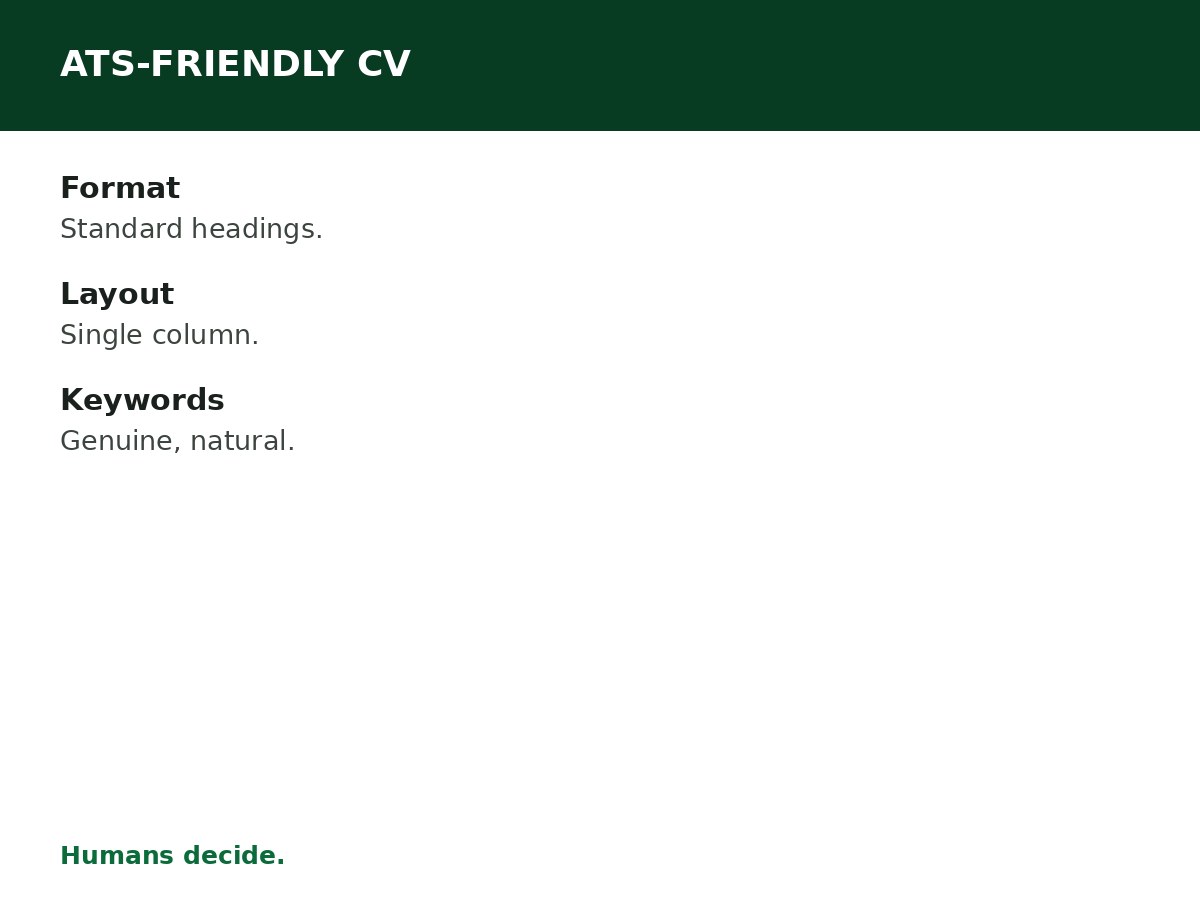
- Standard headings — Work Experience, Education, Skills, and Certifications, in standard wording, so ATS recognises sections.
- Simple layout — single column, standard fonts, no tables, graphics, headers, or footers, for reliable parsing.
- Keywords from the job description — skills, tools, and qualifications, from the job description, included naturally, where genuinely held, not stuffed.
- Standard file format — Word (.docx) or PDF, as the application states, with text (not scanned images), for reliable parsing.
- Reverse-chronological order — most recent experience and education first, as employers state, for clear parsing.
ATS myths
- Keyword stuffing does not work — stuffing keywords, without genuine skills, fails human review and reference checks, whatever the ATS score.
- Fancy designs hurt ATS — graphic CVs, columns, and tables, break parsing, hiding content from employers. Simple formatting wins for ATS roles.
- ATS is not the final decision — ATS screens CVs; humans decide interviews and hiring. ATS-friendly formatting gets CVs seen; content and proof win interviews.
ATS plus tailoring
- Tailor keywords per role — job-description keywords, matching genuinely held skills, per application, not one keyword set for every role.
- Keep human readability — CVs must read well for humans, not just ATS. Clear, honest, proof-based content wins both screens.
- Proofread before sending — spelling, grammar, and formatting, checked before every submission.
Related Guides & Next Steps
- How to Write a CV With No Work Experience
- CV Format for Nigerian Job Seekers
- Best CV Skills to Add as a Graduate
- How to Write a Graduate CV in Nigeria
Frequently asked questions
What is an ATS-friendly CV? A CV formatted so applicant tracking systems can read it, parse it, and match it to roles — standard headings, simple layout, keywords from the job description, and standard file formats.
What formatting breaks ATS parsing? Complex formatting: tables, graphics, columns, unusual fonts, headers, footers, and scanned images — all can hide content from employers.
Should I stuff keywords into my CV for ATS? No — keyword stuffing, without genuine skills, fails human review and reference checks, whatever the ATS score. Include job-description keywords naturally, where genuinely held.
What file format should I submit for ATS roles? Word (.docx) or PDF, as the application states, with text (not scanned images), for reliable parsing.
Does ATS decide hiring? No — ATS screens CVs; humans decide interviews and hiring. ATS-friendly formatting gets CVs seen; content and proof win interviews.
Sources and last update
- No salary figure, vacancy count, or hiring outcome is asserted anywhere in this article, deliberately — employer career pages and reputable boards, checked at application time, govern.
- No company is named as currently hiring anywhere in this article, deliberately — hiring windows open and close; employer career pages govern.
- Scam patterns: fees for jobs, payment to personal accounts, guaranteed jobs or shortlisting, and CV services selling fake experience are red flags — verify every employer on official channels before applying or paying anything.
- No job, shortlisting, or hiring outcome is promised anywhere in this article.
Last updated: 24 October 2026. Guide — review every 6–12 months, and on every major hiring-platform change.

Written by Olaitan Ilori
Olaitan Ilori is the founder and lead researcher at CareerMedal. He provides verified, practical guides on Nigerian tertiary admissions (JAMB, CAPS, Post-UTME), NELFUND student finance, NYSC service-year survival, and early-career job placement.
View all guides by Olaitan Ilori →