
A scholarship personal statement is not an autobiography — it is an argument: why you, why this field, why this programme, and what you will do with the award. Selectors read hundreds of statements; the ones that win are specific, honest, and tied to the programme’s criteria. This guide gives you the structure, shows the difference between strong and weak writing with original examples, and lists the mistakes that lose awards. No statement is written for you here — your statement must be yours, in your voice, with your facts.
The structure that works
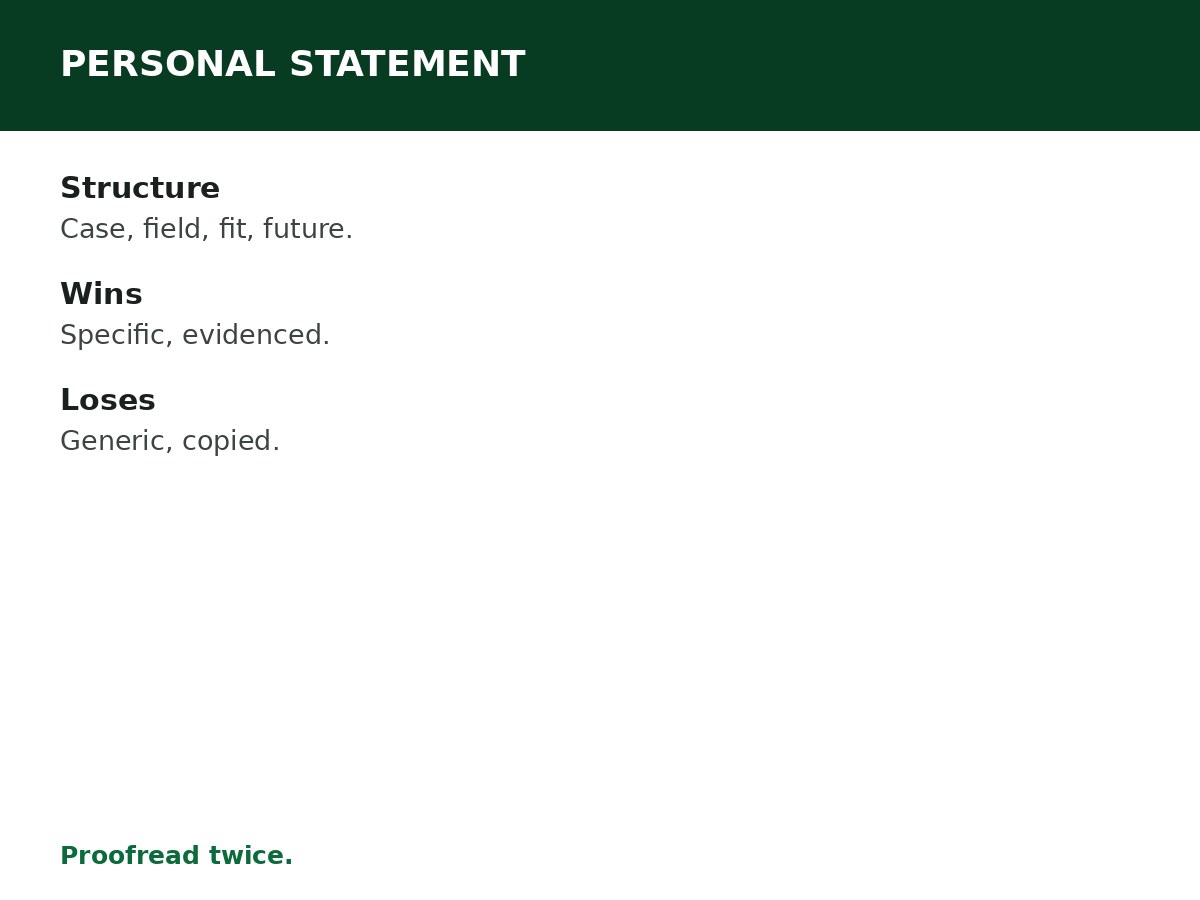
- Opening (2–3 sentences) — who you are, what you are applying for, and the one sentence that frames your case. Not your life story; your case.
- Why this field (1 paragraph) — what drew you to the field, with one specific experience (a project, a course, a problem you saw), not a generic claim.
- Why you are ready (1–2 paragraphs) — your academic record, your projects, your work or community experience, tied to the programme’s criteria. Evidence, not adjectives.
- Why this programme (1 paragraph) — what this specific programme offers (supervisor, facilities, field focus) that others do not. Generic praise of the programme loses; specific fit wins.
- What you will do with the award (1 paragraph) — your plan after the award: career, community, research, or teaching. Selectors fund futures, not pasts.
- Closing (1–2 sentences) — restate your case, thank the selectors, stop. Do not beg, do not flatter, do not repeat.
Strong vs weak: original examples
Weak: ‘I have always been passionate about engineering since childhood, and I believe I deserve this scholarship because I am hardworking and dedicated.’ — Generic, unprovable, and identical to a thousand other statements.
Strong: ‘In my second year, I built a solar-powered water pump for my department’s farm project, using locally sourced parts. The pump cut watering time by half, and the project taught me that engineering in Nigeria must work with local materials, not imported ones. I want to study energy engineering to scale that approach.’ — Specific, evidenced, tied to field and future.
Weak: ‘This university is world-renowned and prestigious, and studying there would be a dream come true.’ — Flattery, not fit.
Strong: ‘Your department’s work on off-grid energy systems matches the solar-pump project I built in my second year, and Professor X’s research on local materials is the reason I chose this programme over others.’ — Specific fit, named reason.
What selectors actually score
- Fit — does your field, level, and plan match the programme’s criteria?
- Evidence — do you show, with specifics, or only claim, with adjectives?
- Clarity — can a busy selector follow your argument in one reading?
- Honesty — do your claims match your documents (transcripts, references)? Mismatches disqualify.
- Future — do you have a credible plan for after the award?
Mistakes that lose awards
- Generic statements — interchangeable with any applicant, any programme.
- Life story without argument — hardship matters only where it explains your case, not as a standalone story.
- Flattery — praising the programme instead of showing fit.
- Claims without evidence — ‘hardworking’, ‘passionate’, ‘dedicated’ without a project, grade, or experience behind them.
- Copied statements — copied statements are detected, and they disqualify. Write yours, in your voice.
- Errors — spelling, grammar, and factual errors signal carelessness. Proofread, then proofread again.
Related Guides & Next Steps
- Scholarships for Nigerian Students in 2026/2027
- State Government Scholarships in Nigeria
- Scholarship Application Mistakes to Avoid
- Edo State Scholarship Guide
Frequently asked questions
How long should a scholarship personal statement be? As the programme states — commonly 500 to 1,000 words, or one to two pages. Follow the programme’s limit exactly; over-length statements are penalised or ignored.
Should I mention hardship in my personal statement? Only where it explains your case — how it shaped your field choice, your resilience, or your plan. Hardship as a standalone story, without argument, does not win awards.
Can I use the same personal statement for multiple scholarships? Only as a base — adapt it to each programme’s criteria, field, and fit. A generic statement sent everywhere loses everywhere.
Should someone else write my personal statement? No — your statement must be yours, in your voice, with your facts. Copied or ghostwritten statements are detected, and they disqualify.
What if my grades are average? Lead with evidence beyond grades — projects, work, community service, and a credible future plan. Grades are one criterion, not the only one, in most programmes.
Sources and last update
- Scholarship programmes named here are established programmes as reported; amounts, deadlines, and eligibility change every cycle — the official programme page for the current cycle governs, and no amount or deadline is asserted anywhere in this article, deliberately.
- Scholarship-vs-loan distinction from the NELFUND cluster guides (Batches 6–10): a scholarship is not repaid; NELFUND is a loan, repayable from 2 years after NYSC at 10% of income.
- Scam patterns from the fake-agents guide (Batch 12): application fees, guaranteed awards, and payment to personal accounts are red flags.
- No admission, award, or visa outcome is promised anywhere in this article.
Last updated: 24 October 2026. Guide — review every 3–6 months and on every scholarship-cycle update.

Written by Olaitan Ilori
Olaitan Ilori is the founder and lead researcher at CareerMedal. He provides verified, practical guides on Nigerian tertiary admissions (JAMB, CAPS, Post-UTME), NELFUND student finance, NYSC service-year survival, and early-career job placement.
View all guides by Olaitan Ilori →