
Scholarships for Nigerian students in 2026/2027 fall into three groups: Nigerian scholarships (for study in Nigeria), government and corporate scholarships (oil, telecoms, and foundation programmes), and international scholarships (for study abroad). This guide maps all three, names the established programmes, and tells you how to verify each one for the current cycle — because amounts, deadlines, and eligibility change every year, and no amount or deadline is asserted anywhere in this article, deliberately. The official programme page for the current cycle is the only reliable source for those details.
Scholarships for study in Nigeria
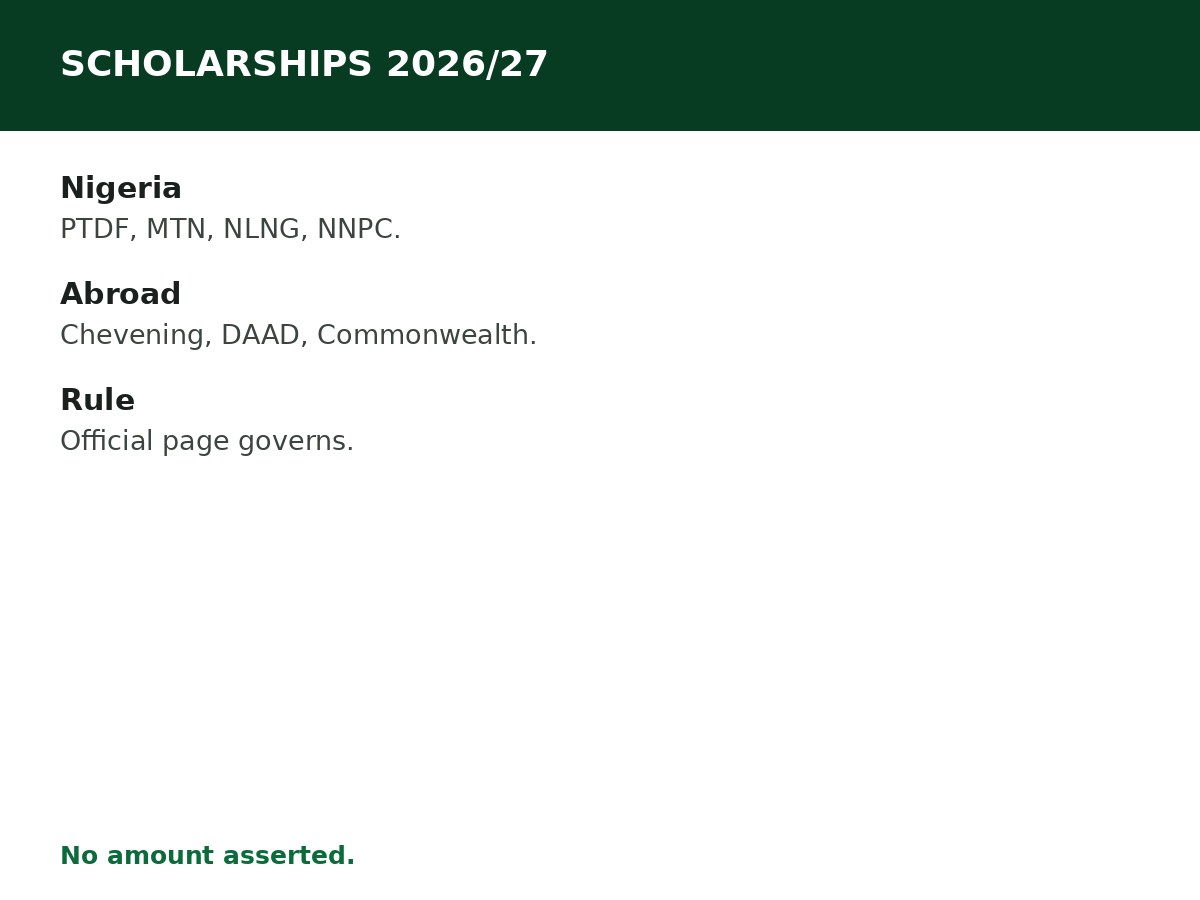
- PTDF (Petroleum Technology Development Fund) — scholarships for Nigerian students, notably in oil, gas, and related fields.
- NNPC and joint-venture scholarships (Shell SPDC, Chevron/Agbami, TotalEnergies, SEPLAT) — undergraduate scholarships for Nigerian students, often targeted at host communities and specific fields.
- MTN Foundation Scholarship — undergraduate scholarships for Nigerian students in science and technology fields.
- NLNG (Nigeria LNG) Scholarship — undergraduate and postgraduate scholarships for Nigerian students.
- Jim Ovia Scholarship — undergraduate scholarships for Nigerian students.
- University and state scholarships — many universities and state governments run their own schemes; check your institution’s student-affairs office and your state scholarship board.
Scholarships for study abroad
- Commonwealth Scholarships — for study in the UK, for citizens of Commonwealth countries including Nigeria.
- Chevening Scholarships — UK government scholarships for future leaders, for master’s study in the UK.
- DAAD Scholarships — German government scholarships for study in Germany.
- Erasmus Mundus — European Union joint master’s programmes with scholarships.
- MEXT Scholarships — Japanese government scholarships for study in Japan.
- Mastercard Foundation Scholars Programme — for African students, at partner universities in Africa and abroad.
- BEA (Bilateral Education Agreement) Awards — Nigerian government awards for study in partner countries.
How to apply, in order
- Shortlist by level and field — undergraduate, master’s, or PhD; your field; Nigeria or abroad.
- Check the official programme page for the current cycle — amounts, deadlines, and eligibility for this cycle only.
- Prepare documents early — transcripts, certificates, identification, references, and (for study abroad) language proof where required.
- Apply through the official portal only — never through an agent, a personal account, or a link sent in a group.
- Track deadlines in a calendar — scholarship cycles close hard; late applications are not considered.
Red flags: scholarship scams
- Application fees — genuine scholarships rarely charge an application fee. A fee demand is a red flag (see the no-application-fee guide).
- Guaranteed awards — no genuine scholarship guarantees an award before selection.
- Payment to personal accounts — genuine programmes pay through official channels, never to a personal account.
- Pressure to pay quickly — urgency plus payment equals scam, in almost every case.
Related Guides & Next Steps
- How University Admission Works in Nigeria
- Fully Funded Scholarships for Nigerians
- Undergraduate Scholarships for Nigerian Students
- Scholarship Application Mistakes to Avoid
Frequently asked questions
When do 2026/2027 scholarships open? Cycles vary by programme — some open in the final quarter of the year, others in the first quarter. Check each programme’s official page for the current cycle; no single opening date exists.
Can I apply for multiple scholarships at once? Yes — apply to every programme you are eligible for. Some programmes exclude candidates who already hold another award; check each programme’s terms.
Do scholarships cover everything? It depends on the programme: fully funded awards cover tuition, living costs, and often travel; partial awards cover part of the cost. Check what each programme covers before applying.
Is a scholarship the same as a NELFUND loan? No. A scholarship is not repaid. NELFUND is a loan, repayable from 2 years after NYSC at 10% of income. Do not confuse the two.
How do I avoid scholarship scams? Apply through official portals only, never pay an application fee to a personal account, never trust a guaranteed award, and verify every programme on its official page.
Sources and last update
- Scholarship programmes named here are established programmes as reported; amounts, deadlines, and eligibility change every cycle — the official programme page for the current cycle governs, and no amount or deadline is asserted anywhere in this article, deliberately.
- Scholarship-vs-loan distinction from the NELFUND cluster guides (Batches 6–10): a scholarship is not repaid; NELFUND is a loan, repayable from 2 years after NYSC at 10% of income.
- Scam patterns from the fake-agents guide (Batch 12): application fees, guaranteed awards, and payment to personal accounts are red flags.
- No admission, award, or visa outcome is promised anywhere in this article.
Last updated: 24 October 2026. Guide — review every 3–6 months and on every scholarship-cycle update.

Written by Olaitan Ilori
Olaitan Ilori is the founder and lead researcher at CareerMedal. He provides verified, practical guides on Nigerian tertiary admissions (JAMB, CAPS, Post-UTME), NELFUND student finance, NYSC service-year survival, and early-career job placement.
View all guides by Olaitan Ilori →