

Writing a graduate CV in Nigeria means presenting degree, NYSC status, and skills — in the format Nigerian employers expect — without inventing experience. This guide covers graduate CVs specifically, distinct from the no-experience CV guide (which covers CVs without any experience) and the NYSC-listing guide (which covers NYSC entries specifically).
What Nigerian employers expect
- Degree and institution first — degree, institution, and graduation year, prominently, as employers state.
- NYSC status clearly stated — discharge, exemption, or exclusion, with certificate number where appropriate, as the NYSC-listing guide covers. Serving corps members state current status honestly, never claiming discharge before discharge.
- Skills with evidence — skills demonstrated by projects, internships, and SIWES, not skill lists without proof.
- Contact details — name, phone, email, and city, with portfolio or LinkedIn link, where available.
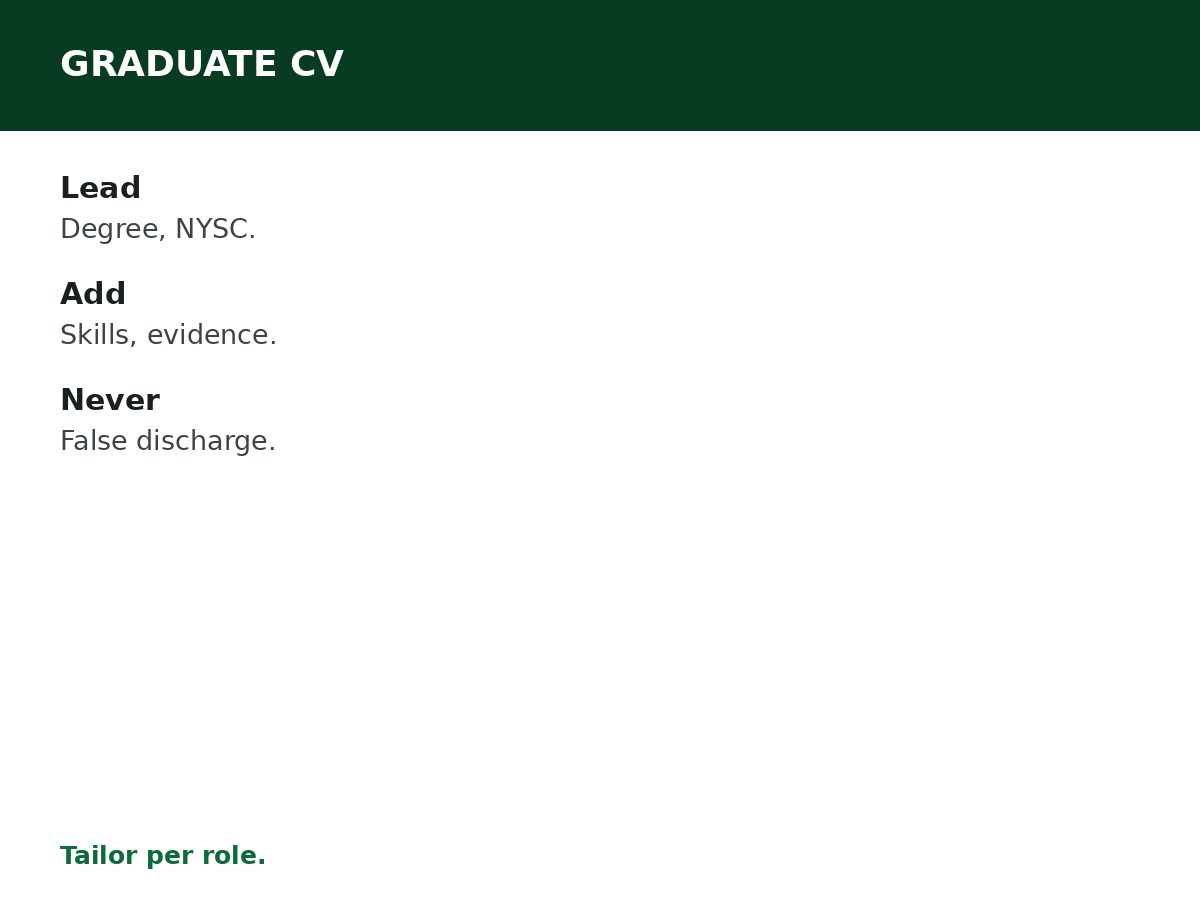
Graduate CV structure
- Contact details — name, phone, email, city, and portfolio or LinkedIn link.
- Professional profile — 2–3 lines, on degree, skills, and target roles, as the profile guide covers.
- Education — degree, institution, year, and relevant coursework or projects.
- NYSC — status, year, and PPA, where relevant, as the NYSC-listing guide covers.
- Experience — internships, SIWES, volunteer work, and projects, with responsibilities and results.
- Skills — skills with evidence, grouped by type.
- Certifications — relevant certifications, where earned, with providers and years.
Common graduate CV mistakes
- Claiming discharge before discharge — serving corps members claiming discharge, or exemption, before it is issued, fail background checks. State current status honestly.
- Inflated titles and experience — inflated internship titles, and invented responsibilities, are fraud, and reference checks expose them.
- Generic CVs for every role — one generic CV, sent to every role, loses to tailored CVs, matching each role’s requirements.
- Errors and poor formatting — spelling, grammar, and formatting errors cost interviews, whatever the content.
Tailoring and ATS
- Match the job description — skills and experience, matching the role’s requirements, highlighted first, as the ATS guide covers.
- ATS-friendly formatting — standard headings, simple formatting, and keywords from the job description, as the ATS guide covers.
- Proofread before sending — spelling, grammar, and formatting, checked before every submission.
Related Guides & Next Steps
- How to Write a CV With No Work Experience
- How to Write an ATS-Friendly CV
- CV Format for Nigerian Job Seekers
Frequently asked questions
What should a graduate CV in Nigeria include? Degree and institution, NYSC status (discharge, exemption, or exclusion), skills with evidence, internships/SIWES/projects, and contact details, in the format Nigerian employers expect.
How do I state NYSC on a graduate CV? By stating status clearly (discharge, exemption, or exclusion), with year and PPA where relevant. Serving corps members state current status honestly, never claiming discharge before discharge.
Should I include my NYSC certificate number on my CV? Certificate numbers are optional on CVs, as employers state — include them where the application requests them, not by default, for privacy.
How long should a graduate CV be? One page, for most fresh graduates, as employers state — two pages only where internships, projects, and experience justify the length.
Should I tailor my graduate CV for each role? Yes — skills and experience, matching each role’s requirements, highlighted first, with ATS-friendly formatting, as the ATS guide covers.
Sources and last update
- No salary figure, vacancy count, or hiring outcome is asserted anywhere in this article, deliberately — employer career pages and reputable boards, checked at application time, govern.
- No company is named as currently hiring anywhere in this article, deliberately — hiring windows open and close; employer career pages govern.
- Scam patterns: fees for jobs, payment to personal accounts, guaranteed jobs or shortlisting, and CV services selling fake experience are red flags — verify every employer on official channels before applying or paying anything.
- No job, shortlisting, or hiring outcome is promised anywhere in this article.
Last updated: 24 October 2026. Guide — review every 6–12 months, and on every major hiring-platform change.

Written by Olaitan Ilori
Olaitan Ilori is the founder and lead researcher at CareerMedal. He provides verified, practical guides on Nigerian tertiary admissions (JAMB, CAPS, Post-UTME), NELFUND student finance, NYSC service-year survival, and early-career job placement.
View all guides by Olaitan Ilori →