
Healthcare-related courses in Nigeria span licensed clinical professions, allied health sciences, and health-adjacent sciences — medicine, nursing, pharmacy, laboratory science, therapy, and public health. The courses below are grouped by route, with the degree, duration, and professional body for each. Healthcare courses share one trait: licensing gates practice, so the professional body and route matter as much as the degree — and most healthcare courses require Biology, Chemistry, and Physics, so subject requirements close these courses to candidates without those subjects.
Licensed clinical professions
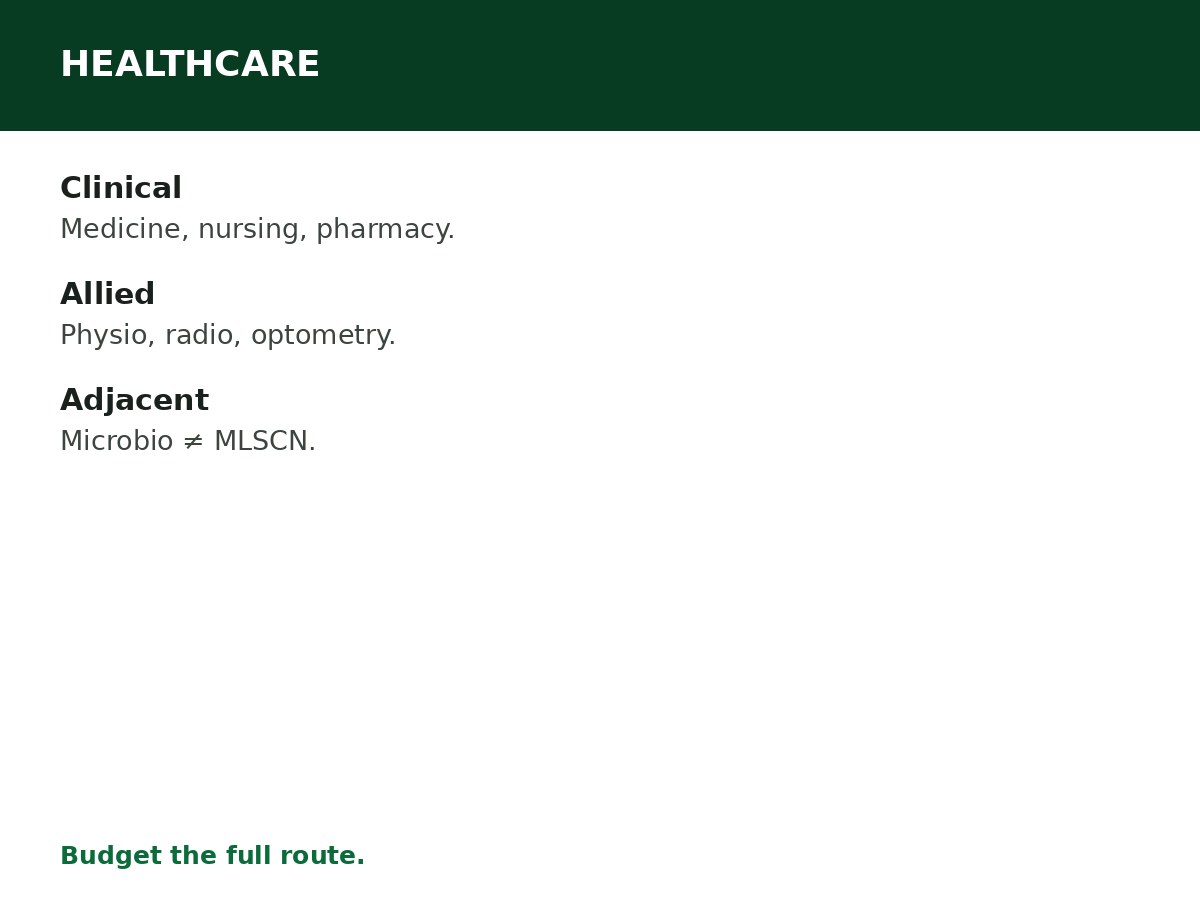
- Medicine and Surgery (MBBS) — 6 years + housemanship + residency. MDCN registration. The most competitive and most structured healthcare route.
- Nursing Science (B.NSc) — 5 years + internship. NMCN licensing. Hospital and community-health demand, plus international mobility (destination licensing additional).
- Pharmacy (B.Pharm/PharmD) — 5–6 years + internship. PCN registration. Hospital, community, industry, and regulatory paths. Check which qualification the programme awards.
- Dentistry (BDS) — 6 years + housemanship. MDCN registration (dental). Clinical dental practice.
- Medical Laboratory Science — 5 years + internship. MLSCN registration. Professional clinical-laboratory route, distinct from microbiology.
Allied health professions
- Physiotherapy — BPT 5 years + internship. Professional registration as the body requires. Rehabilitation and movement practice.
- Radiography — BSc 4–5 years + internship. Professional registration as the body requires. Imaging and diagnostics practice.
- Optometry — OD 6 years + internship. Professional registration as the body requires. Vision care practice.
- Nutrition and Dietetics — BSc 4 years + internship. Professional registration as the body requires. Clinical and community nutrition practice.
- Public Health — BSc 4 years. Population health, epidemiology, and health-systems work — an unlicensed health-adjacent route, with public-sector and NGO demand.
Health-adjacent sciences (not clinical licences)
- Microbiology, Biochemistry — BSc 4 years + SIWES. Laboratory, industry, and research roles. Neither automatically qualifies you as a medical laboratory scientist (MLSCN route) or as a pharmacist (PCN route) — stated explicitly, because the confusion is common.
- Anatomy, Physiology — BSc 4 years. Foundations for medicine, research, and teaching — not clinical practice routes on their own.
- Health Information Management — BSc 4 years. Health records, data, and systems — a growing health-technology route.
How to choose among healthcare courses
- Licensed vs unlicensed: licensed courses (medicine, nursing, pharmacy, laboratory science, therapy) restrict supply and protect demand, but require professional examinations, internships, and long training. Unlicensed health-adjacent courses (public health, microbiology, biochemistry) offer faster entry but fiercer competition and no practice monopoly.
- Training length and cost: medicine (6 years + housemanship + residency) and dentistry are the longest commitments; nursing and pharmacy are 5–6 years; allied health is 4–6 years. Budget the full route, not just the degree.
- Subject requirements: most healthcare courses require Biology, Chemistry, and Physics at UTME and O’Level. If you lack any of these, retaking is the route — no workaround exists for licensed healthcare courses.
- Accreditation per programme, per session: verify NUC accreditation and the relevant professional body’s recognition for the specific programme, for the session — both matter, and neither follows from the university’s general standing.
Related Guides & Next Steps
- Admission Requirements for Nigerian Universities
- How to Choose a Course After JAMB
- How University Admission Works in Nigeria
- Best Universities to Study Medicine in Nigeria
- Courses Related to Business in Nigeria
Frequently asked questions
Which healthcare course is best? No single course holds that title. Medicine offers the most secure licensed route; nursing offers the broadest mobility route; pharmacy offers the most diverse industry route. “Best” depends on your interests, your appetite for long training, and your licensing goals.
Can I practise healthcare with a microbiology or biochemistry degree? Not as a medical laboratory scientist or pharmacist — those are separate licensed routes (MLSCN, PCN). Microbiology and biochemistry lead to laboratory, industry, and research roles, not to clinical licensure.
Do I need Biology, Chemistry, and Physics for healthcare courses? Yes, at most institutions — the three sciences are core UTME and O’Level requirements for licensed healthcare courses. Retaking a missing science is the route if healthcare is your goal.
Which healthcare course has the shortest training? Public health, health information management, and health-adjacent sciences (4 years) are shorter than licensed clinical courses (5–6 years plus internship/housemanship). Shorter training does not mean easier entry or weaker prospects — it means a different route.
Should I choose a healthcare course only for job security? No — choose by the intersection of security, your interests, and your strengths. Healthcare training is long and demanding: a course you cannot sustain for 5–6 years, however secure, is a dropout risk.
Sources and last update
- Course groupings, durations, and professional routes from the respective course guides (Batches 13–17), summarised here — the course guides govern where they differ in detail.
- Professional routes (MDCN, NMCN, PCN, MLSCN, and allied-health bodies) from professional-body guidance as reported, with per-session verification directed.
Last updated: 24 October 2026. Guide — review every 3–6 months and on every JAMB brochure update.

Written by Olaitan Ilori
Olaitan Ilori is the founder and lead researcher at CareerMedal. He provides verified, practical guides on Nigerian tertiary admissions (JAMB, CAPS, Post-UTME), NELFUND student finance, NYSC service-year survival, and early-career job placement.
View all guides by Olaitan Ilori →