

There is no official ranking of medical schools in Nigeria — but the strongest choices are consistently the universities with established teaching hospitals, full NUC and MDCN accreditation for the MBBS programme, and competitive departmental cut-offs. The institutions below are those most consistently mentioned for medicine, grouped by strength of their teaching-hospital and programme history, not ranked in order. Verify accreditation for the session you apply in, because accreditation status changes.
Medicine is the most competitive course in Nigeria, and the choice of university matters more here than in most courses: your clinical training happens in the teaching hospital, and its patient volume, specialties, and equipment shape the doctor you become.
How to judge a medical school
- Teaching hospital: a university teaching hospital with high patient volume and a full range of specialties (surgery, internal medicine, paediatrics, obstetrics and gynaecology, community medicine, and more). Ask: which hospital, how many beds, which specialties run residency programmes there?
- Accreditation: NUC accreditation for the programme, plus Medical and Dental Council of Nigeria (MDCN) recognition for MBBS training. A programme without current MDCN recognition cannot produce registrable doctors — check both, for the session.
- Departmental cut-off: medicine’s departmental cut-offs run at the top of every institution’s range (200+ at the most competitive, as reported). A cut-off is not a quality score, but sustained high competition signals sustained demand.
- Programme structure: MBBS in Nigeria runs 6 years (pre-clinical, para-clinical, and clinical phases), plus housemanship after graduation. Confirm the programme’s structure and its teaching-hospital rotation arrangements for the session.
- Location and cost: teaching-hospital cities differ in living costs, and federal, state, and private medical schools differ sharply in fees. Budget the full 6 years, not the first session.
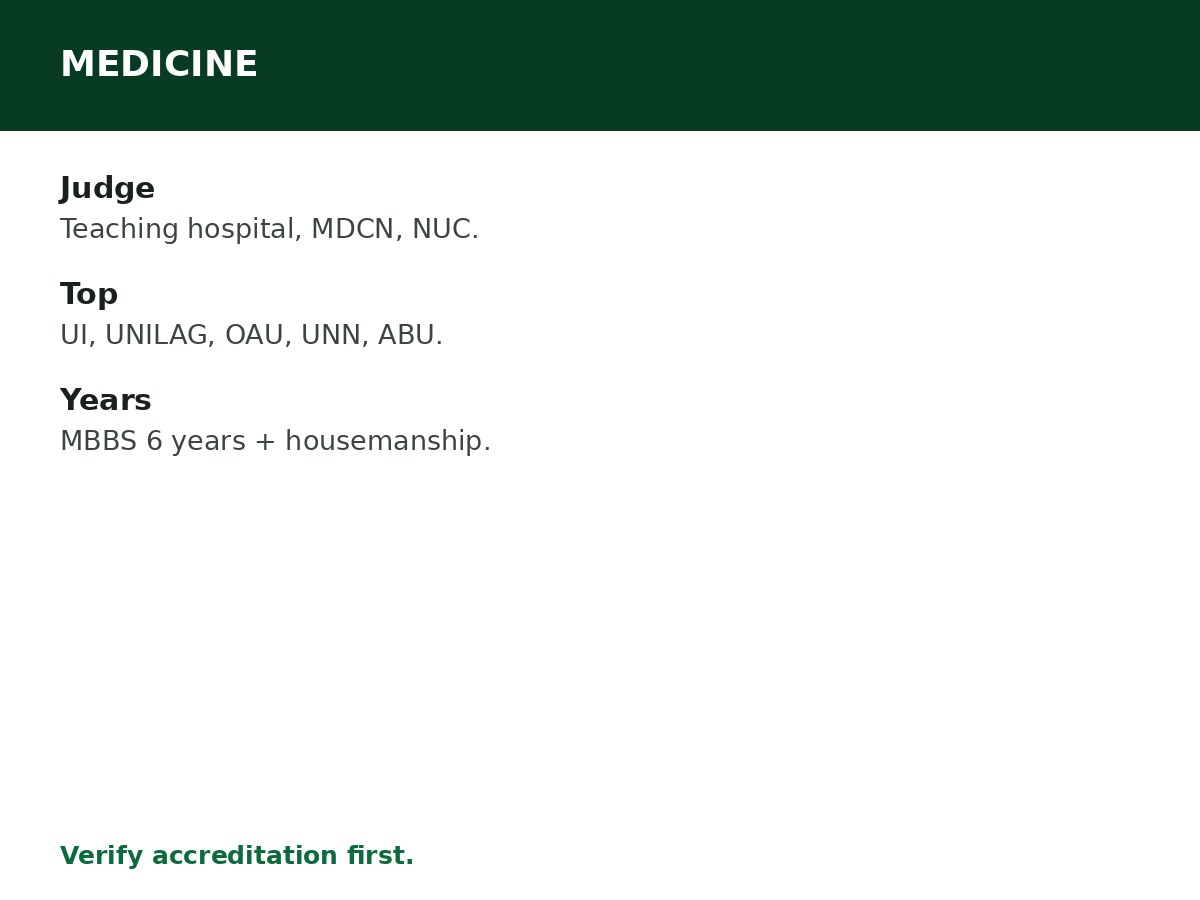
Institutions most consistently mentioned for medicine
University of Ibadan (UI) — Nigeria’s oldest medical school, with University College Hospital (UCH), Ibadan, one of the country’s largest teaching hospitals. Longest programme history, broad specialties, and consistently the most competitive medicine cut-offs.
University of Lagos (UNILAG) — College of Medicine with Lagos University Teaching Hospital (LUTH), Idi-Araba. Large patient volume, broad specialties, Lagos location (with Lagos living costs).
Obafemi Awolowo University (OAU), Ile-Ife — College of Health Sciences with Obafemi Awolowo University Teaching Hospitals Complex (OAUTHC). Strong clinical tradition, competitive cut-offs.
University of Nigeria, Nsukka (UNN) — College of Medicine with University of Nigeria Teaching Hospital (UNTH), Enugu. Major south-east teaching hospital, broad specialties.
Ahmadu Bello University (ABU), Zaria — College of Medicine with Ahmadu Bello University Teaching Hospital (ABUTH), Zaria. Major northern teaching hospital, broad specialties.
University of Benin (UNIBEN) — College of Medical Sciences with University of Benin Teaching Hospital (UBTH). Major south-south teaching hospital, competitive cut-offs.
University of Ilorin (UNILORIN) — College of Health Sciences with University of Ilorin Teaching Hospital (UITH). Consistently competitive, with a reputation for stable academic calendars.
University of Maiduguri (UNIMAID) — College of Medical Sciences with University of Maiduguri Teaching Hospital (UMTH). Major north-east teaching hospital.
Usmanu Danfodiyo University, Sokoto (UDUS) — College of Health Sciences with Usmanu Danfodiyo University Teaching Hospital (UDUTH). Major north-west teaching hospital.
Bayero University, Kano (BUK) — College of Health Sciences with Aminu Kano Teaching Hospital (AKTH). Major northern teaching hospital, competitive cut-offs.
Private options with established medical programmes (for example, Babcock University, Bowen University, and Igbinedion University, as reported) offer smaller classes and (typically) more stable calendars at substantially higher fees — verify MDCN recognition and teaching-hospital arrangements for the session, as with any institution.
Related Guides & Next Steps
- Admission Requirements for Nigerian Universities
- How to Choose a University in Nigeria
- How University Admission Works in Nigeria
- Best Universities to Study Nursing in Nigeria
- Best Universities to Study Law in Nigeria
Frequently asked questions
Which university is best for medicine in Nigeria? There is no official ranking. UI, UNILAG, OAU, UNN, ABU, and UNIBEN are the most consistently mentioned, on teaching-hospital strength and programme history — but “best” for you depends on your score, your budget, and the teaching hospital you will train in. Verify accreditation for the session.
How many years is medicine in Nigeria? MBBS runs 6 years, plus housemanship after graduation (and NYSC, where applicable). Confirm the programme structure for the session you apply in.
What UTME score do I need for medicine? Departmental cut-offs for medicine run at the top of every institution’s range (200+ at the most competitive, as reported). Meeting the institution minimum is not enough — your score must meet the medicine departmental cut-off for that session.
Does the teaching hospital matter more than the university name? For clinical training, yes — your rotations, patient exposure, and specialty breadth happen in the teaching hospital. Judge the hospital (volume, specialties, residency programmes) alongside the university.
Can I study medicine at a private university? Yes, where the programme holds current NUC accreditation and MDCN recognition, with teaching-hospital arrangements in place. Verify both for the session, and budget the full 6 years at private fees.
Sources and last update
- Institution shortlist (UI/UCH, UNILAG/LUTH, OAU/OAUTHC, UNN/UNTH, ABU/ABUTH, UNIBEN/UBTH, UNILORIN/UITH, UNIMAID/UMTH, UDUS/UDUTH, BUK/AKTH) from teaching-hospital and programme-history reporting, grouped by strength, not ranked — no official ranking is asserted.
- Accreditation (NUC + MDCN), 6-year MBBS structure, and cut-off competitiveness from JAMB and professional-body guidance as reported, with per-session verification directed.
Last updated: 24 October 2026. Guide — review every 3–6 months and on every NUC/MDCN accreditation update.

Written by Olaitan Ilori
Olaitan Ilori is the founder and lead researcher at CareerMedal. He provides verified, practical guides on Nigerian tertiary admissions (JAMB, CAPS, Post-UTME), NELFUND student finance, NYSC service-year survival, and early-career job placement.
View all guides by Olaitan Ilori →