

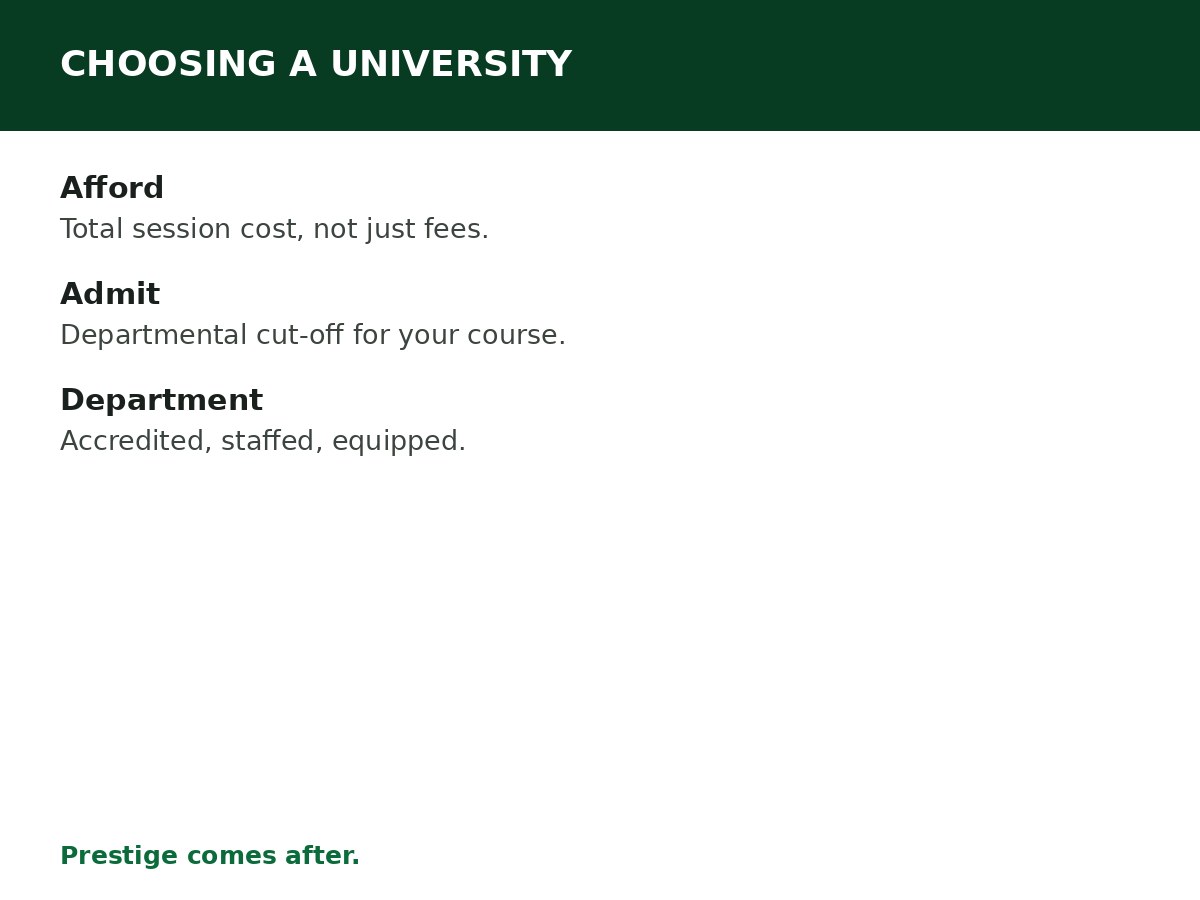
Choose a university in Nigeria by working backwards from three constraints: what you can afford (total session cost, not just fees), where you can actually gain admission (departmental cut-off for your course, not the institutional minimum), and whether the specific department is accredited, staffed, and equipped for your course. Everything else — prestige, location preference, friends’ choices — comes after those three constraints, not before them.
Most bad university choices are not bad institutions. They are good institutions chosen for the wrong course, at the wrong cost, or with the wrong admission odds.
Step 1: Fix your course first (or narrow it to a field)
Your course determines your departmental cut-off, your subject combination, your O’Level requirements, and your career path. Choosing an institution before a course means choosing blind on the numbers that decide admission. If you are undecided between courses, narrow to a field (for example, health sciences, engineering, social sciences) and shortlist institutions that are strong in that field — then decide the exact course with the course-choice guide.
Step 2: Apply the affordability test
- Total session cost = fees + accommodation + transport + food + books and materials + data. Compare this total across institutions, not fees alone — a low-fee institution far from home can cost more overall than a higher-fee institution nearby.
- Funding reality: if you need NELFUND, your shortlist is public institutions only. If you are considering private institutions, confirm the full fee schedule and payment-plan terms before shortlisting — a private place you cannot fund for four years is not a real option.
- Fee trajectory: fees rise between sessions. Ask current students (not just the prospectus) what fees were last session and what is expected next session, so your four-year plan is realistic.
Step 3: Apply the admission test
- Departmental cut-off for your course, at each institution, for the current session — not the institutional minimum. If you do not meet it, the institution is not a realistic choice for that course, however much you like it.
- Screening format: exam-format institutions reward strong exam preparation; screening-only institutions reward strong O’Level grades. Choose the format that suits your profile.
- First-choice and catchment: most institutions screen first-choice candidates first, and some consider catchment area. Factor both into your shortlist order.
- Safety tier: include at least one institution where your profile comfortably exceeds the departmental cut-off, and a polytechnic or college of education as a second safety tier.
Step 4: Check the specific department
- Accreditation: confirm the course is accredited by the NUC for that institution. An unaccredited course is a degree that may not be recognised — check before applying, not after admission.
- Staffing and facilities: visit if you can, or research thoroughly — departmental staff strength, laboratories, libraries, and clinical or practical facilities for your course, where relevant.
- Programme duration reality: ask current students about strikes, calendar stability, and actual programme length. A four-year course that routinely takes six years has a cost that no fee table shows.
- Graduate outcomes: where available, check what graduates of that department actually do — employment, postgraduate admission, professional licensing — rather than relying on the institution’s general reputation.
Step 5: Decide, in order
- Shortlist by course and departmental cut-off (admission test).
- Filter by total session cost and funding (affordability test).
- Rank the survivors by department quality, location, and personal fit.
- Set your JAMB choices in that order, respecting first-choice rules and change-of-institution windows.
- Apply for screening early, with complete documents, and track both the institution’s portal and JAMB CAPS.
Related Guides & Next Steps
- Ambrose Alli University (AAU) Courses, Requirements and School Fees
- Ahmadu Bello University, Zaria (ABU) Courses, Requirements and School Fees
- Ahmadu Bello University, Zaria (ABU) Cut-Off Mark and Admission Guide
- Delta State University (DELSU) Courses, Requirements and School Fees
- Federal University of Technology, Akure (FUTA) Admission Guide
- Federal University of Technology, Owerri (FUTO) Admission Guide
- Federal University of Technology, Akure (FUTA) Courses, Requirements and School Fees
- Federal University of Technology, Owerri (FUTO) Courses, Requirements and School Fees
- Lagos State University (LASU) Courses, Requirements and School Fees
- Obafemi Awolowo University (OAU) Courses, Requirements and School Fees
- Obafemi Awolowo University (OAU) Cut-Off Mark and Admission Guide
- University of Benin (UNIBEN) Courses, Requirements and School Fees
- University of Benin (UNIBEN) Cut-Off Mark and Admission Guide
- University of Ibadan (UI) Courses, Requirements and School Fees
- University of Ibadan (UI) Cut-Off Mark and Admission Guide
- University of Ilorin (UNILORIN) Cut-Off Mark and Admission Guide
- University of Lagos (UNILAG) Cut-Off Mark and Admission Guide
- Federal vs State vs Private Universities in Nigeria
- How to Choose a Course After JAMB
- Universities With High Admission Chances
- How University Admission Works in Nigeria
- 2026/2027 University Admission Guide for Nigerian Students
Frequently asked questions
Should I choose the most prestigious university I can enter? Only if it passes the affordability and department tests for your course. Prestige without affordability is a dropout risk; prestige without a departmental cut-off you meet is not an admission.
Is a newer university a worse choice? Not necessarily. Newer universities often offer higher admission chances and smaller classes, with newer facilities — but check accreditation, staffing, and programme stability for your specific department, as you would for any institution.
How many universities should I shortlist? JAMB’s choice structure limits your formal choices, but your research shortlist should be wider — so that a change of institution, a missed cut-off, or a closed screening window does not leave you with no plan.
Should I follow friends or family to the same university? Only if that university passes your own three tests (affordability, admission, department). A university chosen for company, not fit, is a four-year commitment made for the wrong reason.
What if I cannot afford any university on my shortlist? Revisit funding (NELFUND for public institutions, scholarships, bursaries, payment plans) and revisit the shortlist (lower-fee institutions, closer institutions with lower living costs, polytechnics and colleges of education as a route via Direct Entry). Do not borrow at high interest to fund a choice you cannot sustain.
Sources and last update
- Choice method (course-first, affordability test, admission test, department check, ordered decision) is CareerMedal’s own method, applied to the Nigerian admission system.
- Admission facts (departmental vs institutional cut-offs, first-choice and catchment, screening formats, NUC accreditation, NELFUND public-only) cross-checked across JAMB’s process, the cluster’s guides, and NELFUND’s programme rules.
- No institution ranking, fee amount, or graduate-outcome figure is asserted — those are institution- and course-specific and must be checked locally.
Last updated: 24 October 2026. Guide — review every admission session and on every JAMB/NUC policy update.

Written by Olaitan Ilori
Olaitan Ilori is the founder and lead researcher at CareerMedal. He provides verified, practical guides on Nigerian tertiary admissions (JAMB, CAPS, Post-UTME), NELFUND student finance, NYSC service-year survival, and early-career job placement.
View all guides by Olaitan Ilori →