

Federal, state, and private universities in Nigeria differ mainly in who owns and funds them — and that ownership difference drives fees, admission competition, and funding options, more than it drives degree validity. A degree from any NUC-recognised university, federal, state, or private, is a valid Nigerian degree. The choice between them should turn on fees you can afford, admission chances for your course, and the institution’s actual facilities and staffing — not on a ranking of ownership types.
Ownership, funding, and fees
| Federal | State | Private | |
|---|---|---|---|
| Owner | Federal Government | State Government | Private individual, organisation, or religious body |
| Funding | Federal budget, plus internally generated revenue | State budget, plus internally generated revenue | Tuition and private funding |
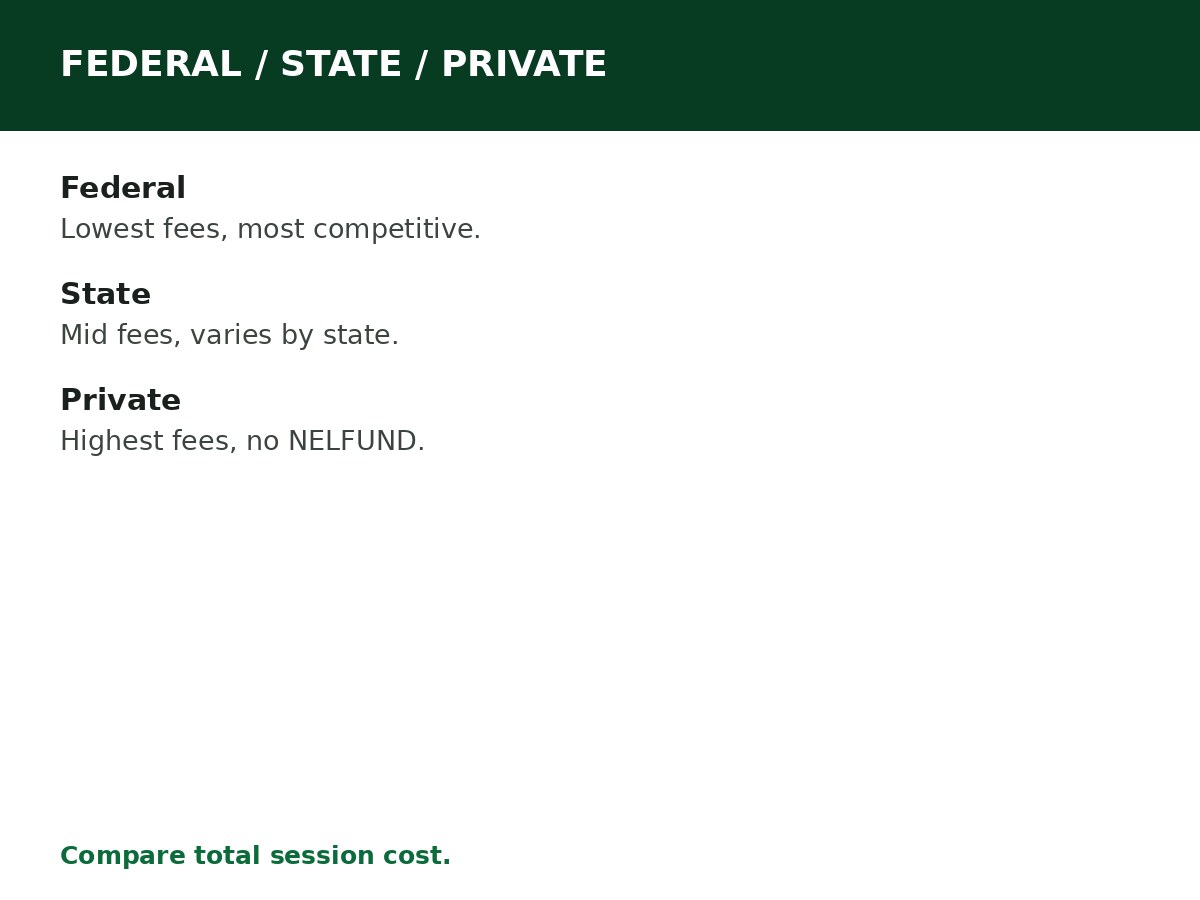
| Typical fees | Lowest, heavily subsidised | Mid-range, subsidised but less than federal (varies widely by state) | Highest, full-cost tuition |
| Fee stability | Most stable, least likely to rise sharply | Varies by state finances | Set by the institution, can rise with costs |
Fee figures are deliberately not quoted here as a table of amounts, because fees vary by institution, course, and session, and a quoted figure would be out of date within a session. Check the institution’s current fee schedule for your course.
Admission competition
- Federal universities are the most competitive overall, because their low fees attract the largest applicant pools — but the newer federal universities (150–160 minimums, lower application volumes) are among the least competitive federal options.
- State universities vary: flagship state universities (LASU, and similar) can be as competitive as federal institutions, while newer or smaller state universities offer higher chances, particularly for candidates from the state (catchment considerations apply at some institutions).
- Private universities vary most: some are highly competitive (Covenant, reported at 200 for 2026), while others are flexible on minimums and screening. Private admission is generally less oversubscribed than federal admission, but “private” alone does not guarantee a place — and private fees are the binding constraint for most families.
Funding options by type
- Federal and state (public): NELFUND eligible, subject to verification and the institution being onboarded on the portal. Scholarships and bursaries also apply.
- Private: NELFUND not eligible under the current structure. Funding comes from scholarships, bursaries, family support, institutional payment plans, and work. This single difference often decides the choice for families who need loan funding — a private place you cannot fund is not a real option, however attractive the institution.
Other differences that matter
- Strike exposure: public universities (federal and state) are affected by ASUU and state-level staff union actions, which can extend programme duration. Private universities are generally not affected by ASUU strikes, which is a genuine advantage for programme timing — though private institutions have their own disruptions.
- Facilities and staffing: vary by institution, not by ownership type. A well-funded state or private institution can outstrip a poorly funded federal one, and vice versa. Visit (or research thoroughly) the specific institution and department, rather than judging by type.
- Programme range: federal universities offer the widest programme range; state universities are broad but vary; private universities are narrower, often focused on popular and professional programmes, and may not offer your course at all.
- Location and cost of living: a federal university far from home adds transport and accommodation costs that can erase its fee advantage. Total session cost — fees plus living costs — is the honest comparison, not fees alone.
How to choose between types
- Start from funding. If you need NELFUND, your choice is public (federal or state). If you do not, private enters the comparison.
- Compare total session cost (fees + accommodation + transport + living costs) for your specific course, not headline fees.
- Compare admission chances for your course (departmental cut-off, competition, screening format) at each institution you are considering.
- Check the specific department, not just the institution: staffing, facilities, accreditation status, and graduate outcomes for your course matter more than the ownership label.
Related Guides & Next Steps
- Can Private University Students Apply for NELFUND?
- How to Choose a University in Nigeria
- NELFUND Student Loan 2026/2027: Complete Guide
- How University Admission Works in Nigeria
- 2026/2027 University Admission Guide for Nigerian Students
Frequently asked questions
Is a federal university degree better than a state or private degree? No, as a matter of validity — all NUC-recognised degrees are valid Nigerian degrees. Employers and postgraduate programmes judge the institution and the graduate, not the ownership type alone.
Are private universities easier to gain admission into? Not necessarily. Some are flexible, some (like Covenant, reported at 200) are highly competitive. Check each institution’s minimum and departmental cut-off for your course.
Can I get NELFUND at a private university? No, not under the current structure. NELFUND covers public institutions only.
Are federal universities cheaper? Generally yes, on fees — but total session cost includes accommodation, transport, and living costs, which can narrow or erase the gap depending on location.
Do private universities go on strike? Private universities are generally not affected by ASUU strikes, which is an advantage for programme timing. They can still have their own disruptions, and their fee levels are the main trade-off.
Sources and last update
- Ownership/funding/fee structure, NELFUND public-only eligibility, and strike-exposure differences from the Nigerian university system’s structure and NELFUND’s programme rules, as compiled by CareerMedal.
- Competition examples (Covenant 200, newer federal 150–160) from the 2026 policy figures and low-scores guide’s reported lists.
- No fee amounts, ranking, or graduate-outcome figures are asserted — those are institution- and course-specific and must be checked locally.
Last updated: 24 October 2026. Guide — review every admission session and on every JAMB/NUC policy update.

Written by Olaitan Ilori
Olaitan Ilori is the founder and lead researcher at CareerMedal. He provides verified, practical guides on Nigerian tertiary admissions (JAMB, CAPS, Post-UTME), NELFUND student finance, NYSC service-year survival, and early-career job placement.
View all guides by Olaitan Ilori →