

Choosing a skill to learn is a decision about fit — your interests, aptitude, time, and markets — not about trends. This guide gives a method for choosing, so learners pick skills they will practise long enough to reach working competence, distinct from the skill lists (which cover options) and the timeline guides (which cover durations).
The choice method
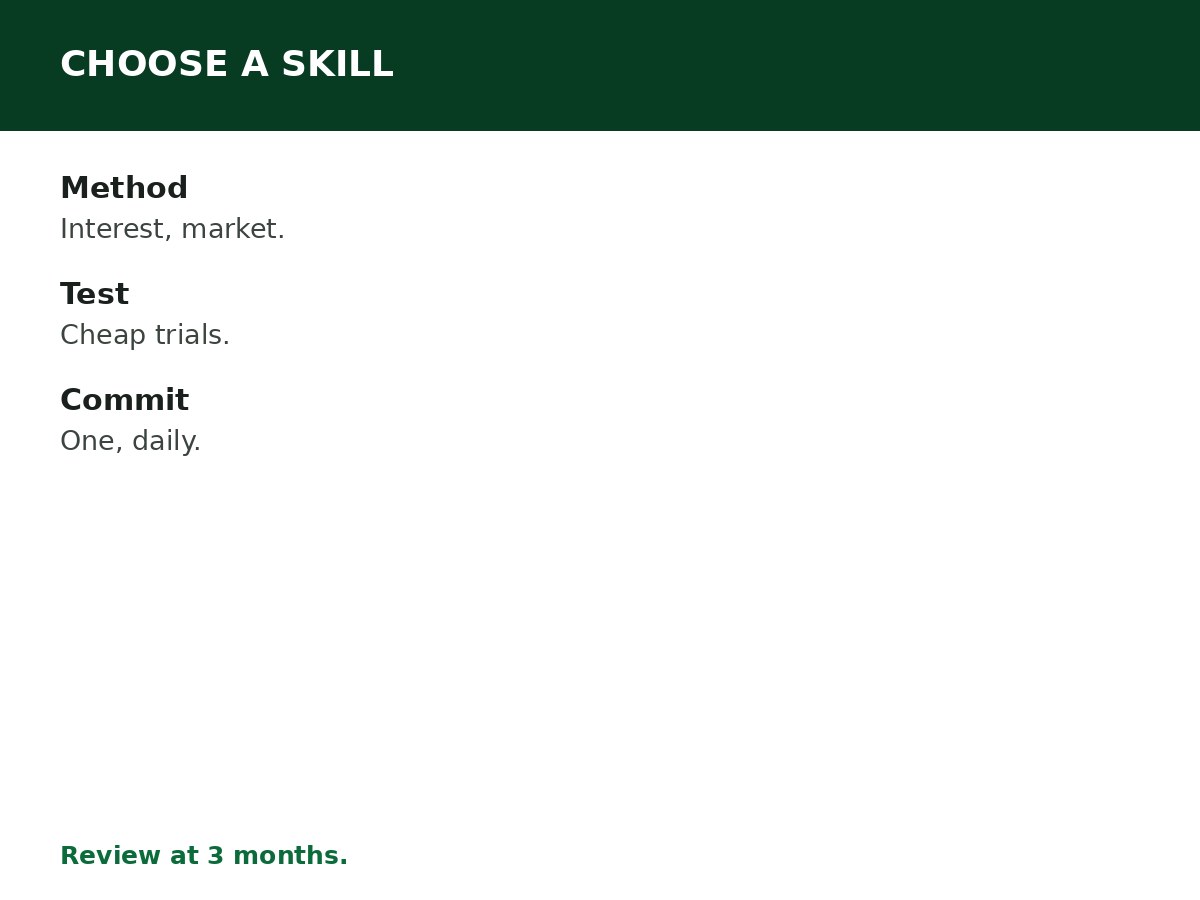
- List your interests — skills you enjoy, or are curious about, not skills others recommend. Enjoyment sustains daily practice, which is what learning actually requires.
- Test aptitude cheaply — short free courses, tutorials, and trial projects, for each candidate skill, before committing months. Aptitude shows in trial work, not in theory.
- Check markets — local and remote demand, for each candidate skill, through job boards, freelance platforms, and local businesses, as the market states. Skills without markets waste effort.
- Check time and cost — duration, schedule, and costs, against your availability and budget, before committing. Skills you cannot practise daily will not stick.
- Commit to one skill — one skill, practised daily, beats three skills, practised occasionally. Depth first, breadth later.
Common choice mistakes
- Choosing by trend alone — trending skills, abandoned after weeks, because interest was never there. Trends change; daily practice does not.
- Choosing by income claims alone — income claims, without competence, markets, or proof, mislead. Earnings follow competence, not enrolment.
- Choosing too many skills — three skills, practised occasionally, deliver none to working competence. One skill, practised daily, delivers one to working competence.
- Choosing without market checks — skills without local or remote markets waste months. Check markets before committing.
After choosing
- Set a daily practice habit — fixed time, daily, for practice, projects, and feedback, from day one.
- Build proof from month one — portfolio, projects, and supervised work, demonstrating the skill, for employment and freelance work.
- Review at 3 months — progress, enjoyment, and market fit, at 3 months, before committing further. Pivoting at 3 months costs little; persisting in a poor fit costs months.
- Specialise gradually — deeper skills and niches, as experience grows, not all at once.
Related Guides & Next Steps
- Federal Government TVET Programme 2026
- How to Start Freelancing in Nigeria
- How to Start as a Beginner Graphic Designer
- Best Vocational Skills for Self-Employment
Frequently asked questions
How do I choose a skill to learn? By listing interests, testing aptitude cheaply, checking markets, checking time and cost, and committing to one skill, practised daily — depth first, breadth later.
Should I choose a skill by trend? No — trending skills, abandoned after weeks, because interest was never there. Trends change; daily practice does not.
Should I learn multiple skills at once? No — one skill, practised daily, beats three skills, practised occasionally. Depth first, breadth later.
How do I check if a skill has a market? Through job boards, freelance platforms, and local businesses, as the market states, before committing months.
When should I review my skill choice? At 3 months — progress, enjoyment, and market fit — before committing further. Pivoting at 3 months costs little; persisting in a poor fit costs months.
Sources and last update
- No programme is named as currently open anywhere in this article, deliberately — training windows open and close, and a frozen list misleads readers within months. Official programme channels, checked at application time, govern.
- No fee, stipend, or income figure is asserted anywhere in this article, deliberately. Official programme pages, checked at application time, govern.
- Scam patterns: training fees demanded for ‘free’ programmes, payment to personal accounts, and guaranteed jobs or income are red flags — verify every programme on official channels before applying or paying anything.
- No job, income, or training outcome is promised anywhere in this article.
Last updated: 24 October 2026. Guide — review every 3–6 months, and on every official programme announcement.

Written by Olaitan Ilori
Olaitan Ilori is the founder and lead researcher at CareerMedal. He provides verified, practical guides on Nigerian tertiary admissions (JAMB, CAPS, Post-UTME), NELFUND student finance, NYSC service-year survival, and early-career job placement.
View all guides by Olaitan Ilori →