

OAU’s departmental cut-offs run at the top of the federal range — 200 was the reported band for its most competitive courses in recent sessions. The institution minimum for universities is 150 (JAMB policy floor) — but that floor is not OAU’s departmental cut-off for any specific course.
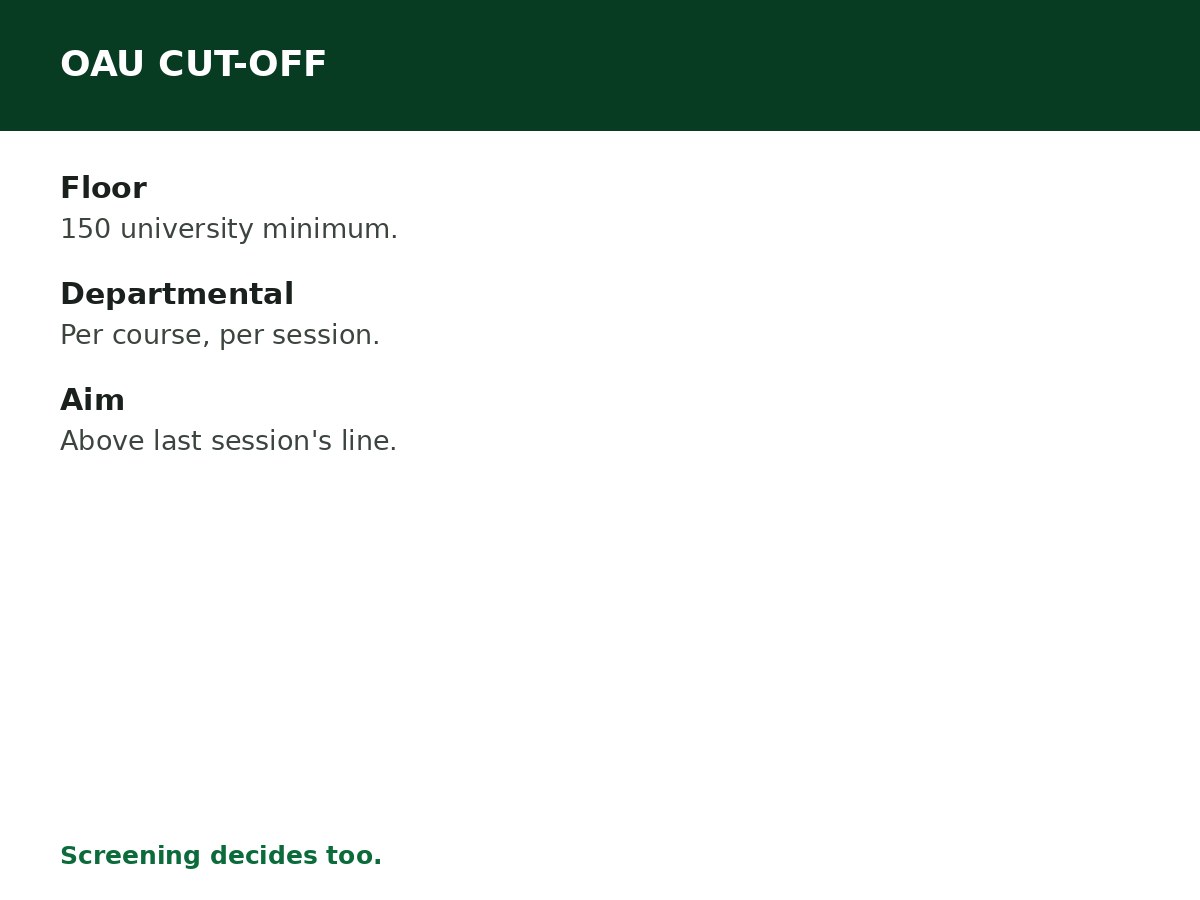
That single paragraph is the honest core of this guide: OAU’s cut-off is not one number. It is an institution minimum (the floor for screening consideration), plus a departmental cut-off per course (the rationing line for that course, that session), plus screening performance on top. Anyone quoting you a single “OAU cut-off mark” without naming the course and the session is quoting something that does not exist.
How OAU cut-offs work
- JAMB policy floor: 150 for universities (2026 policy minimum, as established in the cut-off guides). Below 150, you are not eligible for university screening at all — but 150 does not admit you anywhere by itself.
- Institution screening: OAU screens candidates after UTME (exam, aggregate, or verification, as the session’s notice states). Meeting the floor only qualifies you to be screened.
- Departmental cut-off: each department sets its cut-off from applicants vs places for that session. Competitive courses set theirs high; less competitive courses set theirs lower. The departmental cut-off for your course, for this session, is the number that actually decides admission — and it is published (or inferable from the previous session) only per course, per session.
- Screening performance: where screening carries weight, a strong UTME score with weak screening loses to a moderate UTME score with strong screening. Prepare for the screening format the notice actually describes.
Which courses run highest at OAU
Medicine, law, nursing, pharmacy, engineering, and computer science run highest at OAU. Agriculture, education, and selected Arts and Social Science courses run lower — but ‘lower’ still means above the institution minimum, and still session-dependent.
What score should you aim for
- Aim above the previous session’s departmental cut-off for your course, at OAU — not above the institution minimum, and not above a generic “OAU cut-off” quoted without a course attached. The previous session’s cut-off is a guide, not a guarantee: cut-offs move every session with applicant numbers and places.
- If your score is below the previous cut-off for your first choice, keep the choice only with a backup: a less competitive course in the same field, the same course at a less competitive institution, or a change-of-course plan after screening (where the institution permits it).
- Verify O’Level upload and name consistency early. Eligibility failures (unuploaded results, name mismatches) remove candidates before ranking — and in competitive queues, removed candidates are not replaced by appeals.
Admission requirements (summary)
Five O’Level credits including English and Mathematics for most courses (course-specific subjects as the brochure states), the correct UTME combination, OAU as first choice, screening as the session’s notice states, and minimum age 16. Full detail sits in the admission-requirements guide and OAU’s courses-and-fees profile — this guide governs cut-offs, those guides govern requirements and fees.
Related Guides & Next Steps
- Admission Requirements for Nigerian Universities
- How to Choose a University in Nigeria
- How University Admission Works in Nigeria
- University Acceptance Fee Explained
- University of Lagos (UNILAG) Courses, Requirements and School Fees
Frequently asked questions
What is OAU’s cut-off mark? There is no single number: an institution minimum (150 floor for universities), plus a departmental cut-off per course, per session. OAU’s departmental cut-offs run at the top of the federal range — 200 was the reported band for its most competitive courses in recent sessions. The institution minimum for universities is 150 (JAMB policy floor) — but that floor is not OAU’s departmental cut-off for any specific course.
What score do I need for medicine/law at OAU? Well above the institution minimum, and at or above the departmental cut-off for that course, at OAU, for that session. Departmental cut-offs for competitive courses run at the top of OAU’s range — check the previous session’s cut-off as a guide, and aim above it.
Does scoring above the cut-off guarantee admission? No. Cut-off clearance qualifies you for ranking; screening performance, O’Level grades (where applicable), and available places also decide. A score above the cut-off with weak screening loses in competitive queues.
What if my score is below OAU’s cut-off for my course? Consider a less competitive course in the same field, the same course at a less competitive institution, a change of course or institution where the rules permit it, or the next session with a stronger score. A single competitive choice with no backup is not a strategy.
Where do I find OAU’s official cut-off? On OAU’s official website and screening notice for the session (typed directly), and in JAMB’s published policy for the session. Treat any other source’s “OAU cut-off” — especially a single number with no course attached — as unverified.
Sources and last update
- Cut-off bands from the cluster’s cut-off guides (Batches 11 and 14), summarised here — the cut-off guides govern where they differ in detail, and per-session verification is directed throughout.
- Admission process (floor, screening, departmental rationing, eligibility failures) from the cluster’s admission guides, summarised here — the full guides govern where they differ in detail.
- No per-course departmental cut-off figure beyond the reported band is asserted anywhere in this article, deliberately — departmental cut-offs are per course, per session.
Last updated: 24 October 2026. Guide — review every admission session and on every JAMB policy update.

Written by Olaitan Ilori
Olaitan Ilori is the founder and lead researcher at CareerMedal. He provides verified, practical guides on Nigerian tertiary admissions (JAMB, CAPS, Post-UTME), NELFUND student finance, NYSC service-year survival, and early-career job placement.
View all guides by Olaitan Ilori →