
There is no official ranking of mass communication programmes in Nigeria — but the strongest choices are consistently the universities with established mass communication departments, full NUC accreditation, adequate studios and production facilities, and competitive departmental cut-offs. The institutions below are those most consistently mentioned for mass communication, grouped by departmental strength, not ranked in order. Verify accreditation for the session you apply in.
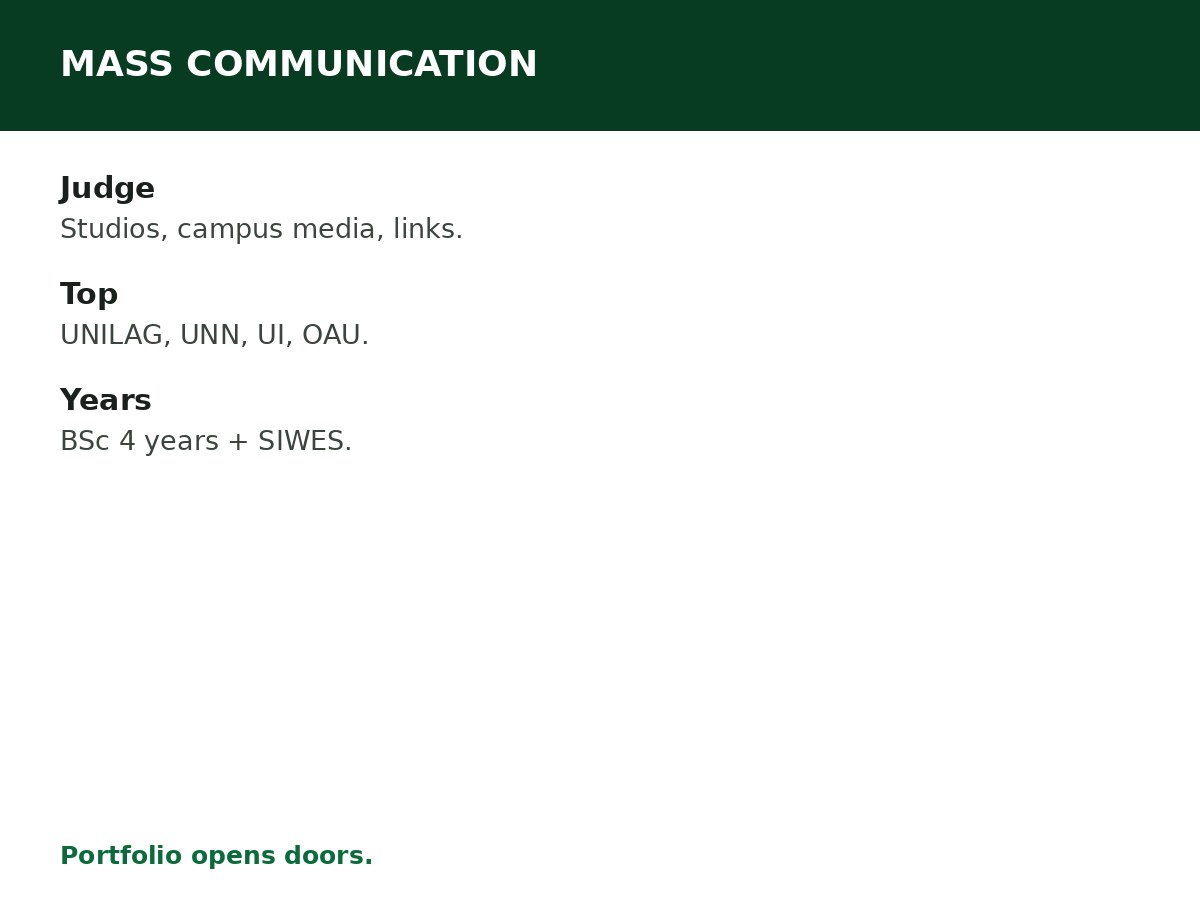
Mass communication is judged on practical output as much as on theory: studios, editing suites, campus radio and television, print production, and industry placements shape the graduate’s portfolio — and the portfolio, more than the degree classification, opens media doors.
How to judge a mass communication programme
- NUC accreditation: full accreditation for the programme, for the session. Verify, do not assume.
- Studios and facilities: radio and television studios, editing suites, print production facilities, and digital-media laboratories. A mass communication programme without working studios is theory without practice — visit or verify before choosing.
- Faculty and specialisation: faculty specialisation (journalism, broadcasting, public relations, advertising, film, digital media, and more), curriculum currency, and industry links (media-house internships, SIWES, campus media).
- Campus media: a campus radio station, television outlet, newspaper, or digital platform where students produce real output. Campus media is where portfolios are built.
- Departmental cut-off: mass communication cut-offs run high at the most competitive institutions (approaching the top of their ranges, as reported). Meeting the institution minimum is not enough.
- Programme structure: BSc Mass Communication runs 4 years, plus SIWES as the programme structures it. Confirm the structure for the session you apply in. (Note: some institutions have restructured mass communication into specialised programmes — journalism, broadcasting, public relations, and others — check the programme structure for the session.)
Institutions most consistently mentioned for mass communication
University of Lagos (UNILAG) — Department of Mass Communication, Akoka, Lagos. Consistently the most competitive mass communication cut-offs, Lagos media-industry proximity, strong campus media tradition.
University of Nigeria, Nsukka (UNN) — Department of Mass Communication, Nsukka. Established department, strong journalism tradition, competitive cut-offs.
University of Ibadan (UI) — Department of Communication and Language Arts, Ibadan. Established department, broad specialisation (communication and language arts, with mass communication strengths).
Obafemi Awolowo University (OAU), Ile-Ife — Department of Mass Communication, Ile-Ife. Established department, competitive cut-offs.
University of Ilorin (UNILORIN) — Department of Mass Communication, Ilorin. Consistently competitive, with a reputation for stable academic calendars.
Bayero University, Kano (BUK) — Department of Mass Communication, Kano. Major northern mass communication department, strong journalism tradition.
Covenant University, Ota — Department of Mass Communication, Ota. Private university with strong media infrastructure and (typically) stable calendars, at private fees.
Nnamdi Azikiwe University (UNIZIK), Awka — Department of Mass Communication, Awka. Established department, competitive cut-offs.
University of Benin (UNIBEN) — Department of Mass Communication, Benin City. Established department, competitive cut-offs.
Lagos State University (LASU), Ojo — School of Communication, Ojo, Lagos. Established communication school, Lagos media-industry proximity.
Related Guides & Next Steps
- Admission Requirements for Nigerian Universities
- How to Choose a University in Nigeria
- How University Admission Works in Nigeria
- Best Universities to Study Medicine in Nigeria
- Best Universities to Study Pharmacy in Nigeria
Frequently asked questions
Which university is best for mass communication in Nigeria? There is no official ranking. UNILAG, UNN, UI, and OAU are the most consistently mentioned, on departmental strength and media-industry proximity — but “best” for you depends on your score, your budget, and the studios and campus media you will work in. Verify accreditation and facilities for the session.
How many years is mass communication in Nigeria? BSc Mass Communication runs 4 years, plus SIWES as the programme structures it. Confirm the structure for the session you apply in — some institutions have restructured into specialised programmes.
What UTME subjects do I need for mass communication? English, Literature-in-English, and two other Arts or Social Science subjects (as the brochure states for the course and institution — check the brochure for the session, as subject requirements vary by institution).
Does a mass communication degree guarantee a media job? No — media employment is portfolio-driven. The degree structures the theory and provides the studios and placements; the portfolio (campus media output, internships, freelance work) opens the doors. Build the portfolio from first year, not final year.
Should I specialise early (journalism, PR, broadcasting) or study general mass communication? General mass communication first, specialisation through electives, campus media roles, and internships — unless an institution’s restructured programme requires an early specialisation choice, in which case choose by the career you want and the programme’s facilities for that specialisation.
Sources and last update
- Institution shortlist (UNILAG, UNN, UI, OAU, UNILORIN, BUK, Covenant, UNIZIK, UNIBEN, LASU) from departmental-history and media-industry reporting, grouped by strength, not ranked — no official ranking is asserted.
- Accreditation (NUC), 4-year BSc structure, and programme-restructuring note from programme guidance as reported, with per-session verification directed.
Last updated: 24 October 2026. Guide — review every 3–6 months and on every NUC accreditation update.

Written by Olaitan Ilori
Olaitan Ilori is the founder and lead researcher at CareerMedal. He provides verified, practical guides on Nigerian tertiary admissions (JAMB, CAPS, Post-UTME), NELFUND student finance, NYSC service-year survival, and early-career job placement.
View all guides by Olaitan Ilori →