
Science students in Nigeria — those with O’Level credits in English, Mathematics, Biology, Chemistry, and Physics — can study the widest range of university courses: medicine and health sciences, engineering and technology, pure and applied sciences, agriculture, and environmental sciences. The list below groups the main options by field, with the UTME subjects each typically requires. Check the JAMB brochure for your course and institution for the session, because subject requirements vary by institution.
“Science student” is a secondary-school stream, not a university admission category. What matters for admission is your specific O’Level credits and your UTME subjects — a science student without Physics, for example, cannot study engineering, however strong their other subjects are.
Health sciences
- Medicine and Surgery (MBBS) — English, Biology, Chemistry, Physics. 6 years + housemanship.
- Nursing Science (B.NSc) — English, Biology, Chemistry, Physics. 5 years + licensing.
- Pharmacy (B.Pharm/PharmD) — English, Biology, Chemistry, Physics. 5 or 6 years, depending on the programme.
- Medical Laboratory Science — English, Biology, Chemistry, Physics. Professional MLSCN route, distinct from microbiology.
- Physiotherapy, Radiography, Optometry, Dentistry — English, Biology, Chemistry, Physics (with institution variations — check the brochure).
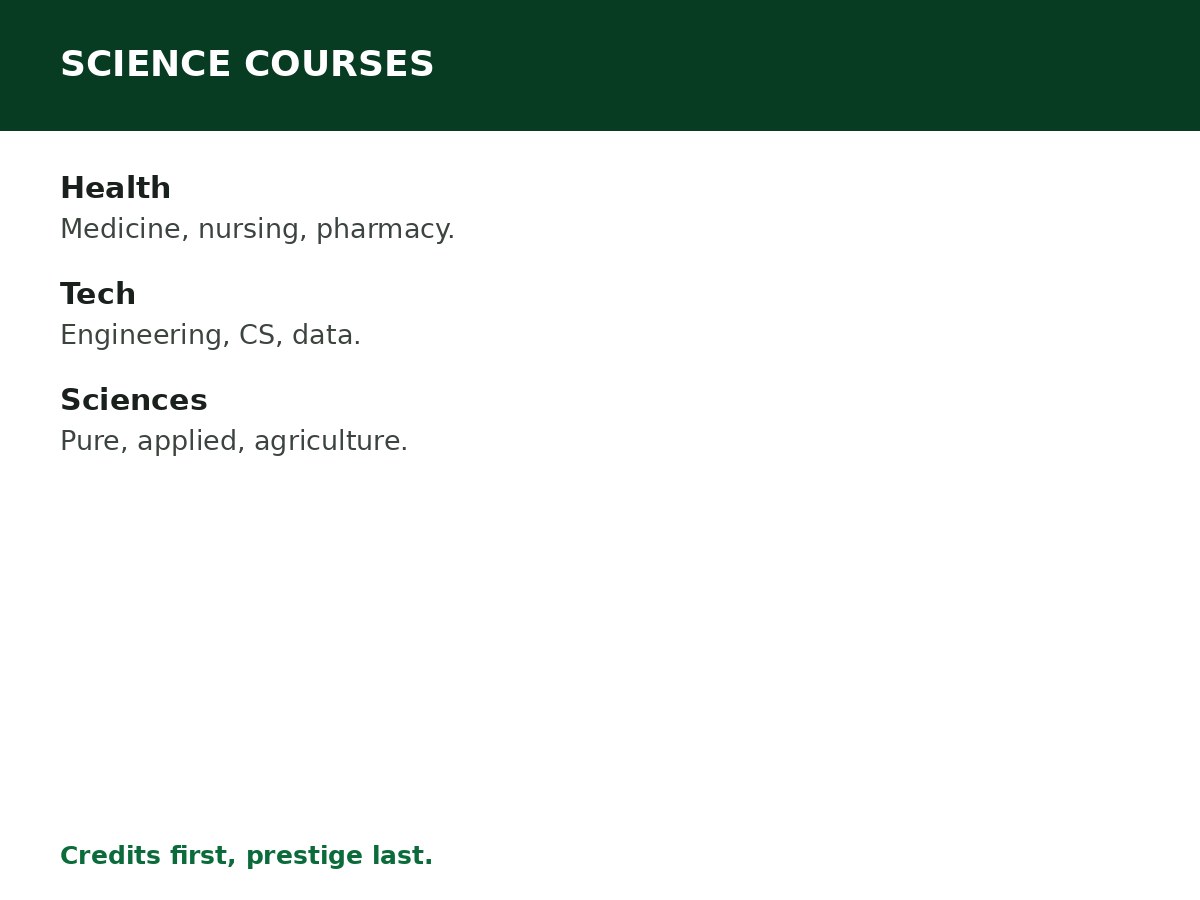
Engineering and technology
- Civil, Mechanical, Electrical/Electronics, Chemical, Petroleum, Computer Engineering — English, Mathematics, Physics, Chemistry. 5 years + SIWES.
- Computer Science — English, Mathematics, Physics, and one of Chemistry, Biology, or Economics. 4 years + SIWES.
- Cybersecurity, Data Science, Software Engineering, Information Technology — English, Mathematics, Physics, and a fourth subject as the brochure states. 4 years + SIWES.
- Architecture — English, Mathematics, Physics, and one of Chemistry, Geography, or Fine Art. Typically 4 years + 2 years professional MSc.
Pure and applied sciences
- Microbiology, Biochemistry — English, Biology, Chemistry, Physics or Mathematics. 4 years + SIWES.
- Chemistry, Physics, Mathematics, Statistics — English, Mathematics, Physics, Chemistry (with variations by discipline). 4 years + SIWES.
- Biology, Botany, Zoology — English, Biology, Chemistry, Physics or Mathematics. 4 years + SIWES.
- Geology, Geophysics — English, Mathematics, Physics, Chemistry. 4 years + SIWES.
Agriculture and environmental sciences
- Agriculture, Agronomy, Animal Science, Crop Science, Agricultural Economics — English, Chemistry, Biology, and Mathematics or Physics (as the brochure states). 4–5 years, depending on the programme.
- Forestry, Fisheries, Food Science and Technology — English, Chemistry, Biology, and a fourth subject as the brochure states.
- Environmental sciences (Environmental Management, Urban and Regional Planning, Surveying, Estate Management) — English, Mathematics, and two science or social-science subjects as the brochure states.
How to choose from this list
- Start from your O’Level credits, not from prestige. A course whose O’Level and UTME requirements you do not meet is not an option, however attractive it sounds.
- Check the brochure for your course and institution, for the session. Subject requirements vary by institution — the combinations above are typical, not universal.
- Weigh duration and professional route. Medicine (6 years), engineering (5 years), and pharmacy (5–6 years) are long commitments with professional licensing; pure sciences (4 years) are shorter, with broader but less licensed career paths.
- Consider the without-subject guides if you lack a subject: courses without Physics, without Chemistry, without Biology, and without Mathematics are covered in their own guides.
Related Guides & Next Steps
- Admission Requirements for Nigerian Universities
- How to Choose a University in Nigeria
- How University Admission Works in Nigeria
- Best Universities to Study Medicine in Nigeria
- Courses for Arts Students in Nigeria
Frequently asked questions
What courses can science students study in Nigeria? Medicine and health sciences, engineering and technology, pure and applied sciences, agriculture, and environmental sciences — the widest range of any stream, grouped above by field.
Can a science student study an Arts or Commercial course? Yes, where you meet that course’s O’Level and UTME requirements. A science student with strong English and relevant Arts subjects can study law, mass communication, or accounting, for example — but check the brochure, because some Arts and Commercial courses require specific Arts or Social Science subjects you may not hold.
What if I am a science student without Physics? Your options narrow sharply for engineering, medicine, pharmacy, and most physical sciences. See the without-Physics guide for the courses that remain open, and consider retaking Physics if your target course requires it.
Which science course has the best job prospects? No course guarantees employment. Medicine, pharmacy, engineering, computer science, cybersecurity, and data science currently show the strongest formal-sector demand, as reported — but prospects depend on skills, internships, and professional licensing, not on the course name alone.
How do I choose between similar science courses? By the career you want, the professional route (licensed vs unlicensed), the duration, and the laboratories and faculty of the specific programme — not by which course sounds most prestigious. Visit the programme’s facilities where possible, and check its accreditation before deciding.
Sources and last update
- Course groupings and typical UTME combinations from JAMB brochure patterns and the cluster’s course guides, with per-institution brochure confirmation directed throughout.
- Durations and professional routes from the respective course guides (Batches 13–15), summarised here — the course guides govern where they differ in detail.
Last updated: 24 October 2026. Guide — review every 3–6 months and on every JAMB brochure update.

Written by Olaitan Ilori
Olaitan Ilori is the founder and lead researcher at CareerMedal. He provides verified, practical guides on Nigerian tertiary admissions (JAMB, CAPS, Post-UTME), NELFUND student finance, NYSC service-year survival, and early-career job placement.
View all guides by Olaitan Ilori →