
Courses that support working abroad are those whose qualifications transfer across borders: licensed health professions (with destination-country licensing, which is separate and additional), technology skills (which transfer on portfolio, not on degree), and internationally recognised professional qualifications (accounting, engineering, law with conversion). The courses below are those most consistently associated with international mobility, grouped by route, with the honest caveats attached. No Nigerian degree alone authorises work abroad — destination-country licensing, visas, and employer sponsorship always apply, and they are separate processes from the degree.
Work-abroad claims are routinely inflated. This guide therefore states mobility in terms of route (licensed, skills-based, conversion-based) and never as a placement rate or salary figure — no reliable national figure exists, and any guide quoting one is guessing.
Licensed health professions (licensing route)
- Medicine and Surgery — international mobility exists, but requires destination-country licensing examinations (for example, USMLE for the United States, PLAB/UKMLA for the United Kingdom, AMC for Australia — as the destination requires), plus visa and employer sponsorship. The Nigerian MBBS is the starting qualification, not the licence.
- Nursing Science — international mobility exists, but requires destination-country nursing registration (for example, NMC for the United Kingdom, NCLEX for the United States and Canada, AHPRA for Australia — as the destination requires), plus visa and employer sponsorship. The Nigerian B.NSc is the starting qualification, not the licence.
- Pharmacy — international mobility exists, but requires destination-country pharmacy registration (as the destination requires), plus visa and employer sponsorship.
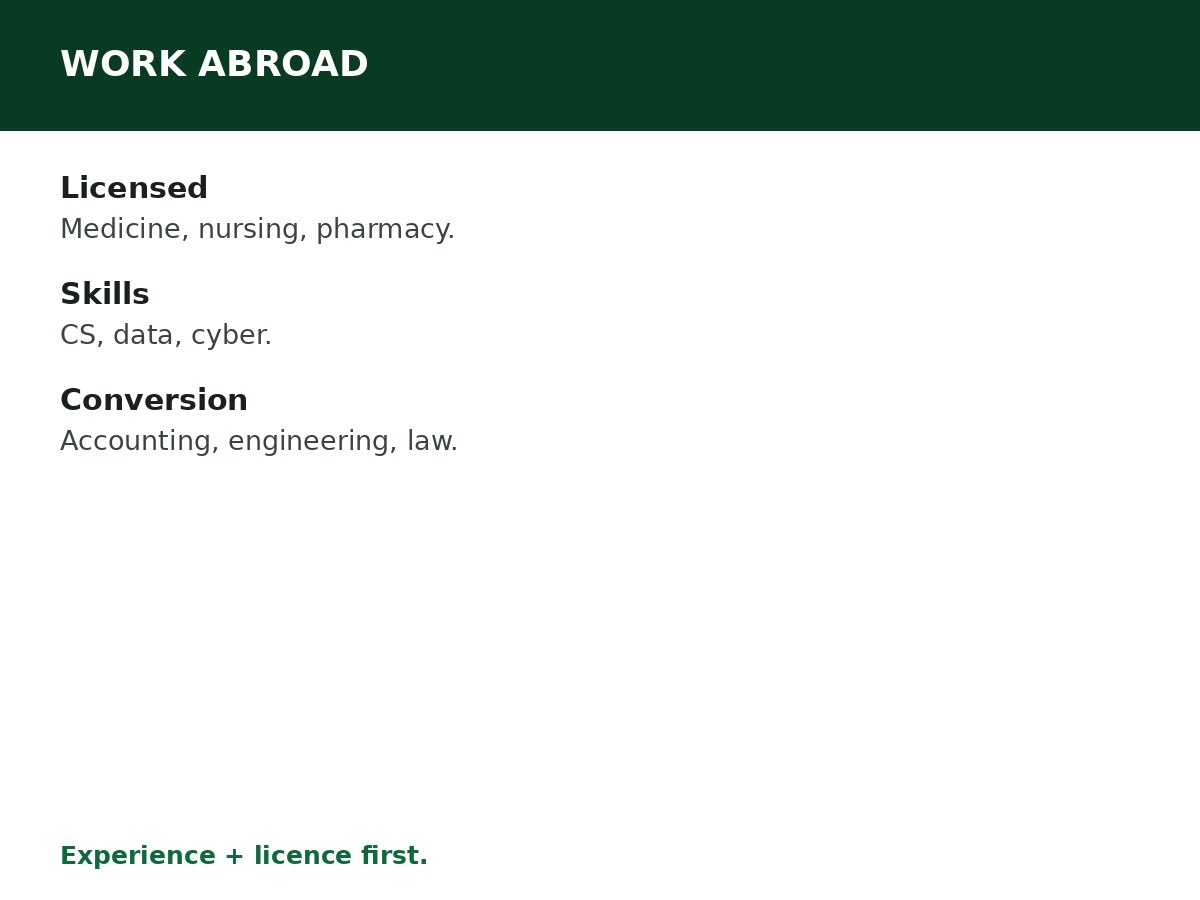
Technology (skills route)
- Computer Science, Cybersecurity, Data Science — skills transfer on portfolio and demonstrable work, not on degree recognition. Remote work for foreign employers is often the first step, followed by relocation where sponsorship is available. Visa and sponsorship remain separate hurdles — skills do not waive them.
- Software Engineering, Information Technology — as computer science, with role-specific mobility.
Professional qualifications (conversion route)
- Accounting — ICAN qualification, plus destination-country accounting recognition or conversion (for example, ACCA’s global recognition, or CPA conversion where applicable). The Nigerian degree opens the ICAN route; ICAN and destination recognition open the international route.
- Engineering — COREN registration, plus destination-country engineering recognition or conversion (as the destination requires, often involving the Washington Accord framework for accredited programmes — check whether your programme’s accreditation is recognised under it).
- Law — Nigerian LLB plus Law School, plus destination-country legal conversion (for example, SQE for England and Wales, bar examinations elsewhere — as the destination requires). Law is the least transferable profession, because legal systems differ by country — conversion is substantial, not automatic.
What working abroad actually requires (beyond the course)
- Destination-country licensing or recognition. Every licensed profession requires it, separately from the Nigerian qualification. Budget the examinations, fees, and time for it — they are substantial.
- Visa and sponsorship. Every work-abroad route requires a visa, and most require employer sponsorship. No course provides either.
- Language and credential evaluation. Destination countries require language proficiency (where applicable) and credential evaluation (for example, WES or equivalent) — both separate processes from the degree.
- Experience. Most destination employers and licensing bodies require post-qualification experience (housemanship, internship, or work experience, as the destination requires). Fresh graduates face the steepest mobility barriers.
Related Guides & Next Steps
- Admission Requirements for Nigerian Universities
- How to Choose a Course After JAMB
- How University Admission Works in Nigeria
- Best Universities to Study Medicine in Nigeria
- Professional Courses Worth Studying in Nigeria
Frequently asked questions
Which course is best for working abroad? Nursing and medicine offer the most structured international routes (licensing examinations + sponsorship demand), and computer science offers the most flexible skills route (portfolio + remote work). “Best” depends on your destination, your licensing appetite, and your experience.
Does a Nigerian degree alone let me work abroad? No — destination-country licensing, visa, and sponsorship always apply, separately from the degree. Any guide claiming a degree alone authorises foreign work is misleading.
Can I work abroad immediately after graduation? Rarely — most destinations require post-qualification experience, licensing examinations, and sponsorship. Plan for a post-graduation phase in Nigeria (housemanship, internship, work experience) before mobility becomes realistic.
Is remote work for a foreign employer the same as working abroad? No — remote work for a foreign employer from Nigeria is not relocation, and it does not require a work visa for the employer’s country (though tax and contract terms apply). It is often the most accessible first step toward international work.
Should I choose a course only because it can lead to working abroad? No — choose by the intersection of mobility, your interests, and your strengths. A course you cannot sustain for 4–6 years, however mobile, is a dropout risk, and licensing examinations after graduation are harder than the degree itself.
Sources and last update
- Mobility routes (licensed, skills-based, conversion-based) and destination requirements (licensing examinations, visa, sponsorship, credential evaluation, experience) from professional-body and immigration guidance as reported, stated qualitatively — no placement or salary figure is asserted, deliberately.
- Course-to-route mappings from the respective course guides (Batches 13–16), summarised here — the course guides govern where they differ in detail.
Last updated: 24 October 2026. Guide — review every 3–6 months and on every destination-policy change.

Written by Olaitan Ilori
Olaitan Ilori is the founder and lead researcher at CareerMedal. He provides verified, practical guides on Nigerian tertiary admissions (JAMB, CAPS, Post-UTME), NELFUND student finance, NYSC service-year survival, and early-career job placement.
View all guides by Olaitan Ilori →