
Fake admission agents sell what does not exist: guaranteed admission, “upgraded” courses, confirmed offers, and reopened screening windows. Real admission in Nigeria runs through exactly two systems — JAMB CAPS and your institution’s official portal — and neither one takes payment from an intermediary. If someone is selling you access to either system, they are selling a scam.
Admission season is scam season because the stakes are high, the process is confusing, and the timeline is tight. Agents exploit all three.
The Common Scams, Named
- “Guaranteed admission” for a fee: No one can guarantee admission. Admission is decided by merit (UTME + screening + O’Level), departmental cut-offs, and available quota, processed on CAPS. A “guaranteed” offer that is not on CAPS is completely invalid.
- “Admission runs” / “sorting” for screening or exams: Paying someone to influence a screening score is both a financial fraud and an academic offense that leads to disqualification.
- Fake screening and admission portals: Lookalike websites that mimic an institution’s portal, collect your JAMB number and payment, and deliver nothing. The real portal is reached by typing the institution’s official web address directly.
- Fake acceptance-fee collection: Personal bank accounts or individuals on WhatsApp claiming to be school bursary staff collecting fees that never reach the institution.
- “Reopened” screening windows and “special lists”: Closed screening windows do not reopen for an individual fee, and there are no special lists outside CAPS and the institution’s published lists.
- “Upgrade” offers: No one can upgrade your course, institution, or UTME score for a fee. Official changes only happen through JAMB’s accredited change of course service.
- Fake scholarships requiring upfront fees: Any scholarship or grant that requires you to pay an “application” or “clearance” fee upfront is a fee fraud. Legitimate scholarships do not charge applicants to receive funds.
How to Verify Anything an Agent Tells You
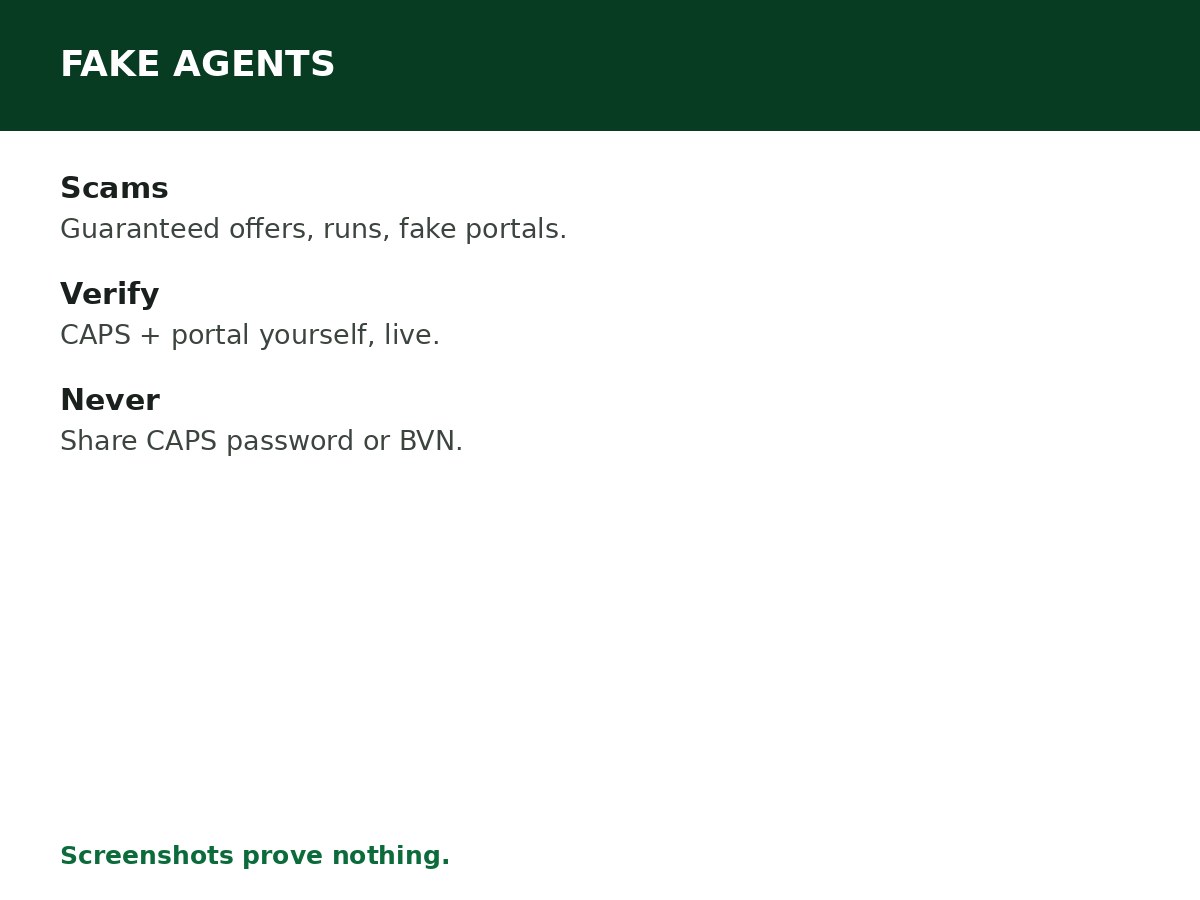
- Check CAPS yourself: If the agent claims you have been admitted, your personal JAMB CAPS profile will reflect it. If CAPS does not show it, you have not been admitted.
- Check the institution’s official portal: If the agent claims a screening window, a fee, or a list, verify on the university portal directly.
- Call the institution’s admissions office: Use only numbers published on the university’s main website (not a phone number provided by the agent).
- Check the NUC list of accredited universities: Verify that the institution is licensed by the National Universities Commission (NUC).
- Ask for the process, not the promise: A legitimate university process has verifiable steps, official bank invoices, and portal receipts.
Strict Rules That Protect You
- Never pay money into a personal bank account: All university payments must be generated via official portal invoice (Remita, Paystack, or designated collecting banks).
- Never share your JAMB profile password or CAPS login with an agent: An agent holding your password can accept or reject admission offers without your consent.
- Never trust a screenshot as proof: Digital screenshots of admission letters and payment confirmations are easily faked in image editors. Always verify on the live system.
Frequently Asked Questions
Can an agent really secure admission for me?
No. Admission is merit-based and quota-regulated through JAMB CAPS. Anyone claiming otherwise is running an advance-fee fraud.
What if the agent claims to work inside the university?
Legitimate university staff do not market admissions through social media or private WhatsApp groups. Any staff member doing so is violating civil service regulations.
I already paid an agent. What should I do?
Contact your bank immediately to flag the beneficiary account for fraud, preserve all chat evidence and payment slips, and report the case to the institution’s security unit and the police.
Related Guides & Next Steps
- How to Check a University Admission List
- How to Pay Acceptance Fee Safely
- How to Verify a University Admission Portal
- How University Admission Works in Nigeria
- 2026/2027 University Admission Guide for Nigerian Students

Written by Olaitan Ilori
Olaitan Ilori is the founder and lead researcher at CareerMedal. He provides verified, practical guides on Nigerian tertiary admissions (JAMB, CAPS, Post-UTME), NELFUND student finance, NYSC service-year survival, and early-career job placement.
View all guides by Olaitan Ilori →