
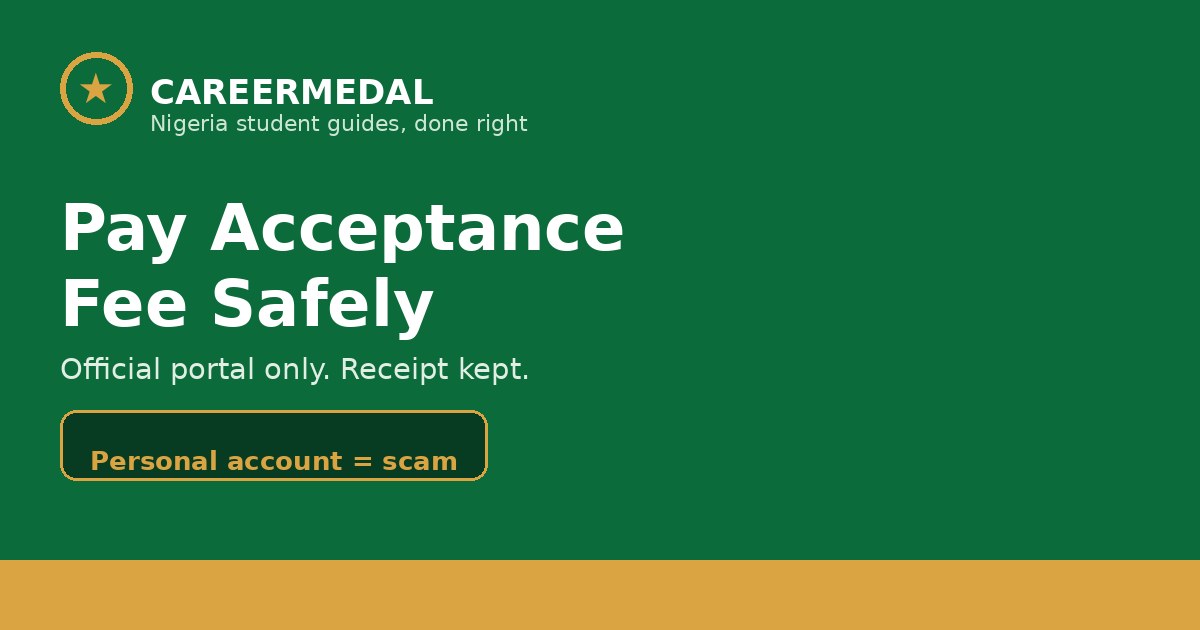
Pay your acceptance fee safely by paying only on your institution’s official portal, through its official payment channel, within the institution’s deadline, and keeping the payment receipt and transaction reference. Every acceptance-fee scam works the same way: it moves you off the official portal and onto a personal account, an agent, or a lookalike site — and money paid there is lost, not paid.
Acceptance fees are time-pressured (deadlines can mean losing the offer) and amount-variable (each institution sets its own fee). That combination — urgency plus an unfamiliar amount — is exactly what scammers exploit.
Before you pay
- Confirm the fee on the institution’s official portal. The acceptance fee for your course and session is published by the institution (portal notice, admission letter, or clearance instructions). Do not pay an amount quoted by an agent, a group chat, or a blog — confirm it on the portal first.
- Confirm the deadline. Missing the acceptance-fee deadline can mean losing the admission offer. If the deadline is near and NELFUND disbursement (where applicable) has not arrived, ask the institution about temporary arrangements — but do not let the deadline pass while waiting for a third party’s assurance.
- Confirm the payment channel. Institutions publish their official payment method on the portal (portal-integrated payment, bank payment with a generated reference, or a specified channel). The channel is institution-specific — there is no single national acceptance-fee payment platform to name here, and any “universal” payment link sent to you is suspect.
- Confirm the offer first. Pay the acceptance fee only after CAPS shows your offer and you have accepted it, and the institution’s list confirms it. Paying an acceptance fee for an offer that is not on CAPS is paying for an admission you do not yet hold.
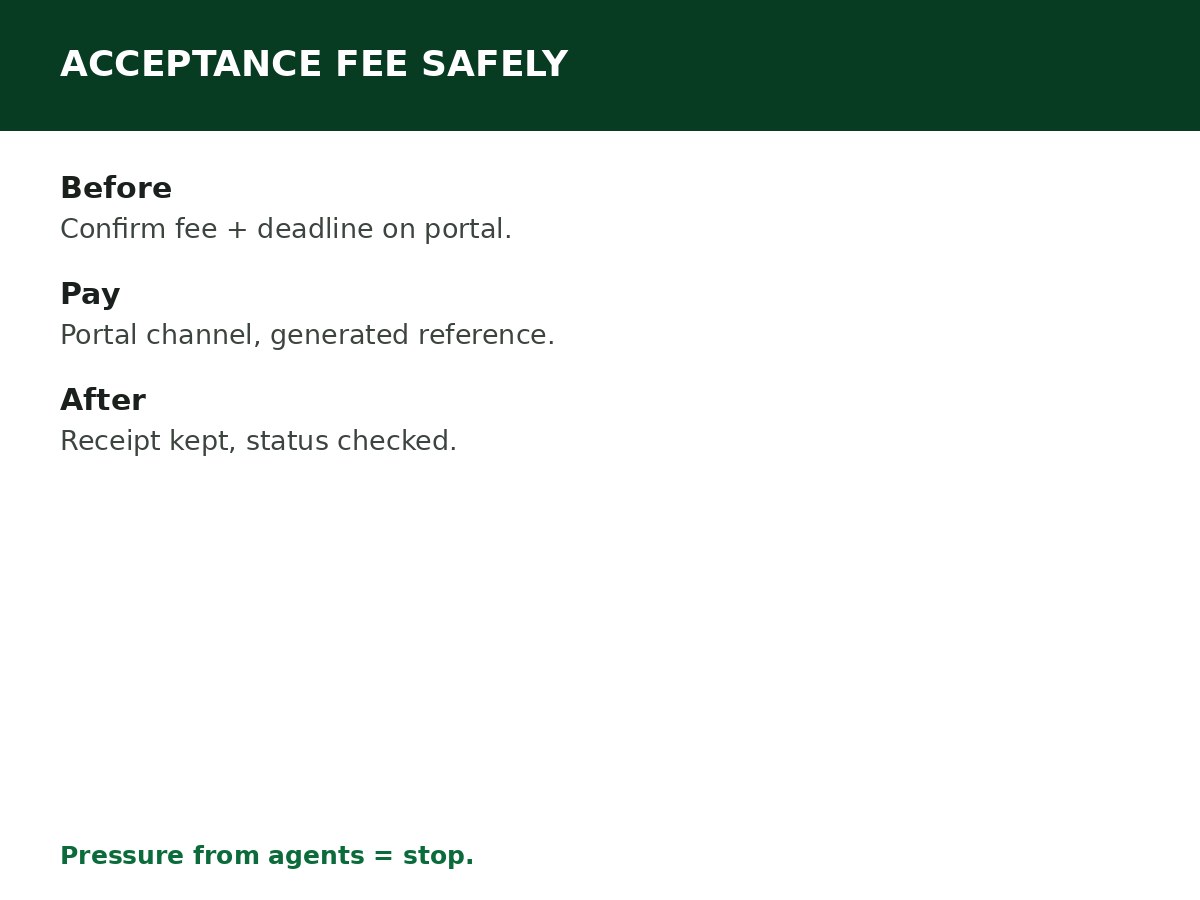
How to pay, step by step
Step 1: Log in to the institution’s official portal (typed directly, or linked from the institution’s main website) with your JAMB number or application credentials.
Step 2: Navigate to the acceptance-fee section and generate your payment invoice or reference, if the portal requires one. The invoice should show your name, JAMB number, course, session, and the exact fee.
Step 3: Pay through the portal’s official channel only. If the portal generates a bank reference, pay that reference at the bank or through the bank’s official channel — not to a personal account, and not through a link sent by an individual.
Step 4: Save the payment receipt and transaction reference immediately (screenshot and download, where offered). Check your portal after payment: the acceptance status should update to paid. If it does not update within the institution’s stated window, contact the bursary with your receipt and reference — do not pay again until the bursary confirms whether the first payment was received.
Step 5: Keep the receipt with your clearance documents. Clearance typically requires the acceptance-fee receipt alongside the JAMB and institution admission letters.
Red flags: stop and verify
- Payment to a personal account (individual’s name, not the institution) — stop. Institutions do not collect acceptance fees into personal accounts.
- A link sent by an agent, a “school official” on WhatsApp, or a social media ad — stop. Go to the portal yourself, by typing its address or via the institution’s main website.
- A fee different from the portal’s published fee, with an explanation (“discount”, “late fee waiver”, “express processing”) — stop. The portal’s fee is the fee.
- Pressure to pay immediately or lose the offer, from an individual — stop. Deadlines are real, but they are published by the institution, not enforced by an agent’s countdown. Check the deadline on the portal yourself.
- A “confirmation fee” or “processing fee” on top of the acceptance fee, charged by an intermediary — stop. The institution’s portal charges what the institution charges; intermediaries add nothing but risk.
If you already paid the wrong way
- Contact your bank immediately to report the transaction and ask about recall or dispute options — the sooner, the better the chance of recovery, and the chance is never guaranteed.
- Report to the institution’s bursary and security unit, with the payment evidence, so the scam account and method are flagged for other candidates.
- Report to the police and to JAMB support where applicable, with all evidence preserved (chats, account details, receipts).
- Do not pay a second “recovery fee” to anyone promising to retrieve the lost money — that is the same scam, run twice.
Related Guides & Next Steps
- Can NELFUND Pay Acceptance Fees?
- How to Avoid Fake Admission Agents (The Red Flags & Verification Rules)
- University Acceptance Fee Explained
- How University Admission Works in Nigeria
- 2026/2027 University Admission Guide for Nigerian Students
Frequently asked questions
Where do I pay my acceptance fee? On your institution’s official portal, through its official payment channel only. Never to a personal account, an agent, or a link sent by an individual.
How much is the acceptance fee? It varies by institution, course, and session. Confirm the exact fee on the institution’s official portal for your session — no national figure is asserted here.
What if the portal does not update after I paid? Wait the institution’s stated window, then contact the bursary with your receipt and transaction reference. Do not pay again until the bursary confirms whether the first payment was received.
Can NELFUND pay my acceptance fee? It depends on your institution’s verified fee schedule and NELFUND’s current coverage for the session — see the acceptance-fee coverage guide. Do not assume inclusion; check the portal schedule and your bursary, and protect your deadline in the meantime.
I paid an agent and got no receipt. What do I do? Contact your bank immediately about the transaction, report to the institution and the police with all evidence, and do not pay any “recovery fee” to anyone promising to retrieve it.
Sources and last update
- Safe-payment method (official portal only, generated invoice/reference, receipt retention, bursary follow-up) from institution payment practices and the cluster’s scam-avoidance guidance.
- Red flags (personal accounts, agent links, fee discrepancies, pressure tactics, intermediary fees) from reported admission-scam patterns, as compiled by CareerMedal.
- No fee amount or payment platform is asserted — both are institution-specific.
Last updated: 24 October 2026. Guide — review every admission session and on every institution payment-policy update.

Written by Olaitan Ilori
Olaitan Ilori is the founder and lead researcher at CareerMedal. He provides verified, practical guides on Nigerian tertiary admissions (JAMB, CAPS, Post-UTME), NELFUND student finance, NYSC service-year survival, and early-career job placement.
View all guides by Olaitan Ilori →