
Verify a university admission portal in three checks: the institution is on the NUC’s list of recognised universities, the portal address matches the institution’s official website (reached by typing it yourself, not by following a link someone sent you), and the portal’s behaviour matches a real admission system (JAMB-number login, published lists and fees, official payment channels, receipts). A portal that fails any one of these checks is not a portal to trust with your details or your money.
Fake portals are the most damaging admission scam because they harvest exactly the details that enable further fraud: JAMB numbers, O’Level results, NIN, phone numbers, and payments.
Check 1: Is the institution real?
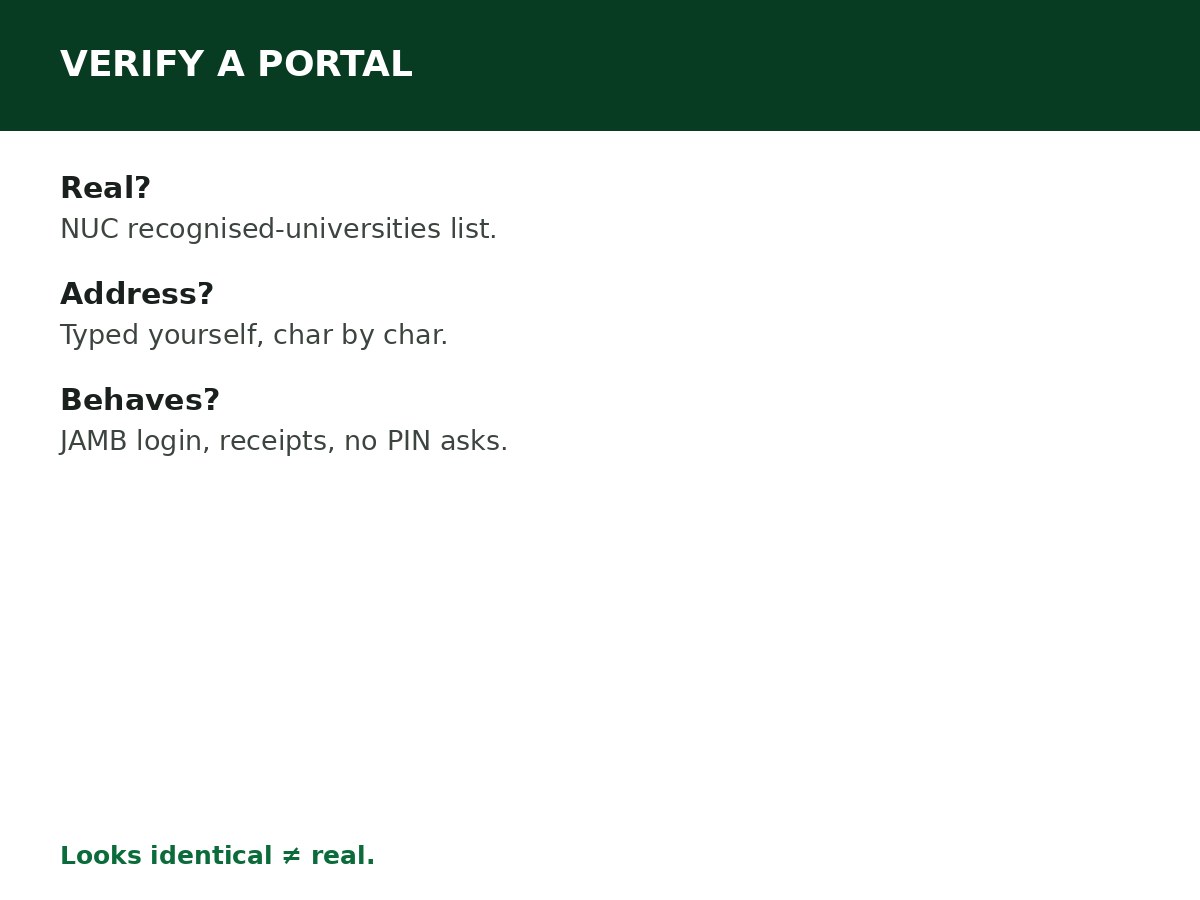
- Check the NUC’s list of recognised universities. The National Universities Commission publishes the list of recognised (federal, state, and private) universities in Nigeria. If the institution is not on that list, its degrees are not recognised as Nigerian university degrees, however professional its website looks.
- Check the institution’s own official website — its history, location, programmes, and contact details should be consistent and verifiable, not just a landing page with an application form.
- Be suspicious of institutions whose only presence is social media and agents. A real university has a physical campus, a published address, and a verifiable academic record. An “institution” that exists only as a website and a WhatsApp number is not a university.
Check 2: Is this the institution’s real portal?
- Reach the portal from the institution’s main website, by typing the institution’s official address yourself. Do not reach it from a link in a group chat, an ad, a search-ad result you have not checked, or an agent’s message — search results and ads can be spoofed, and group links are the commonest fake-portal delivery method.
- Compare the address carefully. Fake portals use near-identical addresses: an extra word, a different suffix (.com vs .edu.ng vs .ng), a hyphen, or a subdomain that mimics the real one. Read the address character by character against the institution’s official website.
- Check for consistency. The real portal’s branding, programme list, fee notices, and contact details should match the institution’s main website. A portal that contradicts the main website (different fees, different courses, different deadlines) is suspect.
- Look for the institution’s published contact channels (admission office phone and email, as published on the main website) and use those — not contact details displayed only on the portal itself — to confirm any doubt.
Check 3: Does the portal behave like a real admission system?
A real admission portal will:
- Ask you to log in with your JAMB registration number (and application credentials), and will pull or verify your UTME details against JAMB’s records.
- Publish admission lists, screening schedules, and fee notices that match the institution’s official announcements.
- Generate invoices or references for payments, and issue receipts through official payment channels — never ask you to pay into a personal account.
- Never ask for your JAMB profile password, your bank PIN, or your BVN as a condition of screening. A portal that asks for those is harvesting credentials, not screening candidates.
- Never promise admission on payment. A real portal processes applications; it does not sell offers.
If you already used a suspicious portal
- Change your JAMB profile password immediately, and check CAPS for any changes you did not make (choice changes, acceptances, rejections).
- Contact your bank if you entered bank details or made a payment, and ask about transaction monitoring and dispute options.
- Report the portal to the institution (if it impersonates a real one), to JAMB support, and to the police, with the address and screenshots preserved.
- Do not pay a “recovery fee” to anyone promising to retrieve money or details from the fake portal — that is the same scam, run twice.
Related Guides & Next Steps
- How to Avoid Fake Admission Agents (The Red Flags & Verification Rules)
- How to Check a University Admission List
- How to Pay Acceptance Fee Safely
- How University Admission Works in Nigeria
- 2026/2027 University Admission Guide for Nigerian Students
Frequently asked questions
How do I know if a university is NUC-recognised? Check the NUC’s published list of recognised universities. If the institution is not on it, its degrees are not recognised as Nigerian university degrees.
Is a .edu.ng address proof that a portal is real? No — addresses can be spoofed or mimicked, and a real-looking suffix is not verification. Compare the full address against the institution’s official website, reached by typing it yourself.
The portal looks exactly like the real one. Can it still be fake? Yes. Fake portals are built to look identical. Appearance is not verification — the address, the NUC listing, and the portal’s behaviour (official channels, receipts, no credential harvesting) are.
Should I apply through a link a friend sent me? No — even a well-meaning friend can forward a fake link. Reach the portal yourself, from the institution’s main website, every time.
What details should I never enter on an admission portal? Your JAMB profile password, bank PIN, BVN, and any one-time code. A real screening portal needs your JAMB number and application details — not your banking credentials.
Sources and last update
- Portal verification method (NUC listing, address comparison via self-typed official website, behavioural checks, credential-harvesting warning) from institution admission practices and reported fake-portal patterns, as compiled by CareerMedal.
- No portal address is quoted here — deliberately, because quoting addresses creates the exact confusion (lookalike addresses) this guide prevents. Reach each portal from its institution’s official website.
Last updated: 24 October 2026. Guide — review every admission session and on every NUC list update.

Written by Olaitan Ilori
Olaitan Ilori is the founder and lead researcher at CareerMedal. He provides verified, practical guides on Nigerian tertiary admissions (JAMB, CAPS, Post-UTME), NELFUND student finance, NYSC service-year survival, and early-career job placement.
View all guides by Olaitan Ilori →