

Courses that can lead to remote jobs are those whose work product is digital and deliverable online: software, data, design, writing, and analysis. The courses below are those most consistently associated with remote-work opportunities, grouped by field, with the honest caveats attached. A course does not itself create a remote job — your portfolio, demonstrable skills, and ability to work asynchronously do. Remote demand is also concentrated in specific skills (not degrees) and is fiercely competitive globally.
Remote-work claims are routinely inflated. This guide therefore states remote suitability in qualitative terms and never as an income figure or placement rate — no reliable national figure exists, and any guide quoting one is guessing.
Technology (strongest remote suitability)
- Computer Science — software development, systems, and web/mobile roles, the most consistently remote-friendly field. Portfolio (GitHub, projects, contributions) matters more than classification.
- Cybersecurity — security operations, analysis, and consulting roles, with remote suitability varying by role (operations and consulting remote well; incident response and forensics less so).
- Data Science — analysis, machine-learning, and data-engineering roles, with portfolio (notebooks, projects, Kaggle or equivalent) mattering most.
- Software Engineering, Information Technology — as computer science, with role-specific remote suitability.
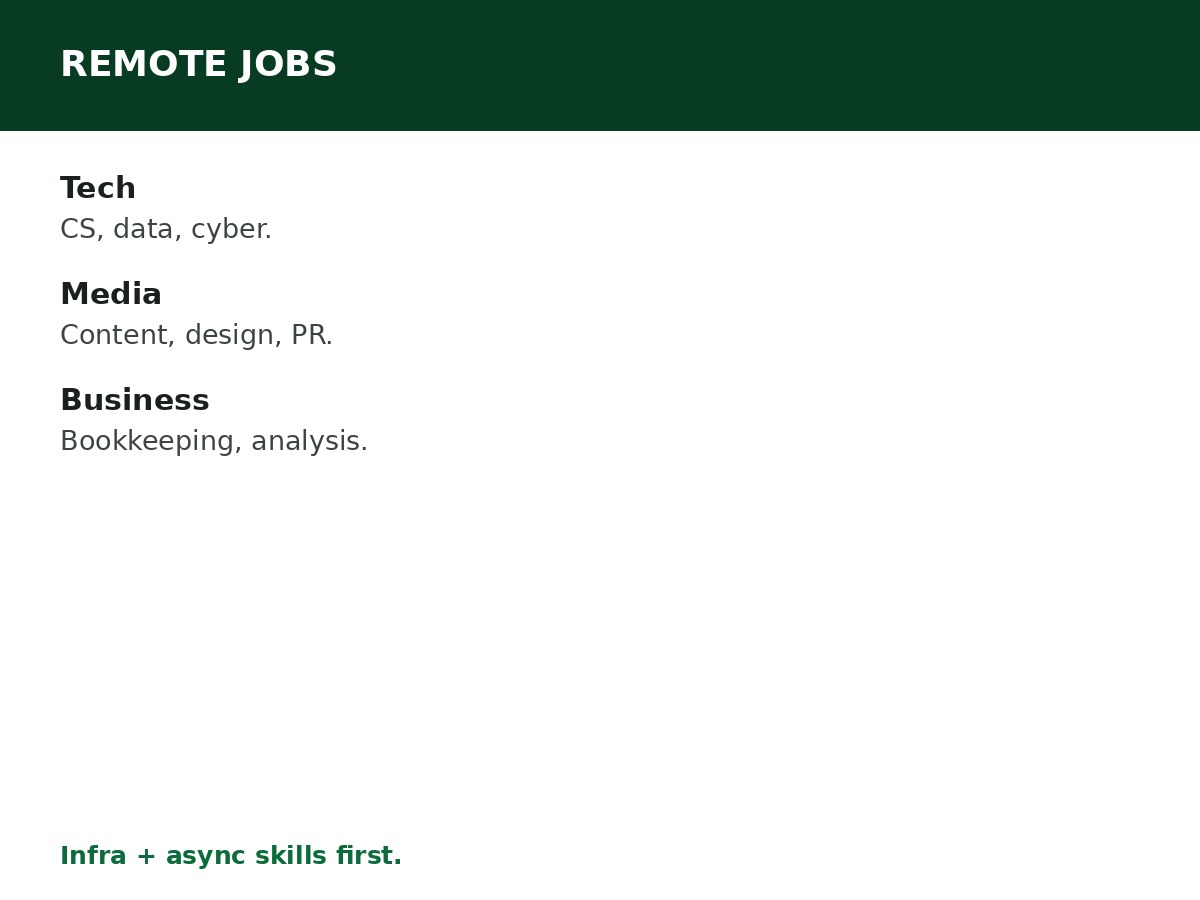
Design and media (portfolio-driven remote suitability)
- Mass Communication — content, social media, public relations, and digital-media roles, with portfolio (published work, campaigns, audience growth) mattering most.
- Fine and Applied Arts, Graphic Design (where offered) — design roles, with portfolio mattering entirely.
- Theatre Arts, Film Production (digital specialisations) — video, editing, and production roles, with showreel mattering most.
Business and analysis (skills-driven remote suitability)
- Accounting — bookkeeping, audit support, and financial-analysis roles, with ICAN or equivalent qualification and software proficiency (accounting packages) mattering most. Full audit practice is less remote-friendly than bookkeeping and analysis.
- Economics — research, analysis, and consulting roles, with quantitative and writing skills mattering most.
- Business Administration, Marketing — digital marketing, operations, and administrative roles, with demonstrable results (campaigns, growth, systems) mattering most.
What remote work actually requires (beyond the course)
- A portfolio, not a degree. Remote employers hire on demonstrable work: code, analysis, designs, published content, campaigns. Build the portfolio from first year.
- Asynchronous work skills. Remote work rewards written communication, self-management, and reliable delivery — skills no course teaches directly, and all remote roles test.
- Reliable infrastructure. Power, internet, and a working device are prerequisites, not conveniences — and they are the most common barrier to remote work in Nigeria, more than qualifications.
- Global competition. Remote roles compete globally, not locally. Your competition is not your classmates — it is practitioners worldwide, and your skills must meet that standard.
Related Guides & Next Steps
- Admission Requirements for Nigerian Universities
- How to Choose a Course After JAMB
- How University Admission Works in Nigeria
- Best Universities to Study Medicine in Nigeria
- Courses for Students Who Want to Work Abroad
Frequently asked questions
Which course is best for remote jobs? Computer science, followed by data science and cybersecurity — on portfolio and skills, not on degree alone. No course guarantees a remote job.
Can I get a remote job with a non-technology degree? Yes — mass communication, accounting, economics, and business administration all lead to remote roles (content, bookkeeping, analysis, digital marketing), with portfolio and demonstrable results mattering most.
Do remote jobs pay in foreign currency? Some do, some do not — and payment terms vary by employer, role, and arrangement. Do not choose a course on the assumption of foreign-currency pay, and verify any employer’s payment terms before accepting work.
What matters more than course choice for remote work? Portfolio, demonstrable skills, asynchronous work ability, and reliable infrastructure — in that order.
Should I study a course only because it can lead to remote work? No — choose by the intersection of remote suitability, your interests, and your strengths. A course you cannot sustain for 4 years, however remote-friendly, is a dropout risk.
Sources and last update
- Remote-suitability assessments (digital deliverability, portfolio primacy, asynchronous skills, infrastructure barrier, global competition) from labour-market reporting and the cluster’s course guides, stated qualitatively — no income or placement figure is asserted, deliberately.
- Course-to-role mappings from the respective course guides (Batches 13–16), summarised here — the course guides govern where they differ in detail.
Last updated: 24 October 2026. Guide — review every 3–6 months and on every labour-market shift.

Written by Olaitan Ilori
Olaitan Ilori is the founder and lead researcher at CareerMedal. He provides verified, practical guides on Nigerian tertiary admissions (JAMB, CAPS, Post-UTME), NELFUND student finance, NYSC service-year survival, and early-career job placement.
View all guides by Olaitan Ilori →