

There is no official ranking of law faculties in Nigeria — but the strongest choices are consistently the universities with established law faculties, full NUC accreditation, Council of Legal Education recognition for the LLB (required for admission to the Nigerian Law School), and competitive departmental cut-offs. The institutions below are those most consistently mentioned for law, grouped by faculty strength and Law School admission record, not ranked in order. Verify accreditation for the session you apply in.
Law is one of Nigeria’s most oversubscribed courses, and the faculty matters: moot-court facilities, law library depth, faculty specialisation, and the Law School pipeline all shape the lawyer you become — and Law School admission itself is competitive, with quotas per institution.
How to judge a law faculty
- Council of Legal Education recognition: the LLB must be recognised by the Council of Legal Education for admission to the Nigerian Law School. A law degree without that recognition does not lead to Call to the Bar — check recognition for the session, before anything else.
- NUC accreditation: full accreditation for the law programme, for the session. Accreditation status changes — verify, do not assume.
- Faculty and facilities: law library depth, moot-court facilities, faculty specialisation (commercial, constitutional, criminal, international, and more), and clinical legal education opportunities.
- Law School pipeline: the faculty’s record of graduates admitted to the Nigerian Law School and called to the Bar. A faculty whose graduates consistently reach the Bar is doing something right — ask for the record, not just the brochure.
- Departmental cut-off: law’s cut-offs run at the top of most institutions’ ranges (200+ at the most competitive, as reported). Meeting the institution minimum is not enough.
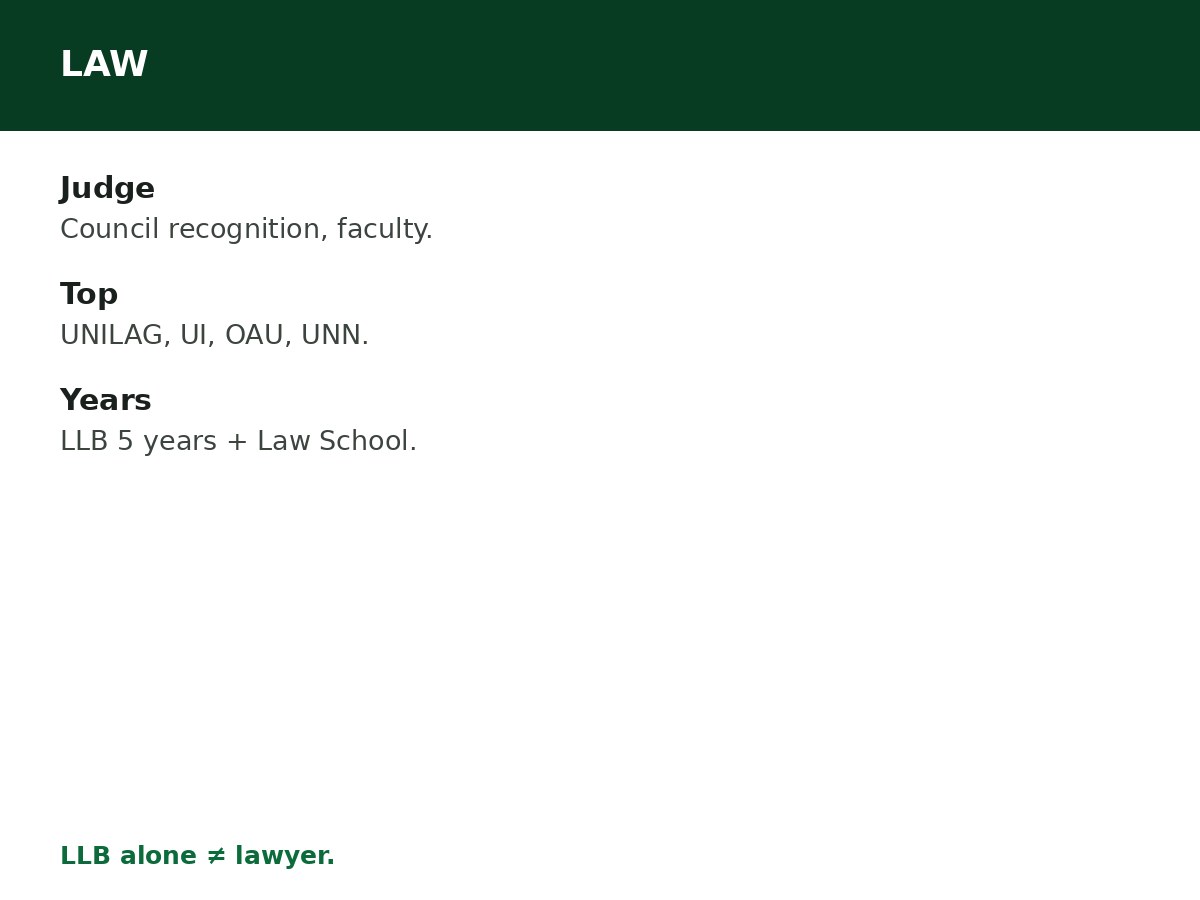
Institutions most consistently mentioned for law
University of Lagos (UNILAG) — Faculty of Law, Akoka, Lagos. Consistently the most competitive law cut-offs in Nigeria, with a strong commercial-law tradition and Lagos legal-market proximity.
University of Ibadan (UI) — Faculty of Law, Ibadan. Oldest law faculty tradition in the country, broad specialisation, competitive cut-offs.
Obafemi Awolowo University (OAU), Ile-Ife — Faculty of Law, Ile-Ife. Strong faculty tradition, competitive cut-offs, moot-court record.
University of Nigeria, Nsukka (UNN) — Faculty of Law, Enugu campus. Established faculty, broad specialisation.
Ahmadu Bello University (ABU), Zaria — Faculty of Law, Zaria. Major northern law faculty, broad specialisation.
University of Benin (UNIBEN) — Faculty of Law, Benin City. Established faculty, competitive cut-offs.
University of Ilorin (UNILORIN) — Faculty of Law, Ilorin. Consistently competitive, with a reputation for stable academic calendars.
University of Jos (UNIJOS) — Faculty of Law, Jos. Established faculty, competitive in the north-central region.
Nnamdi Azikiwe University (UNIZIK), Awka — Faculty of Law, Awka. Established faculty, competitive cut-offs.
Bayero University, Kano (BUK) — Faculty of Law, Kano. Major northern law faculty.
Private options with established law faculties (for example, Babcock University, Covenant University, and Afe Babalola University, as reported) offer smaller classes and (typically) more stable calendars at substantially higher fees — verify Council of Legal Education recognition for the session, as with any institution.
Related Guides & Next Steps
- Admission Requirements for Nigerian Universities
- How to Choose a University in Nigeria
- How University Admission Works in Nigeria
- Best Universities to Study Medicine in Nigeria
- Best Universities to Study Computer Science in Nigeria
Frequently asked questions
Which university is best for law in Nigeria? There is no official ranking. UNILAG, UI, OAU, and UNN are the most consistently mentioned, on faculty strength and Law School pipeline — but “best” for you depends on your score, your budget, and the specialisation you want. Verify Council of Legal Education recognition for the session.
How many years is law in Nigeria? LLB runs 5 years, followed by the Nigerian Law School (1 year) and Call to the Bar. Confirm the programme structure for the session you apply in.
What UTME score do I need for law? Departmental cut-offs for law run at the top of most institutions’ ranges (200+ at the most competitive, as reported). Meeting the institution minimum is not enough.
Does a law degree automatically qualify me as a lawyer? No — the LLB qualifies you for admission to the Nigerian Law School, and Call to the Bar follows successful completion there. The LLB alone does not make you a lawyer.
Can I study law at a private university? Yes, where the programme holds current NUC accreditation and Council of Legal Education recognition. Verify both for the session, and budget the full 5 years at private fees.
Sources and last update
- Institution shortlist (UNILAG, UI, OAU, UNN, ABU, UNIBEN, UNILORIN, UNIJOS, UNIZIK, BUK) from faculty-history and Law School pipeline reporting, grouped by strength, not ranked — no official ranking is asserted.
- Accreditation (NUC + Council of Legal Education), 5-year LLB structure, and Law School route from professional-body guidance as reported, with per-session verification directed.
Last updated: 24 October 2026. Guide — review every 3–6 months and on every NUC/Council of Legal Education update.

Written by Olaitan Ilori
Olaitan Ilori is the founder and lead researcher at CareerMedal. He provides verified, practical guides on Nigerian tertiary admissions (JAMB, CAPS, Post-UTME), NELFUND student finance, NYSC service-year survival, and early-career job placement.
View all guides by Olaitan Ilori →