
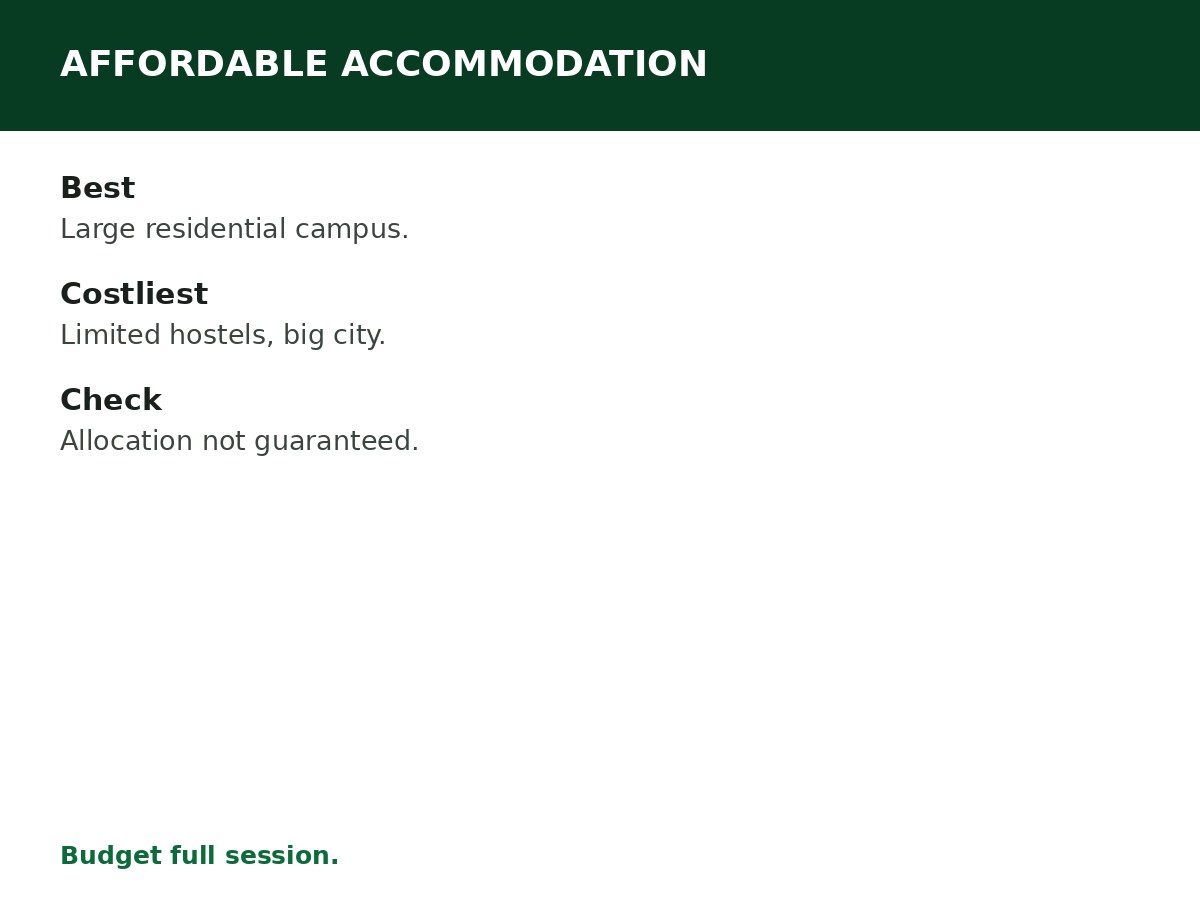
No rent figure is asserted anywhere in this article, deliberately — accommodation costs vary by campus, room type, and town, and they change every session. What this guide explains honestly is the structure: whether a university is affordable to live at depends on hostel availability (how many students get a hostel place), hostel charges, and off-campus rents in that town. A university with a large residential campus and a cheap town is affordable to live at; a university with limited hostels in an expensive city is not, whatever its school charges.
Universities with large residential campuses
- Obafemi Awolowo University (OAU) — largely residential campus, Ile-Ife town costs run lower than Lagos or Abuja.
- Ahmadu Bello University (ABU) — large residential campus, Zaria town costs run lower than Lagos or Abuja.
- University of Nigeria, Nsukka (UNN) — large residential campus, Nsukka town costs run lower than Lagos or Abuja.
- University of Ibadan (UI) — large residential campus, Ibadan town costs run lower than Lagos or Abuja.
- Bayero University, Kano (BUK) — large residential campus, Kano town costs run lower than Lagos or Abuja.
- Federal University of Technology, Akure (FUTA) and Federal University of Technology, Owerri (FUTO) — residential campuses in cheaper towns.
- Nnamdi Azikiwe University (UNIZIK) — residential campus, Awka town costs run lower than Lagos or Abuja.
These are grouped by residential capacity and town cost, NOT ranked by rent — no figure supports a ranking, so none is given.
Where accommodation tends to cost most
Universities with limited hostel places in expensive cities — UNILAG (Lagos), LASU (Lagos), UNIABUJA (Abuja), UNIPORT (Port Harcourt) — push most students off-campus, where rents in those cities run highest. For these universities, budget off-campus rent from the start; do not budget as if a hostel place were guaranteed.
How to check accommodation before choosing
- Ask the university how many hostel places exist vs how many students — allocation is not guaranteed at most universities.
- Get the current session’s hostel charges from the official notice (not from a previous session).
- If you will live off-campus, check rents in that town for the room type you will actually take (single room, self-contain, shared flat).
- Add transport: a cheap room far from campus with high daily transport can cost more than a dearer room near campus.
- Private universities often bundle hostel accommodation into the session total — compare totals, not charges alone.
Related Guides & Next Steps
- Admission Requirements for Nigerian Universities
- How to Choose a University in Nigeria
- How University Admission Works in Nigeria
- University of Lagos (UNILAG) Courses, Requirements and School Fees
- Universities With Strong Computer Science Programmes
Frequently asked questions
Which university has the most affordable accommodation? No rent figure is asserted here, so no ranking is given. Universities with large residential campuses in cheaper towns (OAU, ABU, UNN, UI, BUK, FUTA, FUTO, UNIZIK) tend to run lowest on accommodation — verify hostel availability and current charges for the session.
Is hostel accommodation guaranteed? No — allocation is not guaranteed at most universities. Budget for off-campus accommodation unless a hostel place is confirmed.
Is off-campus accommodation cheaper than hostel? Sometimes, sometimes not — it depends on the town, the room type, and transport. Compare the full cost (rent + transport + utilities), not rent alone.
Do private universities include accommodation? Some bundle hostel accommodation into the session total, others charge it separately. Compare totals, not charges alone.
How do I budget accommodation? Hostel charges (current session, official notice) or off-campus rent in that town, plus transport and utilities, for the full session — not just one semester.
Sources and last update
- Institution groupings from departmental-history, professional-school, and programme reporting, grouped by strength, NOT ranked. Accreditation (NUC) and professional-body recognition from programme guidance as reported, with per-session verification directed.
- Cut-off context from the cluster’s cut-off guides (Batches 11, 14, 20, and 21), summarised here — the cut-off guides govern where they differ in detail.
- No fee figure, no salary figure, and no placement or employment figure is asserted anywhere in this article, deliberately.
Last updated: 24 October 2026. Guide — review every 3–6 months and on every admission session.

Written by Olaitan Ilori
Olaitan Ilori is the founder and lead researcher at CareerMedal. He provides verified, practical guides on Nigerian tertiary admissions (JAMB, CAPS, Post-UTME), NELFUND student finance, NYSC service-year survival, and early-career job placement.
View all guides by Olaitan Ilori →