
Writing a professional email means writing clearly, concisely, and politely — with a clear subject, greeting, purpose, and action — so recipients can act on it quickly, not decode it. This guide covers professional emails specifically, distinct from the resignation-letter and leave-request guides (which cover specific workplace letters) and the cover-letter guide (which covers job applications).
Professional email structure
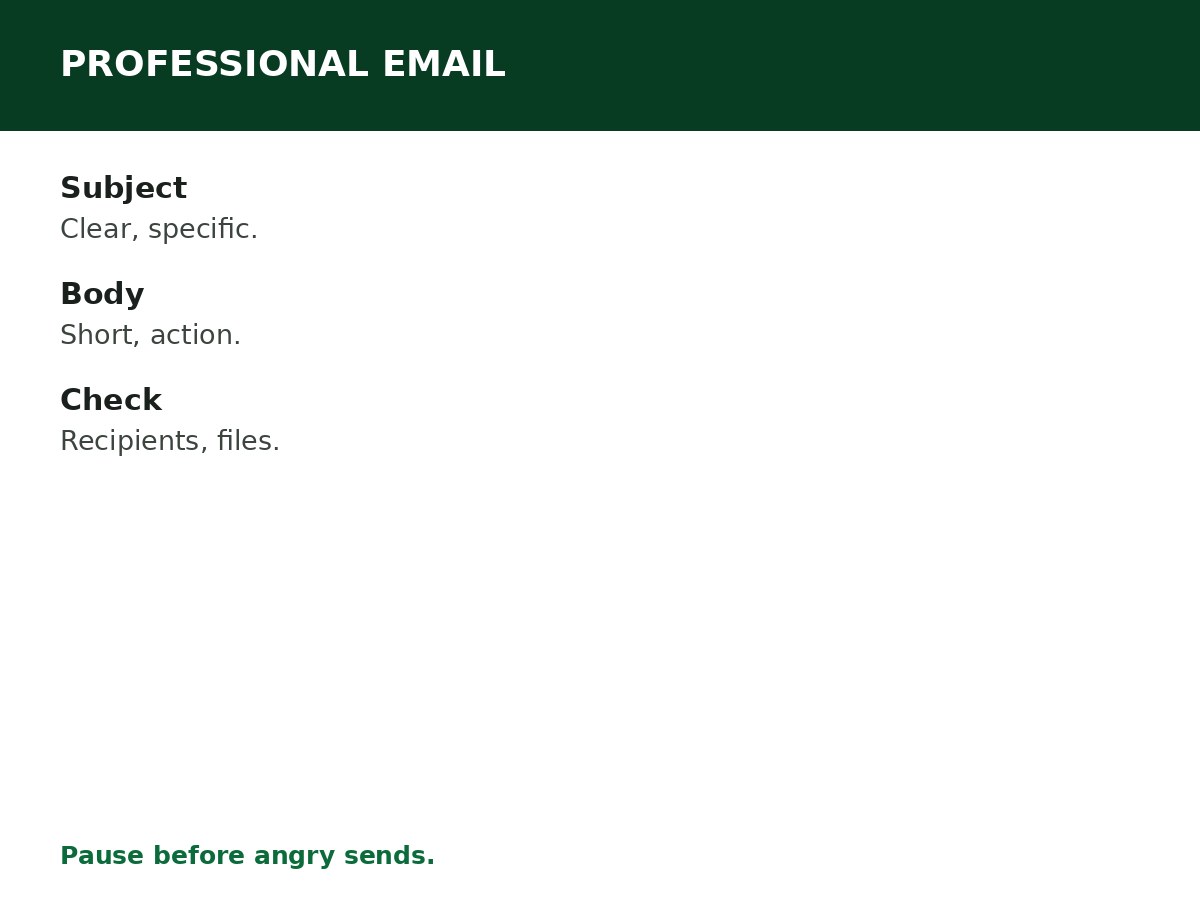
- Subject line — clear, specific subject, stating purpose, for recipient scanning, as workplaces state.
- Greeting — professional greeting, with recipient name, where known, for polite tone.
- Purpose first — purpose, stated in the first line, for recipient clarity, not buried in paragraphs.
- Body — concise paragraphs, with facts, requests, and deadlines, clearly stated, for action.
- Action and closing — requested action, deadline, thanks, and professional sign-off, with name and contact.
Professional email rules
- Clear subjects — subjects stating purpose (‘Leave Request: [Dates]’, ‘Meeting Notes: [Date]’), not vague subjects (‘Hello’, ‘Question’).
- Concise bodies — short paragraphs, bullet points where helpful, for recipient scanning, not walls of text.
- Polite tone — ‘please’, ‘thank you’, and professional language, as workplaces state, without slang or over-familiarity.
- Proofread before sending — spelling, grammar, recipients, and attachments, checked before sending, as errors cost credibility.
- Reply promptly — replies, within workplace timelines, as policies state, for professional conduct.
Professional email mistakes
- Vague subjects — vague subjects, hiding purpose, delaying recipient action, as workplaces state.
- Walls of text — long, unstructured emails, losing recipient attention, whatever the content.
- Wrong recipients and attachments — wrong recipients, missing attachments, and sensitive data sent carelessly, harming trust, as workplaces state.
- Emotional emails — angry or emotional emails, sent hastily, harming relationships, as workplaces state. Draft, pause, and review, before sending sensitive emails.
- Over-familiar tone — slang, emojis, and over-familiarity, with managers and clients, signalling unprofessionalism, as workplaces state.
Email types (brief)
- Requests — purpose, details, deadline, and thanks, concisely, for manager and colleague requests.
- Updates — status, progress, and next steps, clearly, for team updates.
- Follow-ups — polite reminders, referencing prior emails, for delayed responses, as workplaces state.
Related Guides & Next Steps
- How to Write a CV With No Work Experience
- How to Build a LinkedIn Profile as a Graduate
- How to Network as a Young Professional
- How to Write a Leave Request
Frequently asked questions
What is a professional email? A clear, concise, polite email — with clear subject, greeting, purpose first, concise body, and action with professional sign-off — so recipients can act on it quickly, not decode it.
What makes a good email subject line? Clear, specific subjects, stating purpose (‘Leave Request: [Dates]’, ‘Meeting Notes: [Date]’), not vague subjects (‘Hello’, ‘Question’).
How long should a professional email be? Concise — short paragraphs, bullet points where helpful, for recipient scanning, not walls of text, whatever the content.
Should I proofread emails before sending? Yes — spelling, grammar, recipients, and attachments, checked before sending, as errors cost credibility.
Should I send angry emails immediately? No — angry or emotional emails, sent hastily, harm relationships, as workplaces state. Draft, pause, and review, before sending sensitive emails.
Sources and last update
- No salary figure, vacancy count, or hiring outcome is asserted anywhere in this article, deliberately — employer career pages and reputable boards, checked at application time, govern.
- No company is named as currently hiring anywhere in this article, deliberately — hiring windows open and close; employer career pages govern.
- Scam patterns: fees for jobs, payment to personal accounts, guaranteed jobs or placements, and mentorship or networking schemes selling access are red flags — verify every employer and programme on official channels before applying or paying anything.
- No job, salary, placement, or hiring outcome is promised anywhere in this article.
Last updated: 24 October 2026. Guide — review every 6–12 months, and on every major hiring-platform change.

Written by Olaitan Ilori
Olaitan Ilori is the founder and lead researcher at CareerMedal. He provides verified, practical guides on Nigerian tertiary admissions (JAMB, CAPS, Post-UTME), NELFUND student finance, NYSC service-year survival, and early-career job placement.
View all guides by Olaitan Ilori →