
Writing a professional profile for your CV means writing 2–3 lines, at the top of your CV, summarising degree, skills, and target roles — so employers grasp your fit in seconds. This guide covers CV profiles specifically, distinct from the CV format guide (which covers overall layout) and the graduate CV guide (which covers graduate content).
What a professional profile is
- 2–3 lines, at the top — a short summary, below contact details, above education and experience, as employers state.
- Degree, skills, target roles — what you studied, what you can do, and what roles you seek, in one short paragraph.
- Not an objective — objectives (‘seeking a challenging position’) state what you want, not what you offer. Profiles state what you offer, for employer scanning.
How to write a strong profile
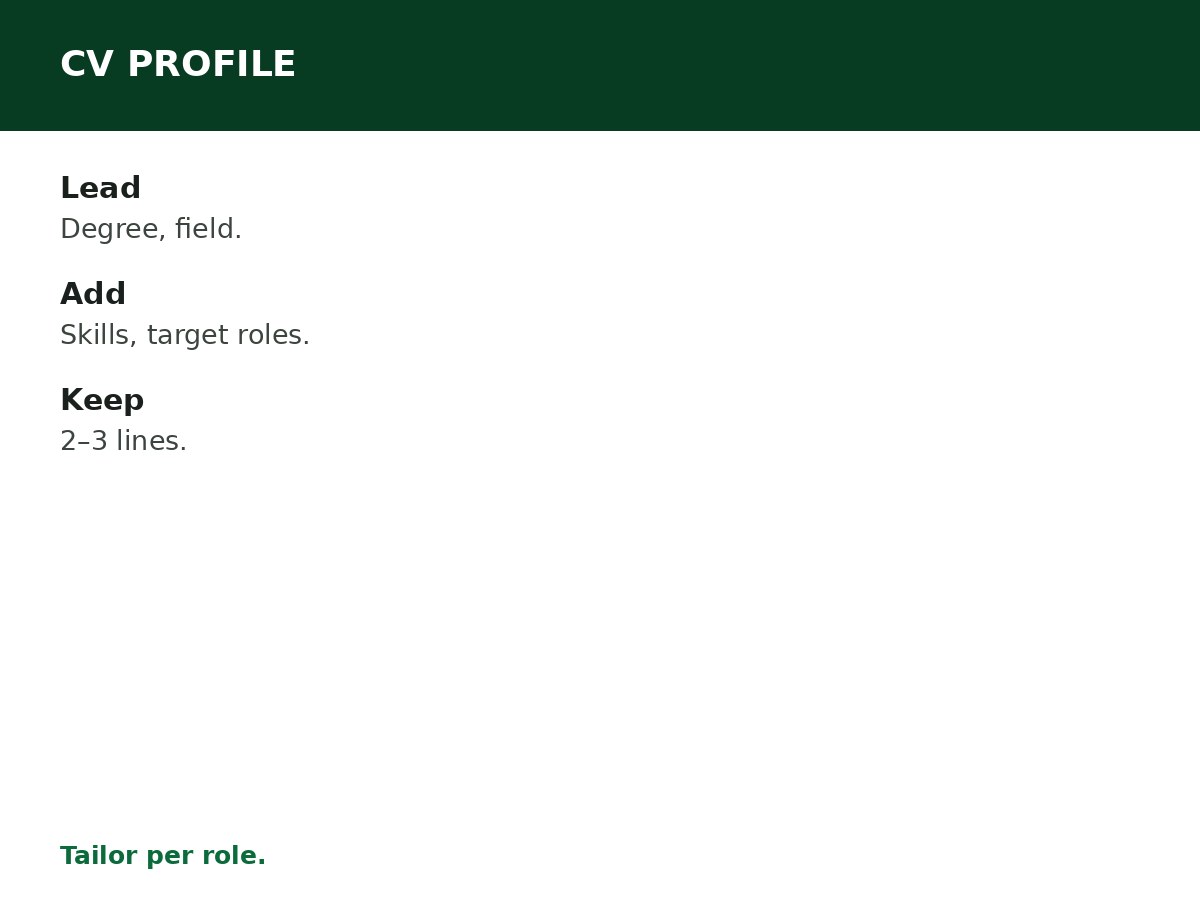
- Lead with degree and field — degree, field, and institution, where relevant, for employer context.
- Add skills with evidence — 2–3 skills, demonstrated by projects, internships, or coursework, not skill lists without proof.
- Name target roles — roles you seek, matching the application, for employer matching.
- Keep it short — 2–3 lines, not a paragraph. Long profiles lose employer attention, whatever the content.
Profile examples (original, adaptable)
- Graduate example — ‘Computer Science graduate, with web development projects and SIWES experience, seeking entry-level software roles, with strong HTML, CSS, and JavaScript skills.’
- No-experience example — ‘Business Administration graduate, with marketing projects and society leadership, seeking entry-level marketing roles, with strong content and social media skills.’
- Adapt, do not copy — examples are templates, not text to copy. Adapt wording to your degree, skills, and target roles, honestly, for every application.
Profile mistakes
- Generic objectives — ‘seeking a challenging position’ and similar phrases, stating wants, not offers, wasting profile space.
- Inflated claims — skills, experience, or qualifications, claimed without evidence, failing interviews and reference checks.
- Long profiles — paragraphs, instead of 2–3 lines, losing employer attention, whatever the content.
- Untailored profiles — one profile, for every role, losing to tailored profiles, matching each role’s requirements.
Related Guides & Next Steps
- How to Write a CV With No Work Experience
- How to List NYSC on Your CV
- How to List Internship Experience on Your CV
- Best CV Skills to Add as a Graduate
Frequently asked questions
What is a professional profile on a CV? 2–3 lines, at the top of your CV, summarising degree, skills, and target roles, so employers grasp your fit in seconds.
How long should a CV profile be? 2–3 lines, not a paragraph. Long profiles lose employer attention, whatever the content.
Should my CV profile state what I want? No — profiles state what you offer (degree, skills, target roles), not what you want. Objectives (‘seeking a challenging position’) waste profile space.
Can I copy a CV profile example? No, verbatim — examples are templates, not text to copy. Adapt wording to your degree, skills, and target roles, honestly, for every application.
Should I tailor my CV profile for each role? Yes — target roles and highlighted skills, matching each role’s requirements, for employer matching.
Sources and last update
- No salary figure, vacancy count, or hiring outcome is asserted anywhere in this article, deliberately — employer career pages and reputable boards, checked at application time, govern.
- No company is named as currently hiring anywhere in this article, deliberately — hiring windows open and close; employer career pages govern.
- Scam patterns: fees for jobs, payment to personal accounts, guaranteed jobs or shortlisting, and CV services selling fake experience are red flags — verify every employer on official channels before applying or paying anything.
- No job, shortlisting, or hiring outcome is promised anywhere in this article.
Last updated: 24 October 2026. Guide — review every 6–12 months, and on every major hiring-platform change.

Written by Olaitan Ilori
Olaitan Ilori is the founder and lead researcher at CareerMedal. He provides verified, practical guides on Nigerian tertiary admissions (JAMB, CAPS, Post-UTME), NELFUND student finance, NYSC service-year survival, and early-career job placement.
View all guides by Olaitan Ilori →