

Listing NYSC on your CV means stating your NYSC status — discharge, exemption, exclusion, or serving — clearly, honestly, and in the format employers expect. This guide covers NYSC entries specifically, distinct from the graduate CV guide (which covers graduate CVs broadly) and the NYSC cluster (which covers NYSC processes).
NYSC statuses, stated honestly
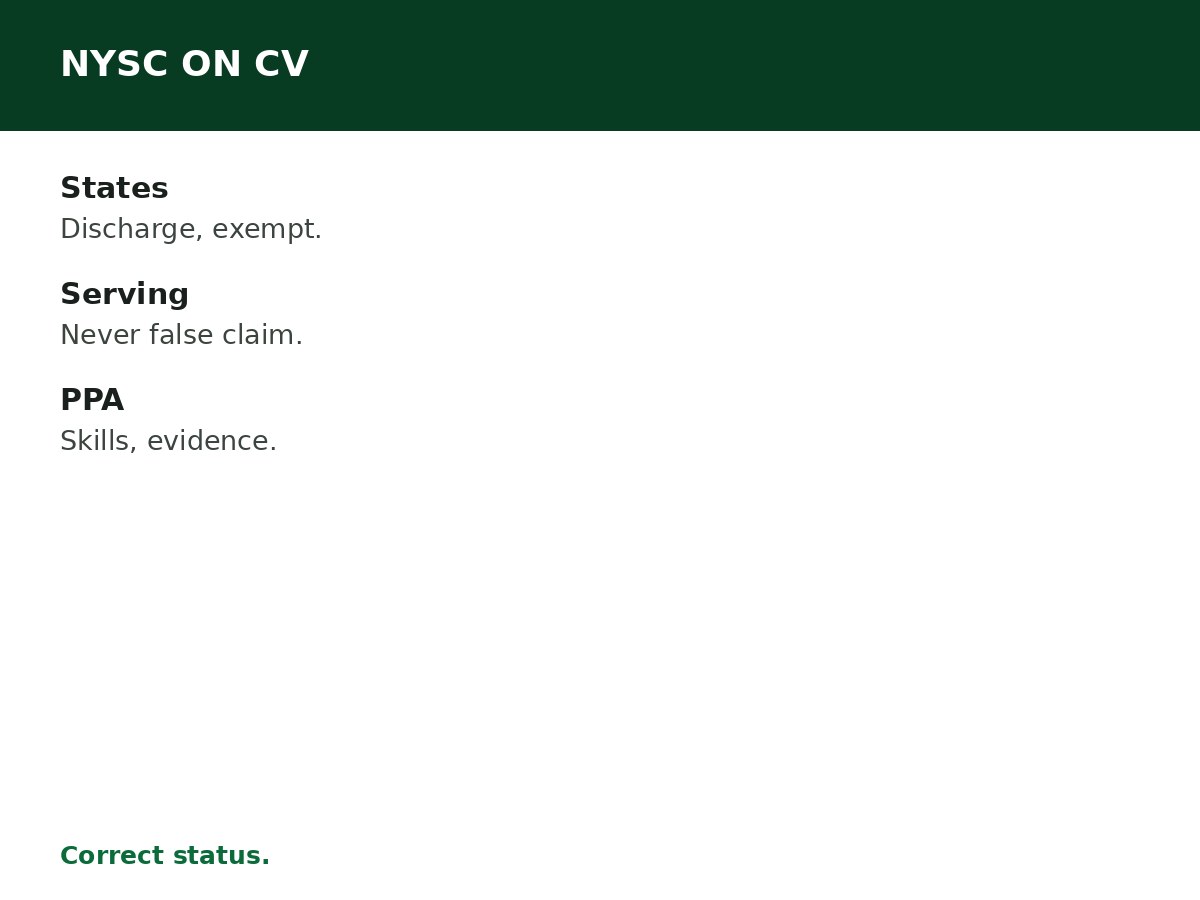
- Discharge — completed service, with discharge certificate, stated as ‘NYSC Discharge, [Year], [PPA, where relevant]’.
- Exemption — exempted from service (age 30+ at graduation, and other NYSC-stated grounds), with exemption certificate, stated as ‘NYSC Exemption, [Year]’.
- Exclusion — excluded from service (part-time, distance-learning, sandwich programmes), with exclusion letter, stated as ‘NYSC Exclusion, [Year]’.
- Serving — currently serving, stated as ‘NYSC, Currently Serving, [Year]–Present, [PPA]’, never claiming discharge before discharge.
Where NYSC goes on a CV
- After Education, before Experience — NYSC, as a distinct section or education sub-entry, after Education, before Experience, as the market states.
- One line, plus PPA where relevant — status, year, and PPA, in one line, with responsibilities and results, where PPA work is relevant to the role.
- Certificate numbers optional — certificate numbers included where the application requests them, not by default, for privacy.
NYSC mistakes
- Claiming discharge before discharge — serving corps members claiming discharge, or exemption, before it is issued, fail background checks. State current status honestly.
- Omitting NYSC entirely — omitting NYSC, where employers expect it, raises questions. State status clearly, whatever it is.
- Confusing exemption and exclusion — exemption (age 30+ and other NYSC-stated grounds) and exclusion (part-time/distance/sandwich) are distinct, as the NYSC cluster covers. State the correct status, with the correct document.
- Inflated PPA roles — inflated PPA titles, and invented responsibilities, are fraud, and reference checks expose them.
NYSC plus skills
- PPA skills with evidence — PPA responsibilities, skills, and results, where relevant to the role, highlighted, for employer matching.
- CDS and projects — CDS projects, and PPA projects, where relevant, demonstrating teamwork and initiative, for employer trust.
- References — PPA supervisors, where appropriate, as references, with permission, for employer checks.
Related Guides & Next Steps
- How to Write a CV With No Work Experience
- How to List Internship Experience on Your CV
- How to Write a Cover Letter in Nigeria
- How to Write a Professional Profile for Your CV
Frequently asked questions
How do I list NYSC on my CV? By stating status clearly (discharge, exemption, exclusion, or serving), with year and PPA where relevant, after Education, before Experience.
Should serving corps members claim discharge on CVs? No — serving corps members state current status honestly, never claiming discharge before discharge. False discharge claims fail background checks.
What is the difference between NYSC exemption and exclusion? Exemption covers age 30+ at graduation and other NYSC-stated grounds, with an exemption certificate. Exclusion covers part-time, distance-learning, and sandwich programmes, with an exclusion letter. They are distinct.
Should I include my NYSC certificate number on my CV? Certificate numbers are optional on CVs — include them where the application requests them, not by default, for privacy.
Where does NYSC go on a CV? After Education, before Experience, as a distinct section or education sub-entry, in one line (status, year, PPA where relevant).
Sources and last update
- No salary figure, vacancy count, or hiring outcome is asserted anywhere in this article, deliberately — employer career pages and reputable boards, checked at application time, govern.
- No company is named as currently hiring anywhere in this article, deliberately — hiring windows open and close; employer career pages govern.
- Scam patterns: fees for jobs, payment to personal accounts, guaranteed jobs or shortlisting, and CV services selling fake experience are red flags — verify every employer on official channels before applying or paying anything.
- No job, shortlisting, or hiring outcome is promised anywhere in this article.
Last updated: 24 October 2026. Guide — review every 6–12 months, and on every major hiring-platform change.

Written by Olaitan Ilori
Olaitan Ilori is the founder and lead researcher at CareerMedal. He provides verified, practical guides on Nigerian tertiary admissions (JAMB, CAPS, Post-UTME), NELFUND student finance, NYSC service-year survival, and early-career job placement.
View all guides by Olaitan Ilori →