
NELFUND repayment works like this: you repay exactly what you borrowed, at 0% interest, starting two years after NYSC, at 10% of your salary (deducted by your employer) if you are employed, or 10% of your monthly profit (remitted by you) if you are self-employed. If you are unemployed and without income, you notify NELFUND with a sworn affidavit every three months instead of paying.
There are no hidden charges in the reported terms, no interest accumulating while you study, and no guarantor to chase. The system is designed to collect slowly, from income, over time — which is why the rate is a percentage of income rather than a fixed monthly bill.
What you repay
- Exactly what was disbursed for you: institutional charges paid to your institution, plus upkeep paid to your bank account, across every session you borrowed. At 0% interest, your repayment total equals your borrowing total.
- Not a penny of interest. NELFUND’s terms are consistently reported as 0% interest, with no processing fees, management fees, or penalties for timely repayment in the guides reviewed.
- Early repayment is allowed, as reported in the guides — you can clear the loan faster than the 10% schedule if you choose to. Confirm the early-repayment process on the portal, as the guides do not publish a single step-by-step for it.
How repayment is collected, by employment status
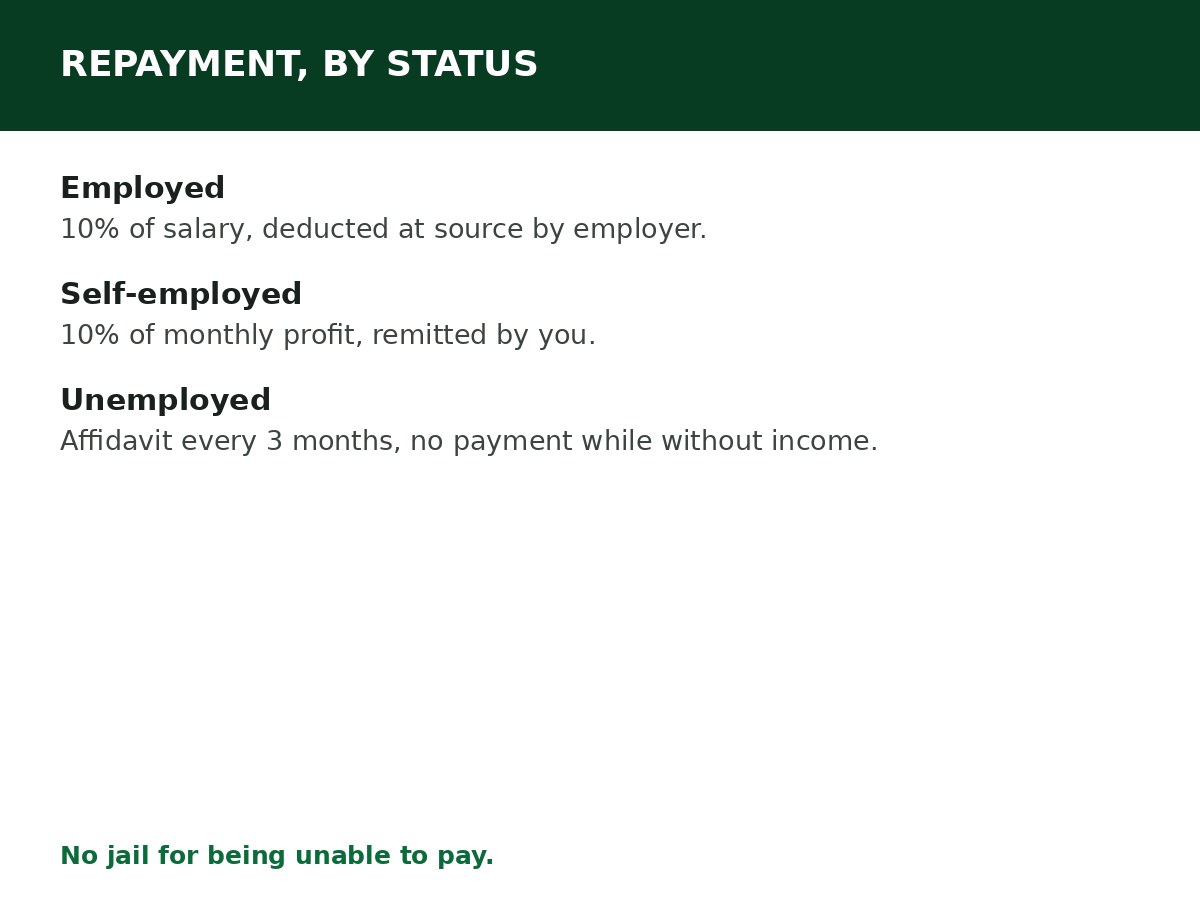
If you are in formal employment: Your employer deducts 10% of your salary at source and remits it to NELFUND monthly, similar to PAYE tax. NELFUND’s Managing Director has explained the mechanism: your employer checks the NELFUND database using your name and NIN, confirms your loan status with NELFUND, deducts 10%, and remits it. For formally employed beneficiaries, the obligation to deduct falls primarily on the employer, not on you personally — but NELFUND can pursue the employer if deductions are not remitted. Your job is to keep your employment details updated with NELFUND, so the deduction is applied correctly.
If you are self-employed: You remit 10% of your total monthly profit to NELFUND yourself. Guides report you must submit information about your business — name, address, registration documents if registered, and banker details — within 60 days of becoming self-employed, and notify NELFUND of your change in status. NELFUND is reported to be developing digital remittance channels for self-employed beneficiaries; confirm the current remittance route on the portal.
If you are unemployed and without income: You do not pay, but you must notify NELFUND and provide the required documentation — a sworn court affidavit, repeated every three months for as long as you remain unable to gain employment. Retain copies of every affidavit and submission. When you secure employment, update your employment details with NELFUND so the 10% deduction arrangement can begin. When you become self-employed, notify NELFUND and switch to the self-employed remittance arrangement.
The GSI mandate you accepted at application
When you applied, you accepted the Global Standing Instruction (GSI) mandate as part of the loan terms. In practical terms, that is the consent that allows recovery through your accounts and deductions as described in the agreement. Understand what recovery consent means before you agree — and read the current agreement presented in your account at application, rather than relying on a blog summary of it. One guide notes the public terms page still mentions the 2023 Act while the 2024 Act replaced it, so the agreement in your account is the version that governs you, and you should ask NELFUND to clarify any conflicting wording.
What happens if you do not pay
- If you are employed and deductions are not happening: the obligation falls on your employer to deduct and remit, and NELFUND can pursue the employer. Check your payslip for the deduction, and update your employment details with NELFUND if you changed jobs.
- If you are self-employed and do not remit: you are personally responsible for remittance, and non-remittance is a breach of the loan terms.
- If you are unemployed and do not notify: you lose the recorded protection of the affidavit process. The protection for unemployed beneficiaries depends on the notification — it is not automatic.
- False statements are a separate, serious matter. Submitting a false statement to NELFUND about your employment status is reported as an offence attracting imprisonment for up to three years on conviction. That is about dishonesty, not about being unable to pay.
Related Guides & Next Steps
- How Much Can You Get From NELFUND?
- When Does NELFUND Repayment Start?
- NELFUND Student Loan Requirements
- NELFUND Student Loan 2026/2027: Complete Guide
- NELFUND Frequently Asked Questions
Frequently asked questions
How much of my salary will NELFUND take? 10%, deducted at source by your employer and remitted to NELFUND monthly, once repayment begins (two years after NYSC).
I am self-employed. How do I pay? Remit 10% of your total monthly profit to NELFUND, after notifying NELFUND of your self-employment and submitting your business details (reported within 60 days of becoming self-employed). Confirm the current remittance channel on the portal.
Can I pay off my NELFUND loan early? Early repayment is reported as allowed. Confirm the process on the portal.
What if I change jobs? Update your employment details with NELFUND, so deductions continue correctly with your new employer. Repayment arrangements change when your employment status changes.
Will NELFUND jail me if I cannot pay? No. NELFUND has debunked viral claims of life imprisonment for unpaid loans as fake news. The actual position: no repayment is required while you are genuinely unemployed and without income, provided you notify NELFUND with a sworn affidavit every three months. False statements, not inability to pay, attract criminal liability.
Sources and last update
- Repayment mechanics (0%, 10% salary at source via employer NIN check, 10% monthly profit self-employed, 60-day business-info window, affidavit every three months, early repayment allowed, GSI consent), cross-checked across NELFUND’s own statements as reported by Punch, Channels TV, Nairametrics, and NELFUND guides.
- Life-imprisonment myth explicitly corrected per NELFUND’s own debunking.
Last updated: 24 October 2026. Guide — review every session and on every NELFUND guideline update.

Written by Olaitan Ilori
Olaitan Ilori is the founder and lead researcher at CareerMedal. He provides verified, practical guides on Nigerian tertiary admissions (JAMB, CAPS, Post-UTME), NELFUND student finance, NYSC service-year survival, and early-career job placement.
View all guides by Olaitan Ilori →