

Courses with high admission competition are those where applicant numbers vastly exceed available places, so departmental cut-offs rise well above institution minimums and small score differences decide admission. This guide explains how high competition works — what drives it, how it affects cut-offs, and how to apply strategically — rather than simply listing competitive courses (see the most-competitive-courses guide for the list). Understanding the mechanism matters more than memorising the list, because competition shifts by institution and session.
High competition is a rationing problem, not a quality judgment. Places are fixed (by teaching-hospital beds, studio seats, laboratory capacity, or faculty size); applicants are not. When applicants exceed places by a large margin, the departmental cut-off rises until applicants equal places — and that cut-off is what you must meet.
What drives high competition
- Prestige and career perception. Medicine, law, and nursing attract applicants on prestige and perceived security, regardless of training length or difficulty.
- Professional licensing. Courses leading to a licence (MDCN, NMCN, PCN, Bar, COREN) attract applicants because licensing restricts supply and protects demand — which, circularly, raises competition for entry.
- Capacity limits. Teaching hospitals (medicine, nursing, pharmacy), studios (architecture, mass communication), and laboratories (sciences, engineering) cap places physically. A course with 50 studio seats cannot admit 500 applicants, however strong they are.
- Location concentration. Institutions in Lagos, Ibadan, Ile-Ife, Nsukka, Zaria, and other major university cities attract disproportionate applications, raising their cut-offs above less applied-to institutions offering the same course.
- Session variation. Applicant numbers shift every session with JAMB registration totals, policy changes, and economic conditions — so a course’s competitiveness at an institution in one session does not guarantee the same competitiveness the next.
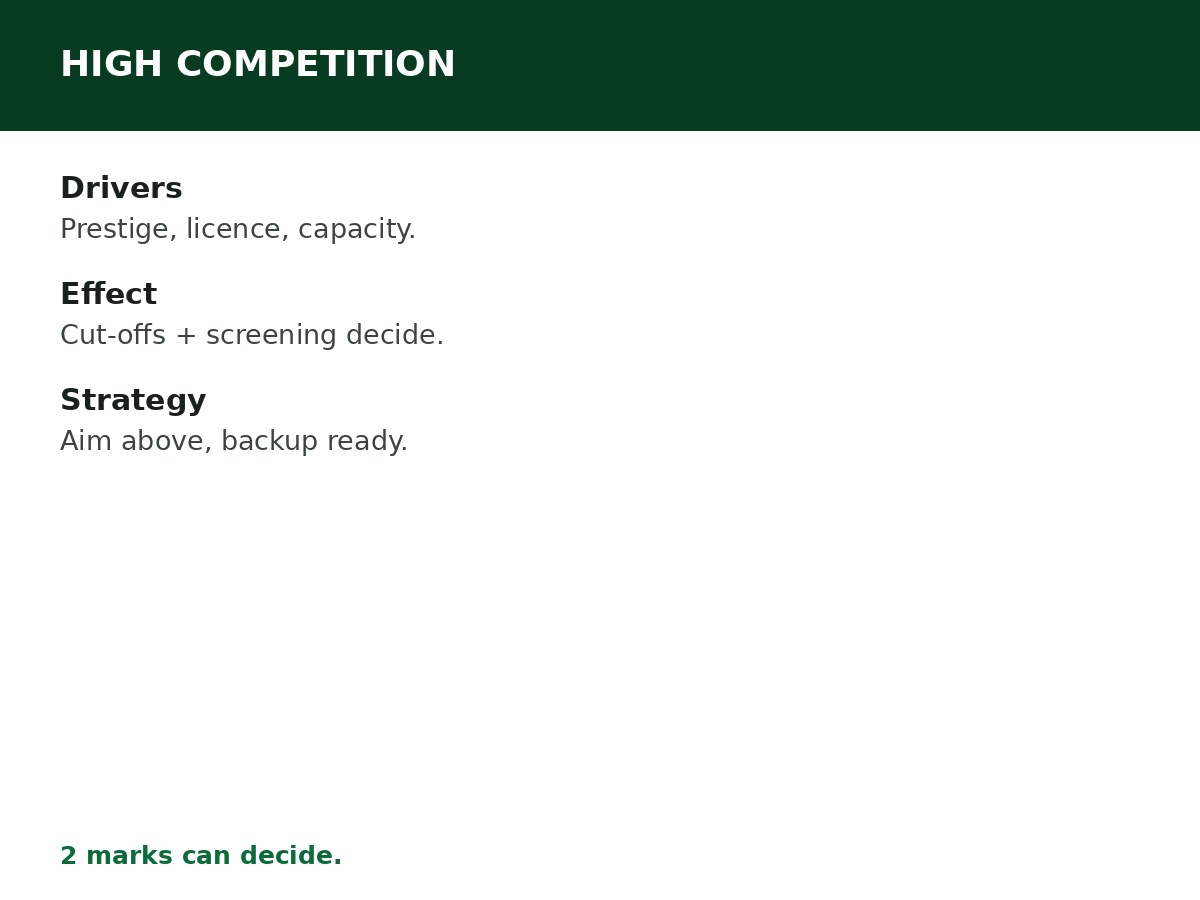
How high competition affects you
- Cut-offs rise above minimums. The institution minimum (for example, 150 or 200) is the floor for screening consideration; the departmental cut-off for a high-competition course runs well above it, and moves every session. Aim above the previous session’s departmental cut-off, not above the institution minimum.
- Screening performance matters more. When many candidates meet the UTME cut-off, screening (exam score, O’Level aggregate, or physical verification, as the institution runs it) becomes the differentiator. A strong UTME score with weak screening loses to a moderate UTME score with strong screening.
- Small differences decide. In high-competition queues, 2–5 marks can separate admission from waiting-list from rejection. O’Level grades (for screening-only institutions) and screening scores therefore matter at a granularity that low-competition courses do not require.
- Backup choices matter most. A high-competition first choice without a backup (less competitive course, related course, or less competitive institution) is a plan to wait a year. Every high-competition application needs a fallback.
Applying strategically under high competition
- Aim above the previous departmental cut-off, not above the institution minimum. The previous cut-off is a guide, not a guarantee — aim above it by a margin.
- Choose a backup in the same field (related course, same institution) or the same course at a less competitive institution. A backup is not a compromise — it is a second route to the same career.
- Maximise screening, not just UTME. Prepare for the institution’s screening format (exam revision, document accuracy, or physical readiness, as applicable) with the same seriousness as UTME preparation.
- Verify O’Level upload and name consistency early. Eligibility failures (unuploaded results, name mismatches) remove candidates before ranking — and in high-competition queues, removed candidates are not replaced by appeals.
- Consider the less-competitive route honestly. A less competitive course at a strong institution, with a later transfer option (where the institution permits it), is a legitimate strategy — but check transfer rules before enrolling on that assumption.
Related Guides & Next Steps
- Admission Requirements for Nigerian Universities
- How to Choose a Course After JAMB
- How University Admission Works in Nigeria
- Best Universities to Study Medicine in Nigeria
- Courses You Can Study With Literature-in-English
Frequently asked questions
What causes high admission competition? Applicant numbers vastly exceeding available places, driven by prestige, licensing, capacity limits (hospitals, studios, laboratories), location concentration, and session variation.
How do I know if a course is highly competitive? By its departmental cut-off relative to the institution minimum, and by applicant numbers where published. A course whose departmental cut-off runs well above the institution minimum, consistently, is highly competitive at that institution.
Can I overcome high competition with a high UTME score alone? Partly — a high UTME score clears the cut-off, but screening performance, O’Level grades (where applicable), and available places also decide. A high UTME score with weak screening loses in high-competition queues.
Should I avoid high-competition courses entirely? No — but apply strategically: a high-competition first choice, plus a backup, plus a clear plan if neither lands. Avoiding high-competition courses entirely means avoiding medicine, law, nursing, and other strong careers for no reason.
Does high competition mean the course is better? No — competition measures demand (applicants vs places), not teaching quality, facilities, or career outcomes.
Sources and last update
- Competition mechanism (capacity limits, prestige, licensing, location, session variation; cut-off and screening effects; strategic application) from JAMB admission process and the cluster’s admission and screening guides, stated qualitatively — no applicant-to-place ratio is asserted, deliberately, as ratios vary by institution and session.
- Course list cross-referenced to the most-competitive and less-competitive guides — those guides govern the lists, this guide governs the mechanism.
Last updated: 24 October 2026. Guide — review every 3–6 months and on every admission session.

Written by Olaitan Ilori
Olaitan Ilori is the founder and lead researcher at CareerMedal. He provides verified, practical guides on Nigerian tertiary admissions (JAMB, CAPS, Post-UTME), NELFUND student finance, NYSC service-year survival, and early-career job placement.
View all guides by Olaitan Ilori →