
There is no official ranking of state universities in Nigeria. The universities below are grouped by strength — faculty depth, professional schools, programme breadth, and stability — not ranked in order. State universities share one structural feature: their charges are set with state approval, so they vary more by state than federal charges do (no figure is quoted here — charges vary by course and session, and the official fee schedule for the session governs). All state universities are public, so their students may be covered by NELFUND where the portal lists the institution.
Universities with the strongest state profiles
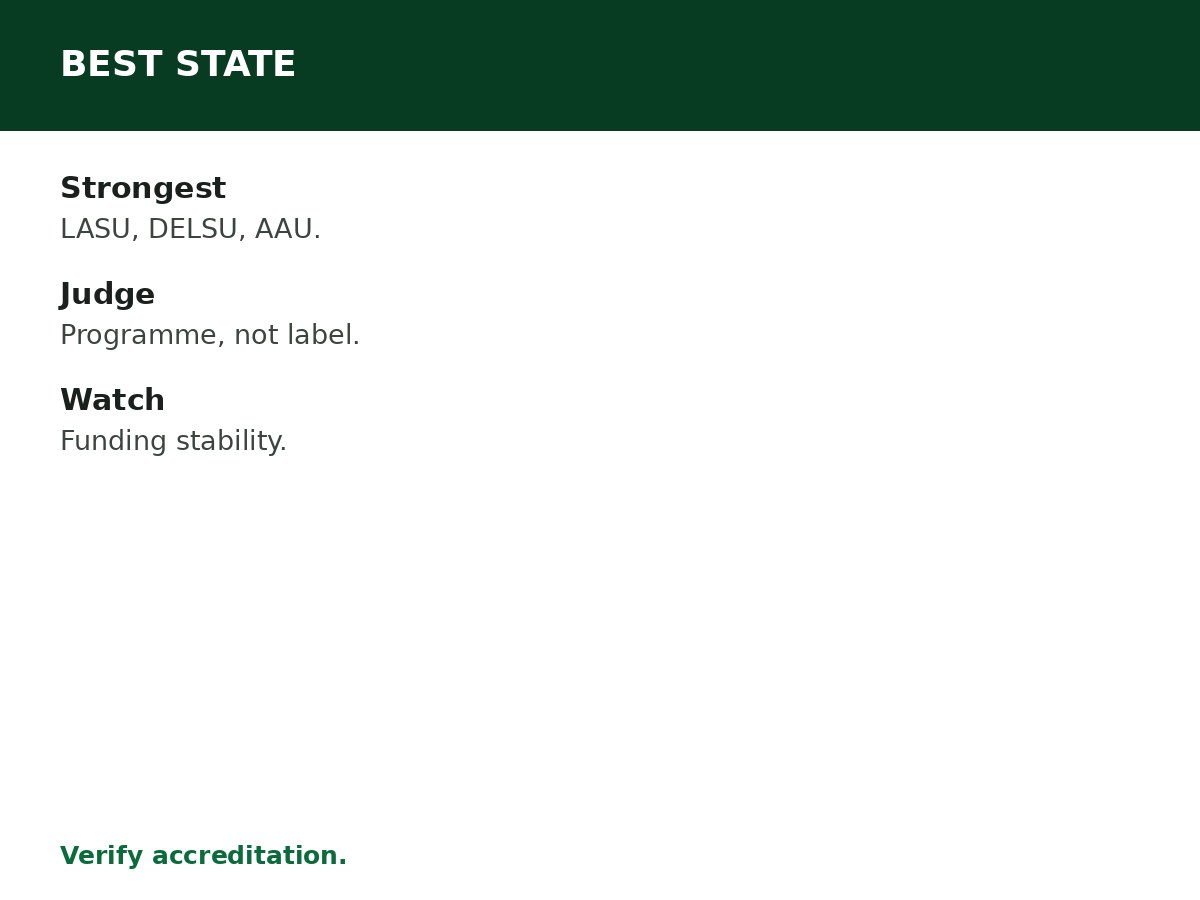
- Lagos State University (LASU) — large faculty, strong professional schools (law, medicine, management), Lagos industry links. Ojo, Lagos State.
- Delta State University (DELSU) — strong professional schools, university-town location. Abraka, Delta State.
- Ambrose Alli University (AAU) — strong professional schools, university-town location. Ekpoma, Edo State.
- Olabisi Onabanjo University (OOU) — established state university, broad programme range. Ago-Iwoye, Ogun State.
- Enugu State University of Science and Technology (ESUT) — technology and professional focus. Enugu, Enugu State.
- Imo State University (IMSU) — large faculty, broad programme range. Owerri, Imo State.
- Ekiti State University (EKSU) — established state university, broad programme range. Ado-Ekiti, Ekiti State.
- Nasarawa State University, Keffi (NSUK) — growing faculty, Abuja-adjacent location. Keffi, Nasarawa State.
- Benue State University (BSU) — established state university, broad programme range. Makurdi, Benue State.
- Ebonyi State University (EBSU) — established state university, broad programme range. Abakaliki, Ebonyi State.
What to look for in a state university
- Programme accreditation: confirm NUC accreditation for your specific programme, for the session — a university’s general standing does not accredit its programmes.
- Professional-body recognition: for licensed courses, the relevant body must also recognise the programme.
- State funding stability: state universities depend on state funding, which varies by state and by administration — a state university’s calendar and facilities can shift with state budgets. Check recent calendar stability before choosing.
- Departmental cut-off: state universities’ competitive courses run above the institution minimum, but generally below the top federal band — DELSU and AAU were reported in the 150–160 range, LASU around 195 (Education 185), all as reported, per-session verification directed. Aim above the previous session’s departmental cut-off for your course.
- Full-session cost: school charges (state-set, varying by state) + accommodation + feeding + transport + materials. A state university in an expensive city can cost more overall than a federal university in a cheaper town — budget the full session, and check NELFUND portal coverage for the session.
State vs federal vs private: the structural difference
State universities are state-funded, which makes their charges and stability vary by state — some states fund generously and steadily, others do not. Federal universities are generally cheaper on charges; private universities charge more but often run more stable calendars and smaller classes. Judge the programme (accreditation, faculty, facilities, cut-off, full-session cost, calendar stability), not the ownership label alone.
Related Guides & Next Steps
- Admission Requirements for Nigerian Universities
- How to Choose a University in Nigeria
- How University Admission Works in Nigeria
- University of Lagos (UNILAG) Courses, Requirements and School Fees
- Best Private Universities in Nigeria
Frequently asked questions
Which state university is best in Nigeria? There is no official ranking. LASU, DELSU, and AAU are the most consistently mentioned, on faculty depth and professional schools — but “best” for you depends on your course, your score, your budget, and the programme’s accreditation. Verify accreditation for the session.
Are state universities cheaper than private universities? Generally yes on school charges, as public institutions — but no figure is quoted here, because charges vary by state, course, and session. Check the official fee schedule for your course, and budget the full session.
Do state universities accept NELFUND? As public universities, state universities’ students may be covered where the NELFUND portal lists the institution for the session — check the portal list. Institutional charges are paid directly to the institution; upkeep, where requested, goes to the student’s bank account.
Is a state university degree worse than a federal degree? Not automatically — employers judge the degree, the institution, your skills, and your experience, not the ownership label. A strong programme at a state university outperforms a weak programme at a federal university.
How do I choose among state universities? By your course first (accreditation, faculty, facilities), then departmental cut-off vs your score, then full-session cost, then calendar and funding stability, then location — in that order.
Sources and last update
- Institution groupings from departmental-history and professional-school reporting, grouped by strength, NOT ranked. Accreditation (NUC) and professional-body recognition from programme guidance as reported, with per-session verification directed.
- Cut-off context from the cluster’s cut-off guides (Batches 11, 14, and 20), summarised here — the cut-off guides govern where they differ in detail.
- No fee figure is asserted anywhere in this article, deliberately.
Last updated: 24 October 2026. Guide — review every 3–6 months and on every admission session.

Written by Olaitan Ilori
Olaitan Ilori is the founder and lead researcher at CareerMedal. He provides verified, practical guides on Nigerian tertiary admissions (JAMB, CAPS, Post-UTME), NELFUND student finance, NYSC service-year survival, and early-career job placement.
View all guides by Olaitan Ilori →