
There is no official ranking of private universities in Nigeria. The universities below are grouped by strength — faculty depth, professional schools, programme breadth, calendar stability, and facilities — not ranked in order. Private universities share two structural features: their charges are higher than public universities (no figure is quoted here — charges vary by institution, course, and session, and the official fee schedule for the session governs), and their students are NOT covered by the NELFUND loan, which is for public institutions only. That second fact changes the affordability maths entirely, and it is stated first because it is the most common misunderstanding about private universities.
Universities with the strongest private profiles
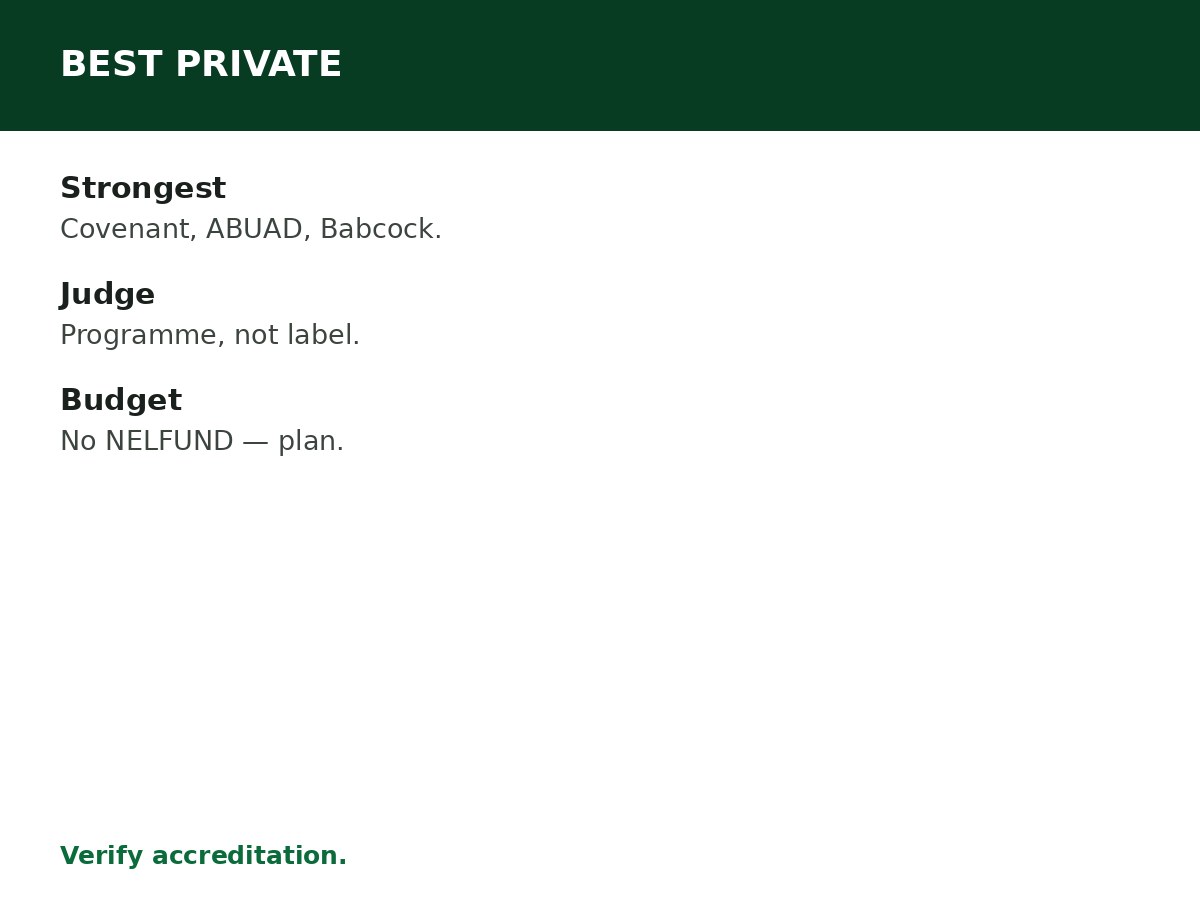
- Covenant University — strong engineering, computing, and management programmes, stable calendar, modern facilities. Ota, Ogun State.
- Afe Babalola University (ABUAD) — strong professional schools (law, medicine, engineering), large teaching hospital. Ado-Ekiti, Ekiti State.
- Babcock University — strong professional schools (medicine, law, management), long-established private institution. Ilishan-Remo, Ogun State.
- Bowen University — strong professional schools, established faith-based institution. Iwo, Osun State.
- Landmark University — agriculture and engineering focus, modern facilities. Omu-Aran, Kwara State.
- Pan-Atlantic University — strong management and media programmes (Lagos Business School). Lekki, Lagos State.
- Igbinedion University — Nigeria’s first licensed private university, broad programme range. Okada, Edo State.
- Lead City University — broad programme range, Ibadan location. Ibadan, Oyo State.
- American University of Nigeria — American-style curriculum, Yola location. Yola, Adamawa State.
- Nile University of Nigeria — broad programme range, Abuja location. Abuja, Federal Capital Territory.
What to look for in a private university
- Programme accreditation: confirm NUC accreditation for your specific programme, for the session — a university’s general standing does not accredit its programmes.
- Professional-body recognition: for licensed courses (medicine, nursing, pharmacy, law, engineering, architecture, accounting), the relevant body must also recognise the programme.
- Calendar stability: private universities’ strongest practical advantage — stable calendars mean a 4-year course runs 4 years, which caps total cost even where session charges are higher.
- Full-session cost: school charges + accommodation + feeding + transport + materials. Private charges are higher, but a stable calendar and an included-hostel package can narrow the total gap vs a public university with a disrupted calendar and high off-campus rents — compare totals, not charges alone.
- NELFUND does not apply: as private institutions, these universities are outside the NELFUND loan. Budget from family funds, scholarships, and payment plans — not from an assumed loan.
Private vs public: the structural difference
Private universities charge more, but typically offer more stable calendars, smaller classes, and better-maintained facilities. Public universities charge less, but calendars and facilities vary with government funding. Judge the programme (accreditation, faculty, facilities, cut-off, full-session cost, calendar stability), not the ownership label alone.
Related Guides & Next Steps
- Admission Requirements for Nigerian Universities
- How to Choose a University in Nigeria
- How University Admission Works in Nigeria
- University of Lagos (UNILAG) Courses, Requirements and School Fees
- Cheapest Federal Universities in Nigeria
Frequently asked questions
Which private university is best in Nigeria? There is no official ranking. Covenant, Afe Babalola, and Babcock are the most consistently mentioned, on faculty depth, professional schools, and facilities — but ‘best’ for you depends on your course, your budget, and the programme’s accreditation. Verify accreditation for the session.
Do private universities accept NELFUND? No. The NELFUND loan is for public institutions only. Private university students cannot access it — budget from family funds, scholarships, and payment plans instead.
Are private universities cheaper than public universities? Generally no on school charges — private charges are higher. But a stable calendar can cap total cost: a 4-year course that runs 4 years costs less overall than a 4-year course stretched by closures. Compare full-session totals, not charges alone.
Is a private university degree worse than a public degree? Not automatically — employers judge the degree, the institution, your skills, and your experience, not the ownership label. A strong programme at a private university outperforms a weak programme at a public university.
How do I choose among private universities? By your course first (accreditation, faculty, facilities), then full-session cost and payment plans, then calendar stability, then location — in that order.
Sources and last update
- Institution groupings from departmental-history, professional-school, and programme reporting, grouped by strength, NOT ranked. Accreditation (NUC) and professional-body recognition from programme guidance as reported, with per-session verification directed.
- Cut-off context from the cluster’s cut-off guides (Batches 11, 14, 20, and 21), summarised here — the cut-off guides govern where they differ in detail.
- No fee figure, no salary figure, and no placement or employment figure is asserted anywhere in this article, deliberately.
Last updated: 24 October 2026. Guide — review every 3–6 months and on every admission session.

Written by Olaitan Ilori
Olaitan Ilori is the founder and lead researcher at CareerMedal. He provides verified, practical guides on Nigerian tertiary admissions (JAMB, CAPS, Post-UTME), NELFUND student finance, NYSC service-year survival, and early-career job placement.
View all guides by Olaitan Ilori →