

No fee figure is asserted anywhere in this article, deliberately — so this guide does not rank universities by price. What it does is give you the honest structure of university charges in Nigeria, tier by tier, and the method for finding your cheapest option. Anyone ranking universities by school fees without quoting a figure is guessing; anyone quoting a figure from a previous session, a different course, or a different faculty is misleading you.
The three tiers, in order
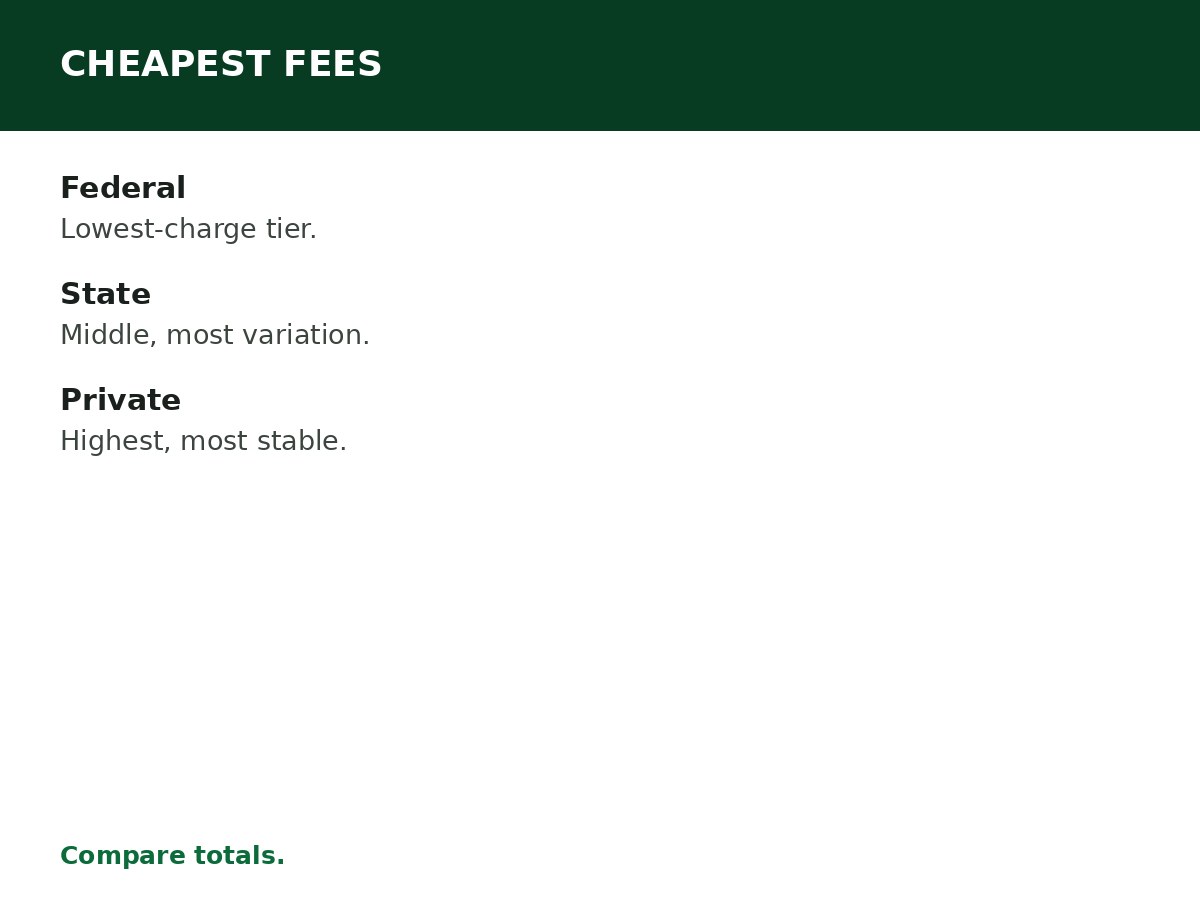
- Federal universities — the lowest-charge tier. Federally funded, so school charges are generally lowest. Examples: UI, UNILAG, OAU, UNN, ABU, UNIBEN, UNILORIN, BUK, UNIZIK, FUTA, FUTO, FUNAAB, UNIPORT, UNICAL, UNIABUJA.
- State universities — the middle tier, with the most variation. Charges set with state approval, so they vary by state, course, and session. Examples: LASU, DELSU, AAU, OOU, ESUT, IMSU, EKSU, NSUK, BSU, EBSU.
- Private universities — the highest-charge tier. No government funding, so charges are highest — but calendars are typically most stable, and scholarships and payment plans are most common. Examples: Covenant, Afe Babalola, Babcock, Bowen, Landmark, Pan-Atlantic, Igbinedion, Lead City.
Within each tier, charges still vary by course and session — the tier is a guide, not a figure.
Why school charges alone do not tell you the cheapest university
The cheapest university for you is the one whose full-session total is lowest: school charges + accommodation + feeding + transport + materials, minus any NELFUND coverage (public universities only, where the portal lists the institution for the session). A federal university in Lagos can cost more overall than a state university in a cheap town. A private university with a scholarship and a stable calendar can cost less overall than a public university with a disrupted calendar and high off-campus rents. Compare totals, not charges alone.
The method, in order
- Shortlist universities offering your course (accredited, for the session).
- Get each one’s official fee schedule for the session — exact course and level.
- Add accommodation (hostel vs off-campus in that town), feeding, transport, and materials.
- Subtract confirmed scholarships (in writing) and NELFUND coverage (public only, portal list for the session).
- Compare totals. That total — not any blog’s ranking — is your cheapest university.
Related Guides & Next Steps
- Admission Requirements for Nigerian Universities
- How to Choose a University in Nigeria
- How University Admission Works in Nigeria
- University of Lagos (UNILAG) Courses, Requirements and School Fees
- Universities With Affordable Accommodation
Frequently asked questions
Which university has the cheapest school fees in Nigeria? No figure is asserted here, so no ranking is given. Federal universities are the lowest-charge tier structurally — within that tier, compare official fee schedules for your exact course and level, plus living costs, to find your cheapest option.
Are federal universities always cheapest overall? Usually, but not always — a federal university in an expensive city can cost more overall than a state university in a cheap town. Compare full-session totals, not charges alone.
Do scholarships change the cheapest university? Yes — a confirmed scholarship (in writing) at a private university can move it below a public university’s total. Unconfirmed scholarships change nothing; get terms in writing.
Does NELFUND make public universities cheaper? NELFUND covers institutional charges (paid directly to the institution) and, where requested, upkeep — for public universities where the portal lists the institution for the session. It does not cover private universities. Check the portal list for the session.
How often do school fees change? Every session, potentially — charges vary by course, faculty, and session. Never budget from a previous session’s figure; get the current session’s official fee schedule.
Sources and last update
- Institution groupings from departmental-history, professional-school, and programme reporting, grouped by strength, NOT ranked. Accreditation (NUC) and professional-body recognition from programme guidance as reported, with per-session verification directed.
- Cut-off context from the cluster’s cut-off guides (Batches 11, 14, 20, and 21), summarised here — the cut-off guides govern where they differ in detail.
- No fee figure, no salary figure, and no placement or employment figure is asserted anywhere in this article, deliberately.
Last updated: 24 October 2026. Guide — review every 3–6 months and on every admission session.

Written by Olaitan Ilori
Olaitan Ilori is the founder and lead researcher at CareerMedal. He provides verified, practical guides on Nigerian tertiary admissions (JAMB, CAPS, Post-UTME), NELFUND student finance, NYSC service-year survival, and early-career job placement.
View all guides by Olaitan Ilori →