
Professional courses worth studying in Nigeria are those whose degrees lead to a recognised professional qualification — a licence, charter, or registration that restricts practice to qualified practitioners and therefore protects demand. The courses below are those most consistently associated with strong professional routes, grouped by profession, with the qualification that follows the degree stated for each. A degree alone is not the professional qualification — the examinations and experience that follow it are.
“Professional course” is often used loosely for any course with good prospects. This guide uses it strictly: a course is professional here only if a recognised body licenses, charters, or registers its practitioners.
Health professions
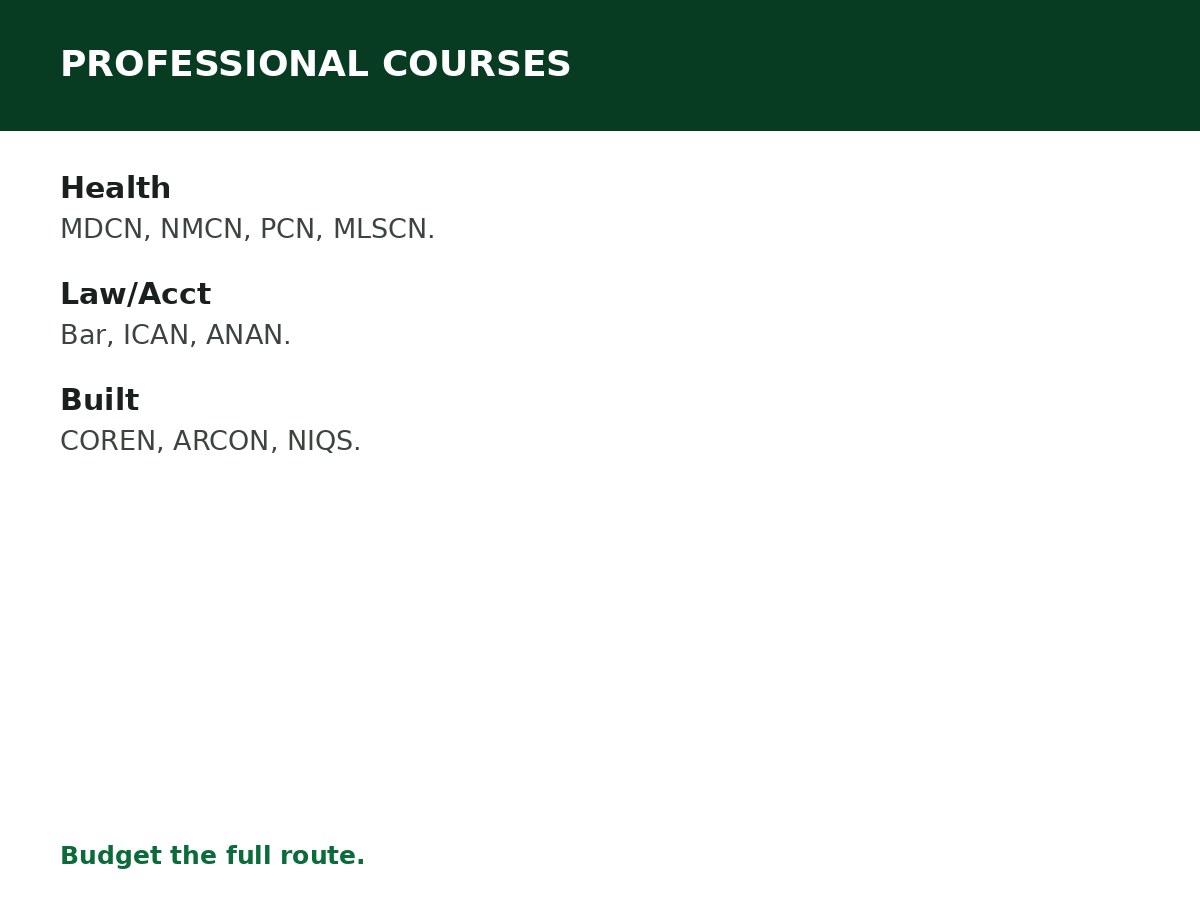
- Medicine and Surgery (MBBS) → MDCN registration, housemanship, residency. The most structured professional route in Nigeria.
- Nursing Science (B.NSc) → NMCN licensing, internship. Structured route, with international mobility (destination licensing additional).
- Pharmacy (B.Pharm/PharmD) → PCN registration, internship. Structured route, with industry, hospital, and regulatory paths.
- Medical Laboratory Science → MLSCN registration, internship. Professional clinical-laboratory route, distinct from microbiology.
- Physiotherapy, Radiography, Optometry, Dentistry → respective professional registration (as the body requires), internship where applicable.
Law and accounting
- Law (LLB) → Nigerian Law School, Call to the Bar. The degree qualifies you for Law School; Call follows successful completion there.
- Accounting → ICAN (ACA), ANAN, or CITN professional examinations, with exemptions as the programme’s accreditation arrangements provide. The degree opens the route; the examinations complete it.
Engineering and architecture
- Engineering (all disciplines) → COREN graduate registration, progressing to full registration with experience. Per-discipline recognition — check your specific discipline.
- Architecture → ARCON registration, following the professional MSc and practical experience. The undergraduate degree alone does not register you.
Other recognised professions
- Surveying (Quantity Surveying, Land Surveying) → respective professional registration (NIQS, NIS — as the body requires), with experience.
- Estate Management → NIESV registration, with experience.
- Teaching (Education degrees) → Teachers Registration Council of Nigeria (TRCN) registration. Education degrees lead to a recognised teaching profession, with TRCN as the registering body.
- Social Work, Psychology (professional routes) → respective professional recognition where applicable — check the body for your specific programme, as recognition varies.
How to choose a professional course
- Confirm the professional body and route before choosing. A course whose professional body you cannot name, and whose examinations you cannot describe, is not a professional course you understand — and understanding the route matters more than the degree.
- Budget the full route, not just the degree. Professional examinations, internships, and experience add years and costs beyond the degree. Medicine (6 years + housemanship + residency), law (5 years + Law School), and accounting (4 years + ICAN) are long commitments — budget them fully.
- Check accreditation for the specific programme, for the session. Professional-body recognition is programme-specific and session-specific — a university’s general reputation does not confer it.
- Weigh licensed vs unlicensed prospects honestly. Licensed professions restrict supply and therefore protect demand — but they also restrict entry, and the examinations that follow the degree are competitive. Unlicensed fields (technology, media, business) offer faster entry but fiercer competition.
Related Guides & Next Steps
- Admission Requirements for Nigerian Universities
- How to Choose a Course After JAMB
- How University Admission Works in Nigeria
- Best Universities to Study Medicine in Nigeria
- Most Competitive Courses in Nigerian Universities
Frequently asked questions
What makes a course “professional”? A recognised body licenses, charters, or registers its practitioners, restricting practice to qualified people. Medicine (MDCN), nursing (NMCN), pharmacy (PCN), law (Bar), accounting (ICAN), engineering (COREN), and architecture (ARCON) are the clearest examples.
Does a professional degree guarantee a job? No — it guarantees eligibility for the professional route, not employment. The examinations, internship, and experience that follow the degree determine whether you complete the route, and skills and internships determine whether you capture demand.
Which professional course is worth studying most? Medicine offers the most secure licensed route; accounting offers the most structured business route; law offers the broadest practice range. “Most worth studying” depends on your interests, your appetite for long training, and your licensing goals.
Can I switch professions after a professional degree? Yes, but at a cost — professional qualifications are field-specific, and switching fields usually means starting a new professional route. Choose the field you can sustain, not just the one that sounds most prestigious.
Should I choose a professional course only for the licence? No — choose by the intersection of professional route, your interests, and your strengths. A licence you cannot sustain the training for is not a career.
Sources and last update
- Professional routes (MDCN, NMCN, PCN, MLSCN, Bar, ICAN/ANAN/CITN, COREN, ARCON, NIQS/NIS, NIESV, TRCN) from professional-body guidance as reported, with per-session verification directed.
- Course-to-profession mappings from the respective course guides (Batches 13–16), summarised here — the course guides govern where they differ in detail.
Last updated: 24 October 2026. Guide — review every 6–12 months and on every professional-body update.

Written by Olaitan Ilori
Olaitan Ilori is the founder and lead researcher at CareerMedal. He provides verified, practical guides on Nigerian tertiary admissions (JAMB, CAPS, Post-UTME), NELFUND student finance, NYSC service-year survival, and early-career job placement.
View all guides by Olaitan Ilori →