

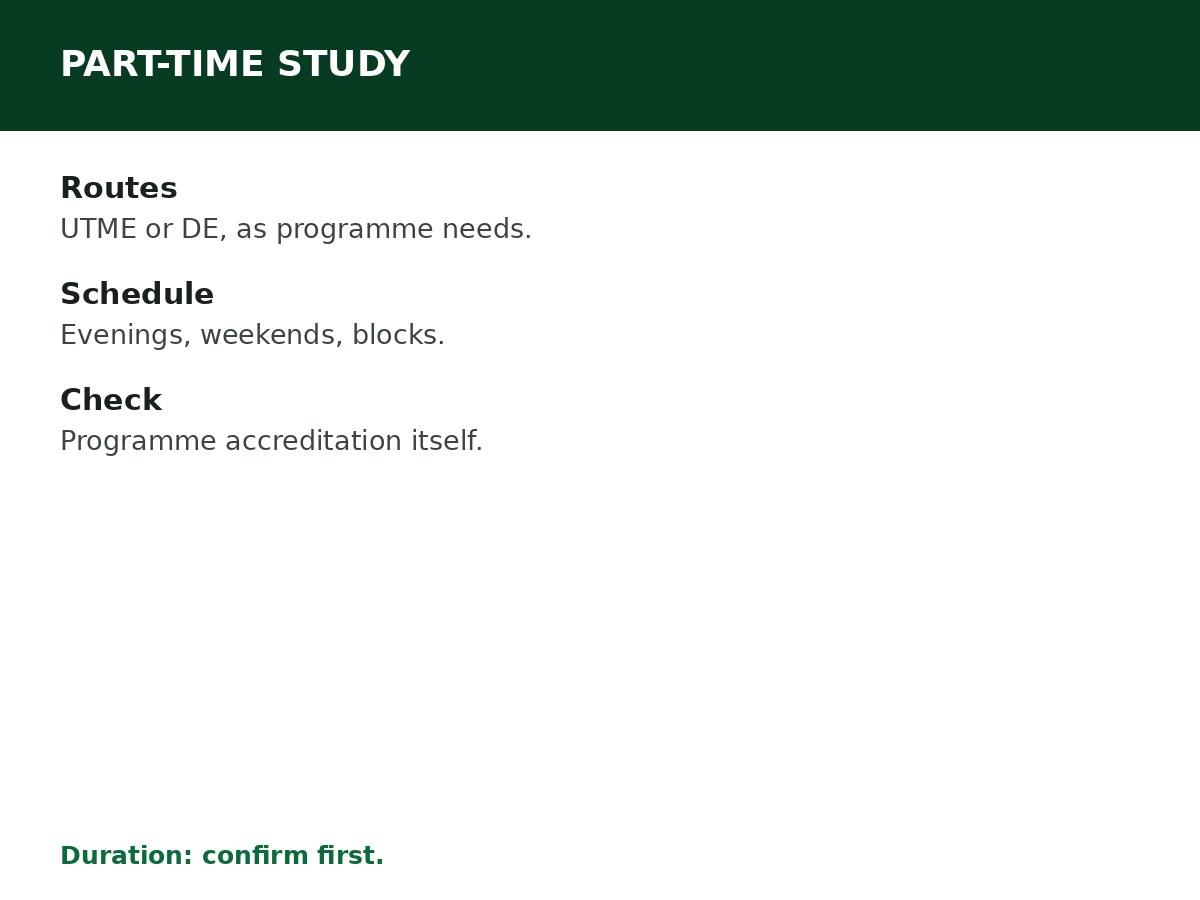
Part-time university admission in Nigeria lets you study for a degree alongside work or other commitments, with classes scheduled outside standard full-time hours (evenings, weekends, or concentrated blocks, depending on the programme). You are admitted through the same routes as full-time students (UTME or Direct Entry, as the programme requires), study the same curriculum over a longer period, and graduate with the institution’s degree — but part-time programmes are institution-specific, longer, and not available for every course, so the programme’s own requirements govern.
Part-time study is often misunderstood as “easier admission” or “a different degree”. Neither is true: admission standards are the programme’s standards, and the degree is the institution’s degree — the difference is scheduling and duration, not standard.
How part-time admission works
- Same entry routes: part-time programmes admit through UTME or Direct Entry, as the programme specifies, with the same O’Level requirements (five credits including English and, for most courses, Mathematics, in course-relevant subjects) and the same JAMB process (profile, choices, screening, CAPS admission) — the difference is the programme mode you select, not a separate admission system.
- Programme-specific availability: not every institution offers part-time programmes, and not every course is offered part-time. Professional courses with heavy practical, clinical, or laboratory requirements are often full-time only. Check the institution’s part-time programme list for the session — a course offered full-time is not automatically offered part-time.
- Longer duration: part-time programmes run longer than their full-time equivalents (the exact extension varies by institution and programme — for example, a 4-year full-time programme may run 5–6 years part-time). Confirm the duration for your specific programme before enrolling, because duration affects total fees and graduation timing.
- Fees: part-time fees are set by the institution per programme and session, and they are typically higher per session than full-time fees for the same course (reflecting the extended scheduling), though total programme cost depends on duration. Confirm the fee schedule for your programme — no part-time fee figure is asserted here.
- Same degree, same accreditation check: the degree awarded is the institution’s degree for that course, and the same NUC accreditation check applies — confirm the part-time programme itself is accredited for that institution, not just the full-time version.
Who part-time study suits — and who it does not
Suits: working adults, parents, and candidates who cannot attend full-time classes for financial or personal reasons, but who can sustain evening/weekend study over a longer period alongside their commitments.
Does not suit: candidates seeking a faster degree (part-time is slower), candidates who need campus-based facilities daily (laboratories, studios, clinics — check access for part-time students), and candidates whose funding depends on full-time enrolment (for example, NELFUND’s full-time requirement, as reported — confirm the current programme rules for any funding route you rely on).
Related Guides & Next Steps
- Admission Requirements for Nigerian Universities
- Distance Learning Universities in Nigeria
- Open University Admission Guide
- How University Admission Works in Nigeria
- 2026/2027 University Admission Guide for Nigerian Students
Frequently asked questions
Is a part-time degree the same as a full-time degree? The degree awarded is the institution’s degree for that course. Check that the part-time programme itself is accredited, and confirm any employer or professional-body recognition questions for your field before enrolling.
Can I switch from part-time to full-time (or vice versa)? That depends on the institution’s transfer rules for programme mode — some institutions permit mode transfer with departmental approval, others do not. Ask the institution before enrolling on the assumption that a switch is possible.
How long does a part-time degree take? Longer than the full-time equivalent — the exact duration varies by institution and programme. Confirm the duration for your specific programme before enrolling.
Do part-time students write JAMB? Yes, where the programme requires UTME or Direct Entry admission — part-time admission runs through the same JAMB routes, with the programme mode selected accordingly. Confirm the route for your specific programme.
Is NELFUND available for part-time students? NELFUND’s programme is reported as requiring full-time enrolment. Confirm the current NELFUND rules for your session before relying on loan funding for a part-time programme.
Sources and last update
- Part-time structure (same JAMB routes, programme-specific availability, longer duration, institution-set fees, same-degree with programme accreditation check) from institution part-time programme practices, as compiled by CareerMedal.
- NELFUND full-time requirement carried forward from the NELFUND guides, with current-rules confirmation directed.
- No part-time fee, duration, or programme list is asserted — all are institution- and programme-specific.
Last updated: 24 October 2026. Guide — review every admission session and on every institution part-time programme update.

Written by Olaitan Ilori
Olaitan Ilori is the founder and lead researcher at CareerMedal. He provides verified, practical guides on Nigerian tertiary admissions (JAMB, CAPS, Post-UTME), NELFUND student finance, NYSC service-year survival, and early-career job placement.
View all guides by Olaitan Ilori →