
PhD scholarships for Nigerians are awarded differently from undergraduate and master’s awards: the research proposal and the supervisor matter as much as grades. This guide names the established PhD programmes, explains how they select, and tells you how to verify each one for the current cycle — because amounts, deadlines, and eligibility change every year, and no amount or deadline is asserted anywhere in this article, deliberately.
Established PhD programmes
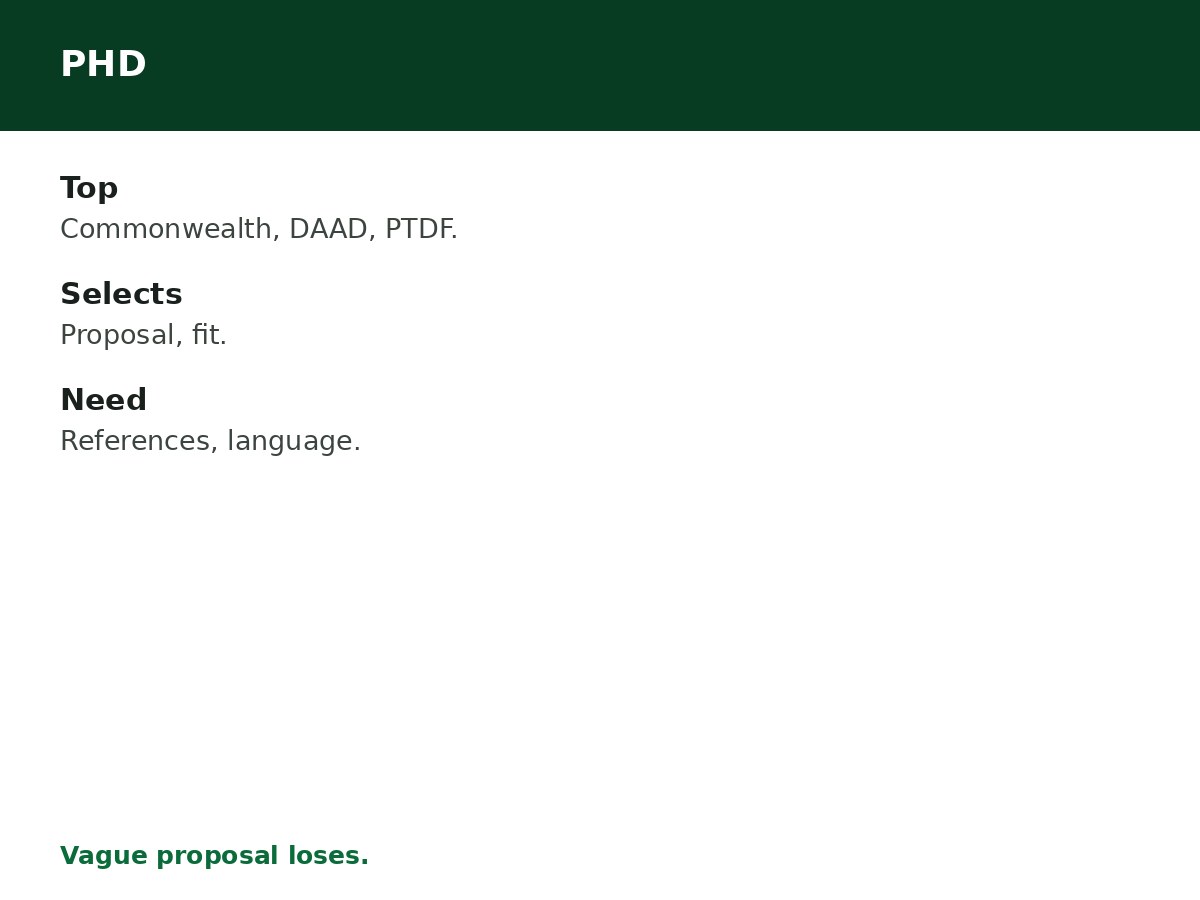
- Commonwealth Scholarships — for PhD study in the UK, for Commonwealth citizens including Nigerians.
- DAAD Scholarships — German government, for PhD study in Germany.
- PTDF Scholarships — for oil, gas, and related fields, in Nigeria and abroad.
- University PhD funding — many universities abroad fund PhD students through research assistantships, teaching assistantships, and departmental scholarships; check each university’s and department’s funding page.
- Research-council funding — UK, European, and other research councils fund PhD projects; check the council’s funding page for the current cycle.
- Mastercard Foundation Scholars Programme — for African students, at partner universities, including doctoral levels where offered.
How PhD scholarships select
- Research proposal — the single most important document. A clear, original, feasible proposal, tied to the supervisor’s research, beats a strong transcript with a vague proposal.
- Supervisor fit — contact potential supervisors before applying, where the programme allows it. A supervisor who wants your project is the strongest asset in a PhD application.
- Academic record — degree class and master’s performance, as the programme states.
- Publications and research experience — where available, they strengthen the application, but they are not always required.
- Language proof — where required (see the without-IELTS guide for waivers and alternatives).
How to apply, in order
- Define your research area and shortlist supervisors and programmes.
- Contact supervisors (where the programme allows it) with a short, specific proposal summary.
- Check the official programme page for the current cycle — amounts, deadlines, eligibility, coverage.
- Prepare documents early — degree certificates, transcripts, research proposal, references, language proof where required.
- Apply through the official portal only, and to multiple programmes in parallel.
Related Guides & Next Steps
- How University Admission Works in Nigeria
- Scholarships for Nigerian Students in 2026/2027
- Scholarships to Study Abroad for Nigerians
- Scholarships Without IELTS for Nigerians
- Masters Scholarships for Nigerians
Frequently asked questions
What matters most in a PhD scholarship application? The research proposal and supervisor fit — a clear, original, feasible proposal, tied to the supervisor’s research, beats a strong transcript with a vague proposal.
Do I need a master’s degree for a PhD scholarship? Most programmes require a master’s degree, as the programme states. Some accept exceptional first-degree holders. Check each programme’s eligibility.
Do I need publications for a PhD scholarship? Publications strengthen the application where available, but they are not always required. A strong proposal and supervisor fit matter more.
Is a PhD scholarship fully funded? Many PhD awards are fully funded (tuition, living, often travel), and many include research-assistant or teaching-assistant funding. Check the programme’s coverage list.
How do I avoid PhD scholarship scams? Apply through official portals only, never pay an application fee to a personal account, never trust a guaranteed award, and verify every programme on its official page.
Sources and last update
- Scholarship programmes named here are established programmes as reported; amounts, deadlines, and eligibility change every cycle — the official programme page for the current cycle governs, and no amount or deadline is asserted anywhere in this article, deliberately.
- Scholarship-vs-loan distinction from the NELFUND cluster guides (Batches 6–10): a scholarship is not repaid; NELFUND is a loan, repayable from 2 years after NYSC at 10% of income.
- Scam patterns from the fake-agents guide (Batch 12): application fees, guaranteed awards, and payment to personal accounts are red flags.
- No admission, award, or visa outcome is promised anywhere in this article.
Last updated: 24 October 2026. Guide — review every 3–6 months and on every scholarship-cycle update.

Written by Olaitan Ilori
Olaitan Ilori is the founder and lead researcher at CareerMedal. He provides verified, practical guides on Nigerian tertiary admissions (JAMB, CAPS, Post-UTME), NELFUND student finance, NYSC service-year survival, and early-career job placement.
View all guides by Olaitan Ilori →