

Distance learning (open and distance learning, ODL) in Nigeria lets you study for a degree primarily online or by distance, without regular physical attendance — through dedicated open universities, or through distance-learning centres (DLCs) run by conventional universities. Admission runs through the same JAMB routes (UTME or Direct Entry) for conventional universities’ DLC programmes, while dedicated open universities admit on O’Level results without UTME. The degree’s validity depends on NUC approval for that specific programme — not on the “distance” label alone.
Distance learning is often confused with “no requirements” or “unaccredited”. Neither is true: ODL programmes have admission requirements, and only NUC-approved ODL programmes carry recognised degrees.
The two distance-learning routes
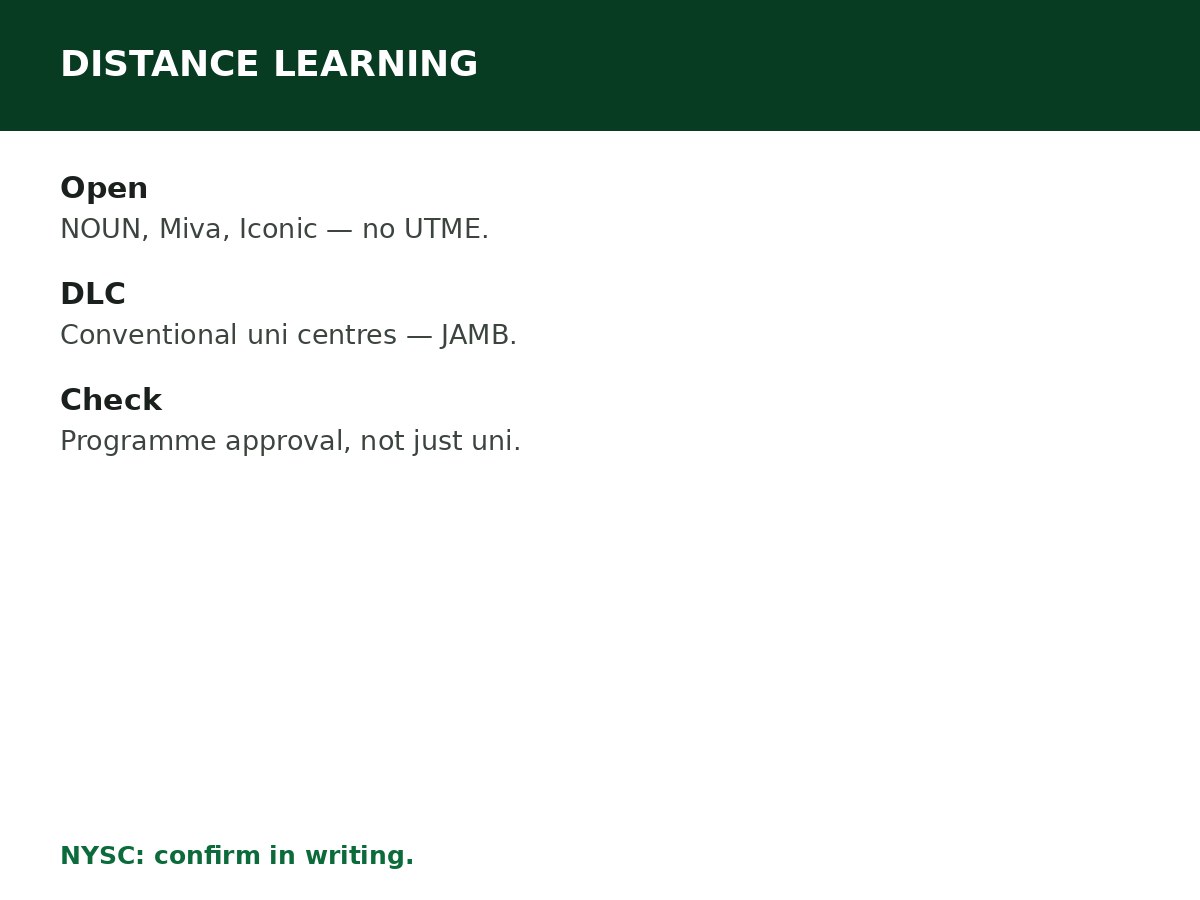
Route 1: Dedicated open universities. Institutions whose entire model is open and distance learning — most notably the National Open University of Nigeria (NOUN, federal), plus private open universities such as Miva Open University and Iconic Open University (both NUC-approved, as reported). Admission: O’Level results (five credits including English and Mathematics, in not more than two sittings, as the programme requires), without UTME. Study: online learning management systems, study centres for support and examinations, and flexible pacing within the programme’s rules.
Route 2: Distance-learning centres of conventional universities. Conventional universities that run ODL programmes through a dedicated centre — for example, the University of Lagos Distance Learning Institute and Ahmadu Bello University’s Distance Learning Centre, as reported. Admission: through JAMB routes (UTME or Direct Entry, as the programme specifies) in most cases, with the DLC programme selected accordingly — confirm the route for your specific programme, because DLC admission rules vary. Study: online materials, periodic physical sessions or examinations at study centres, and the conventional university’s degree on completion.
How to choose a distance-learning programme safely
- Confirm NUC approval for the specific programme, not just for the institution. An institution can be NUC-recognised while a particular ODL programme is not yet approved — and an unapproved programme’s degree may not be recognised.
- Confirm the admission route for the programme: O’Level-only (open university route) or JAMB UTME/DE (conventional DLC route). Applying through the wrong route wastes the application.
- Confirm the study model: fully online, blended (online + periodic physical sessions), examination arrangements (online vs physical centres), and study-centre locations. A programme whose examinations require physical attendance at a distant centre is not fully remote, however it is marketed.
- Confirm total cost and duration, including technology fees, examination fees, and study-centre charges where applicable — ODL fees are institution- and programme-specific, and no figure is asserted here.
- Confirm NYSC mobilisation eligibility for the programme, where NYSC matters to you — ODL graduates’ NYSC treatment has varied by programme and policy, and the institution’s current position should be confirmed in writing before enrolling.
Related Guides & Next Steps
- How to Verify a University Admission Portal
- Open University Admission Guide
- Part-Time University Admission in Nigeria
- How University Admission Works in Nigeria
- 2026/2027 University Admission Guide for Nigerian Students
Frequently asked questions
Do distance-learning degrees count in Nigeria? Yes, where the programme is NUC-approved for that institution. Confirm approval for the specific programme, not just the institution.
Do I need JAMB for distance learning? It depends on the route: dedicated open universities admit on O’Level results without UTME; conventional universities’ DLC programmes typically require JAMB UTME or Direct Entry admission. Confirm the route for your programme.
Is distance learning cheaper than full-time study? Often lower on accommodation and transport (no relocation, no daily commuting), but programme fees vary by institution, and technology, examination, and study-centre charges apply. Compare total programme cost, not headline fees.
Can I work while studying by distance learning? That is the model’s main advantage — flexible pacing alongside work. But flexibility is not absence of deadlines: assignments, examinations, and programme duration rules still apply, and falling behind in a flexible programme is easier than catching up.
Will I be mobilised for NYSC after a distance-learning degree? That depends on the programme and current NYSC policy for ODL graduates. Confirm the institution’s current position in writing before enrolling, if NYSC matters to your plans.
Sources and last update
- ODL structure (two routes, admission rules, study models, NUC programme approval, NYSC caution) from institution ODL practices and guides, as compiled by CareerMedal.
- Named examples (NOUN, Miva, Iconic, UNILAG DLC, ABU DLC) from guides as reported, with programme-specific confirmation directed for each.
- No ODL fee, duration, or programme list is asserted — all are institution- and programme-specific.
Last updated: 24 October 2026. Guide — review every admission session and on every NUC ODL approval update.

Written by Olaitan Ilori
Olaitan Ilori is the founder and lead researcher at CareerMedal. He provides verified, practical guides on Nigerian tertiary admissions (JAMB, CAPS, Post-UTME), NELFUND student finance, NYSC service-year survival, and early-career job placement.
View all guides by Olaitan Ilori →