

A course is accredited in Nigeria when the National Universities Commission (NUC) has granted accreditation to that specific programme, at that specific university, for the current accreditation cycle. Accreditation is programme-specific, university-specific, and time-limited — a university’s general standing does not accredit its courses, and a course accredited five years ago is not necessarily accredited today. The checks below, in order, tell you whether a course is accredited — and what to do when the answer is unclear.
Accreditation is the single most important check before choosing a course, because an unaccredited course can leave you with a degree that employers, NYSC, and postgraduate programmes do not recognise — and that risk is entirely avoidable by checking before you apply.
The checks, in order
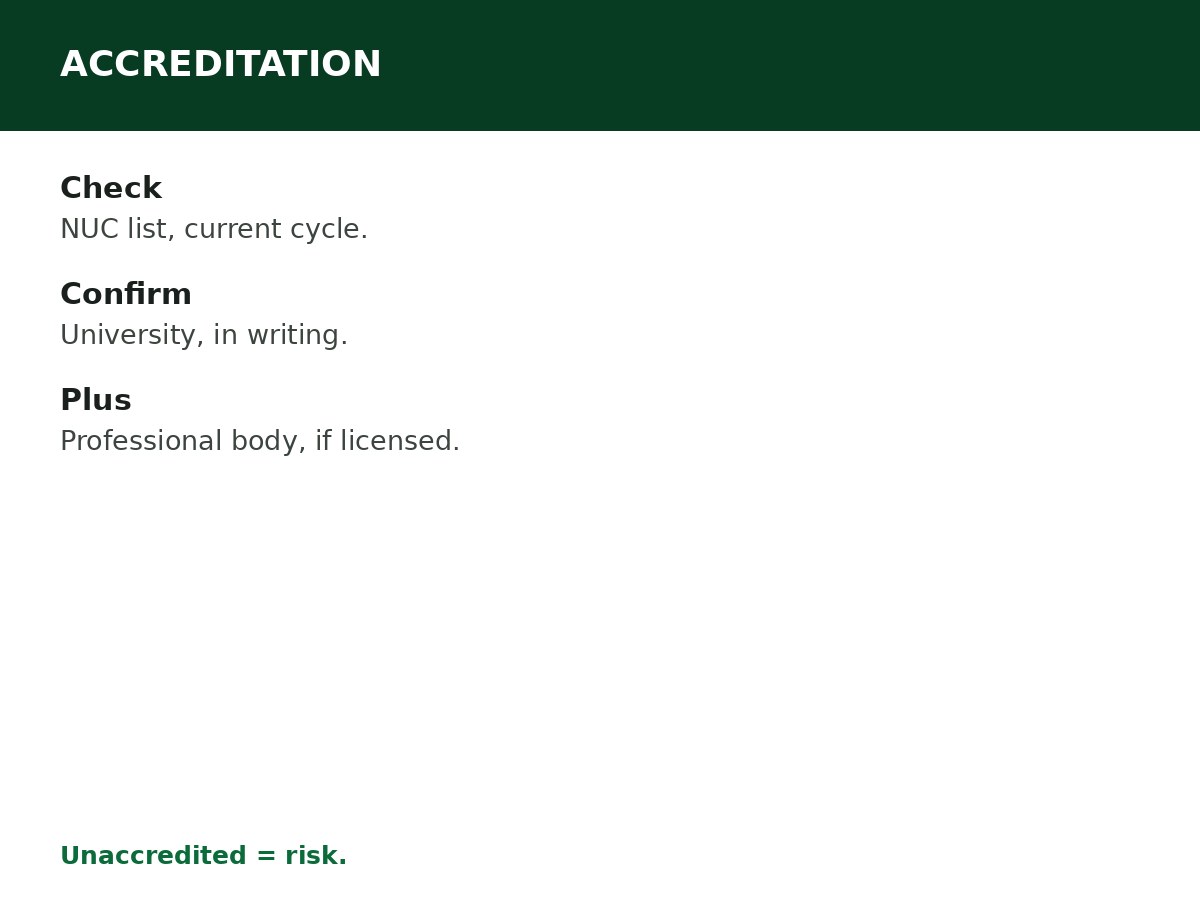
1. Check the NUC’s published accreditation list
The NUC publishes lists of accredited programmes by university, updated after each accreditation exercise. Find your university and your programme on the current list. If the programme appears, it holds accreditation for the cycle the list covers — note the cycle date, because accreditation expires and must be renewed.
2. Check the university’s own accreditation status for the programme
Ask the university’s admissions office or academic planning unit, in writing, whether the programme holds current NUC accreditation, and for which cycle. A written answer (email or letter) is evidence; a verbal assurance is not. If the university cannot produce a current accreditation status for the programme, treat that as a warning, not as a technicality.
3. Check the professional body’s recognition (for licensed courses)
For licensed courses (medicine, nursing, pharmacy, law, engineering, architecture, accounting), NUC accreditation alone is not enough — the relevant professional body must also recognise the programme (MDCN, NMCN, PCN, Council of Legal Education, COREN per discipline, ARCON, ICAN arrangements). Check both: NUC accreditation and professional-body recognition, for the specific programme, for the session.
4. Check the programme’s history
A programme that has run for years, graduated students, and mobilised them for NYSC has a track record you can verify (ask about recent graduating sets and their NYSC mobilisation). A brand-new programme, with no graduating set yet, carries higher accreditation risk — not because new programmes are unaccredited, but because their accreditation has not yet been tested by a full cycle.
5. Check for warning signs
- The programme does not appear on the NUC list for the university, for the current cycle.
- The university cannot confirm accreditation in writing.
- The programme’s name differs from the NUC-listed programme name (a renamed programme may not carry the old programme’s accreditation — check the current name).
- Agents or unofficial sources claim accreditation that the NUC list and the university cannot confirm. Agents do not accredit programmes.
- The programme is advertised with a different university’s name or with a partnership claim that the NUC list does not support.
What to do if a course is not accredited (or unclear)
- Do not apply on the assumption that accreditation will arrive. Accreditation exercises run on NUC schedules, not on admission schedules — a programme unaccredited at application time may remain unaccredited when you graduate.
- Choose an accredited alternative — the same course at an accredited institution, or a related accredited course at the same institution — rather than gambling on an unaccredited programme.
- If you are already enrolled in a programme whose accreditation is unclear, ask the university’s academic planning unit in writing, and check the NUC list for the current cycle. If the programme is genuinely unaccredited, seek transfer advice early — before you have invested years that may not count.
- Report suspected misrepresentation to the NUC (through its published channels) if a university or agent claims accreditation that the NUC list does not support.
Related Guides & Next Steps
- Admission Requirements for Nigerian Universities
- How to Choose a Course After JAMB
- How University Admission Works in Nigeria
- Best Universities to Study Medicine in Nigeria
- How to Check NUC Accreditation for a University Course
Frequently asked questions
What is NUC accreditation? NUC accreditation is the National Universities Commission’s formal approval of a specific academic programme at a specific university, granted after an accreditation exercise and valid for a cycle (after which it must be renewed). It is the standard recognition for Nigerian university programmes.
Does university accreditation mean all its courses are accredited? No — accreditation is programme-specific. A university can hold accreditation for some programmes and not others, and a programme’s accreditation can lapse while the university’s other programmes remain accredited. Check the specific programme.
How often is accreditation renewed? Accreditation is granted for a cycle and must be renewed after each accreditation exercise — the cycle length and exercise schedule are set by the NUC. Check the current cycle date for your programme, not just whether it was ever accredited.
Is NUC accreditation enough for licensed courses? No — licensed courses also need the relevant professional body’s recognition (MDCN, NMCN, PCN, Council of Legal Education, COREN, ARCON, ICAN arrangements). Check both, for the specific programme, for the session.
What happens if I graduate from an unaccredited course? Your degree may not be recognised by employers, NYSC, or postgraduate programmes — and recognition is not retroactively granted if the programme is accredited later. Check before you apply, not after you graduate.
Sources and last update
- Accreditation mechanism (programme-specific, university-specific, time-limited; NUC list; university confirmation; professional-body recognition; warning signs) from NUC accreditation guidance and the cluster’s course guides, with per-session verification directed.
- Professional-body list from the respective course guides (Batches 13–17), summarised here — the course guides govern where they differ in detail.
Last updated: 24 October 2026. Guide — review every 3–6 months and on every NUC accreditation exercise.

Written by Olaitan Ilori
Olaitan Ilori is the founder and lead researcher at CareerMedal. He provides verified, practical guides on Nigerian tertiary admissions (JAMB, CAPS, Post-UTME), NELFUND student finance, NYSC service-year survival, and early-career job placement.
View all guides by Olaitan Ilori →