

No course guarantees a job in Nigeria — but courses with good job opportunities share three traits: a professional licensing route or a demonstrable skill, formal-sector demand that outstrips graduate supply, and transferable skills that survive sector downturns. The courses below are those most consistently associated with strong formal-sector demand, grouped by field, with the honest caveats attached. Prospects depend on skills, internships, licensing, and location — not on the course name alone.
Job-market claims are the easiest claims to inflate and the hardest to verify. This guide therefore states demand in qualitative terms (strong, broad, growing, cyclical) and never as a salary figure or employment rate — no reliable national figure exists for most courses, and any guide quoting one is guessing.
Health sciences (licensed, consistently strong demand)
- Medicine and Surgery — licensed (MDCN), housemanship and residency pipeline, public and private hospital demand. Long training (6 years + housemanship), but the most secure professional route in the country.
- Nursing Science — licensed (NMCN), hospital and community-health demand, plus international mobility (with destination-country licensing, which is separate and additional).
- Pharmacy — licensed (PCN), hospital, community, industry, and regulatory demand.
- Medical Laboratory Science — licensed (MLSCN), laboratory demand across hospitals and diagnostics.
Technology (skills-driven, growing demand)
- Computer Science — software, systems, and data roles, with portfolio and skills mattering more than classification. Demand is broad but competitive — skills differentiate, not the degree alone.
- Cybersecurity — security operations, forensics, and governance roles, with certifications mattering alongside the degree. Growing demand, but a newer field where demonstrable skills are essential.
- Data Science — analysis, machine-learning, and data-engineering roles, with portfolio and projects mattering most. Growing demand, concentrated in Lagos, Abuja, and remote roles.
- Engineering (all disciplines) — infrastructure, energy, manufacturing, and telecommunications demand, with COREN registration mattering for professional practice. Demand is cyclical with infrastructure spending — strong in growth periods, slower in downturns.
Business and finance (professional-route demand)
- Accounting — audit, finance, and compliance demand, with ICAN qualification mattering more than the degree alone for senior roles. The degree opens the route; ICAN completes it.
- Banking and Finance — banking, fintech, and investment demand, with internships and quantitative skills mattering most.
- Economics — policy, banking, consulting, and data-analysis demand, with quantitative training widening the range.
Law and media (portfolio- and route-dependent demand)
- Law — legal practice, corporate, and public-sector demand, with Law School completion and Call to the Bar as the gate. The LLB alone does not practise law — the full route matters.
- Mass Communication — media, public relations, advertising, and digital-content demand, with portfolio mattering more than classification.
How to read this list honestly
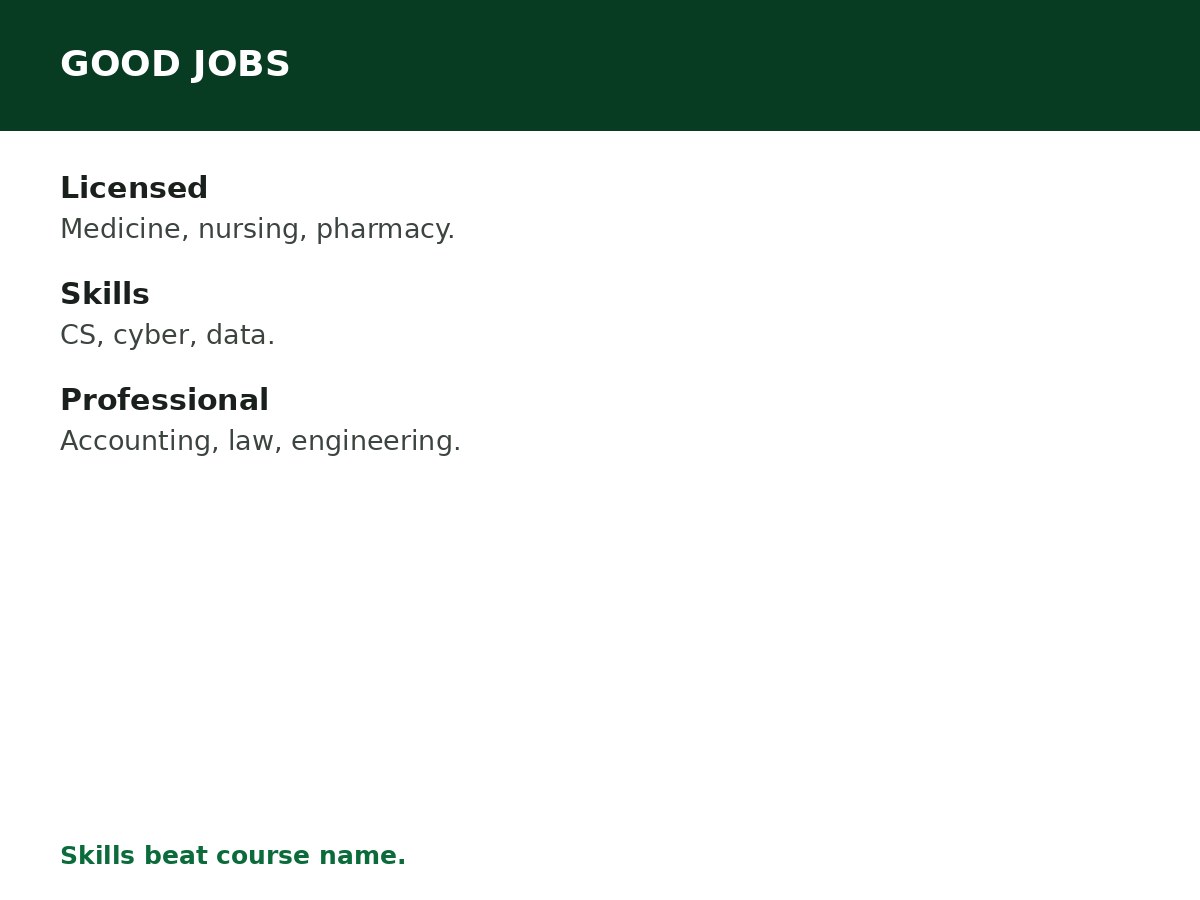
- Licensed courses (medicine, nursing, pharmacy, law, engineering) offer the most secure routes — because licensing restricts supply. But they also require the longest training and the professional examinations that follow the degree.
- Skills courses (computer science, cybersecurity, data science) offer the fastest-growing demand — but also the fiercest competition from self-taught practitioners. Your portfolio, not your degree, differentiates you.
- No course compensates for weak skills. Internships, SIWES, portfolios, certifications, and professional examinations matter more than course choice alone for every course on this list.
- Location matters. Lagos and Abuja concentrate formal-sector demand for technology, finance, and media; teaching hospitals concentrate health demand; infrastructure projects concentrate engineering demand. A course’s prospects in your location may differ from its national picture.
Related Guides & Next Steps
- Admission Requirements for Nigerian Universities
- How to Choose a Course After JAMB
- How University Admission Works in Nigeria
- Best Universities to Study Medicine in Nigeria
- Courses That Can Lead to Remote Jobs
Frequently asked questions
Which course has the best job opportunities in Nigeria? No single course holds that title. Medicine offers the most secure licensed route; computer science, cybersecurity, and data science offer the fastest-growing skills demand; accounting offers the most structured professional route. “Best” depends on your skills, licensing, and location.
Does a high-demand course guarantee me a job? No. Demand describes the market; your skills, internships, licensing, and portfolio determine whether you capture it. A high-demand course with weak skills loses to a low-demand course with strong skills.
Should I choose a course only for job prospects? No — choose by the intersection of prospects, your interests, and your strengths. A course you cannot sustain for 4–6 years, however high-demand, is a dropout risk, and a dropout has no prospects at all.
Are salaries quoted in course guides reliable? Generally no — salary figures vary by employer, location, sector, and experience, and no reliable national figure exists for most courses. Any guide quoting a specific salary for a course is guessing. Judge prospects by demand, licensing, and skills, not by quoted salaries.
What matters more than course choice for employment? Internships and SIWES, professional licensing (where applicable), portfolio and demonstrable skills, and location — in that order, for most courses.
Sources and last update
- Demand assessments (licensed-route security, skills-demand growth, cyclical engineering demand, location concentration) from labour-market reporting and the cluster’s course guides, stated qualitatively — no salary or employment-rate figure is asserted, deliberately.
- Professional routes (MDCN, NMCN, PCN, MLSCN, COREN, ICAN, Law School) from the respective course guides (Batches 13–16), summarised here — the course guides govern where they differ in detail.
Last updated: 24 October 2026. Guide — review every 3–6 months and on every labour-market shift.

Written by Olaitan Ilori
Olaitan Ilori is the founder and lead researcher at CareerMedal. He provides verified, practical guides on Nigerian tertiary admissions (JAMB, CAPS, Post-UTME), NELFUND student finance, NYSC service-year survival, and early-career job placement.
View all guides by Olaitan Ilori →