

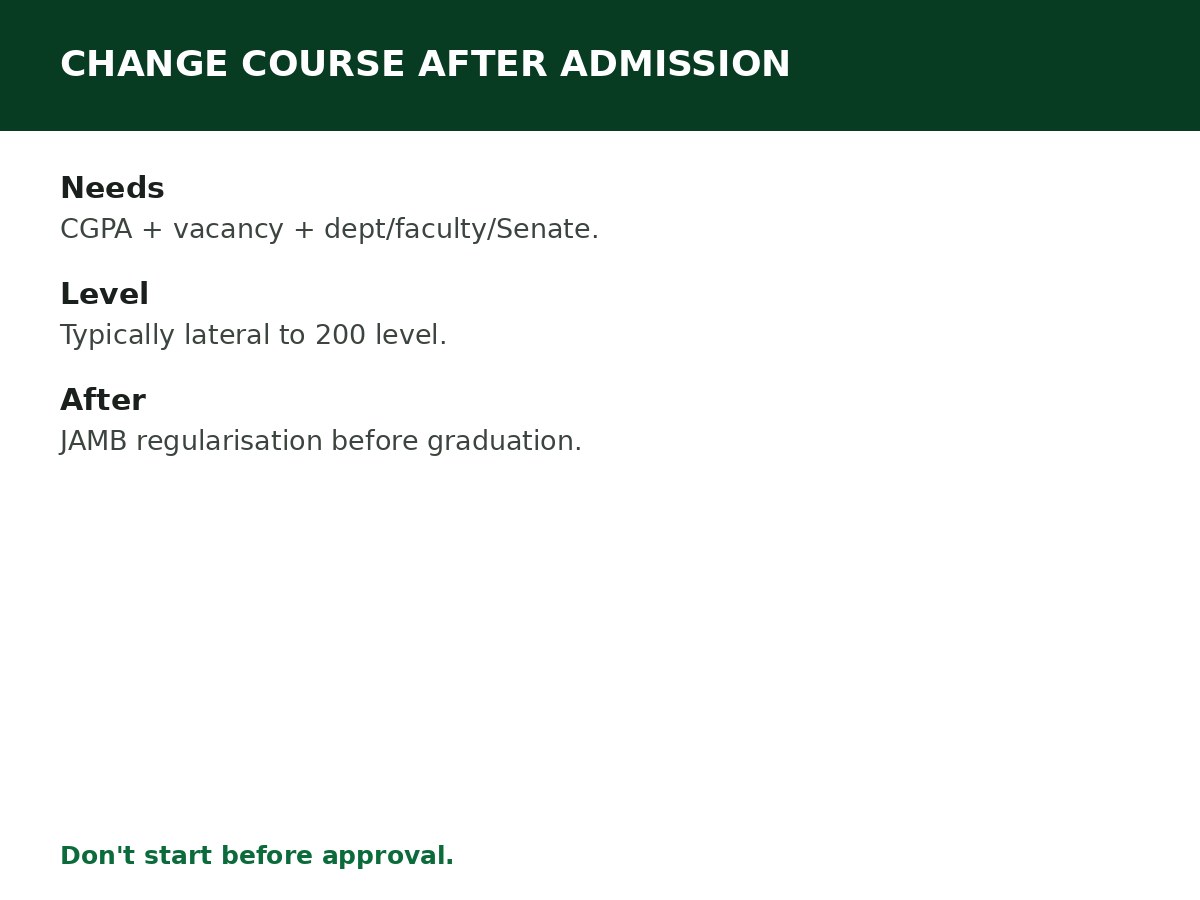
Yes — but not through JAMB’s pre-admission change-of-course window, and not automatically. After admission, changing your course is an intra-university transfer: an internal process run by your institution, requiring a minimum CGPA, a vacancy in the new department, approvals from both departments and faculties, and Senate approval — and, at most institutions, you cannot start the new programme until that approval is confirmed, with JAMB regularisation of the new programme required before graduation.
This is the article students need when they discover, a session into a degree, that they chose the wrong course. The pre-admission change (JAMB e-Facility, before admission) and the post-admission transfer (institutional, after admission) are different processes with different rules — confusing them wastes the window for one and the eligibility for the other.
Intra-university transfer: how it works
Eligibility, generally:
- Completed at least one academic session at the institution, in most cases — transfer applications are typically considered after your first session, not on arrival.
- Minimum CGPA, set by the institution and the receiving department. Reported examples vary widely: some institutions require 2.50 (FUOTUOKE, for inter/intra-faculty transfer), others set lower floors for less competitive moves (FUPRE’s inter-departmental rules cite 1.00 for students on probation in the previous session, with transfer to 200 level). Competitive departments set higher bars. Your institution’s published threshold for your target department is the only figure that matters for your case.
- Vacancy in the receiving department. CGPA alone does not complete a transfer — the receiving department must have space, and must accept you.
- No more than a limited number of carryovers, where the institution sets such a rule (FUPRE cites not more than 2 carryovers for inter-collegiate transfer, as an example of the kind of condition institutions impose).
- Good standing — no outstanding disciplinary action, in most cases.
Process, generally:
- Obtain the transfer form from the Registrar’s office (after paying the institution’s transfer application fee, where one applies — fees vary by institution and are not asserted here as a national figure).
- Submit to your current Head of Department, for processing by the Departmental and Faculty Boards of both your present and intended programmes.
- Senate approval. Transfer is subject to Senate decision. Do not begin classes in the new programme until Senate confirmation is communicated — starting early does not make the transfer valid, and it can create a record problem.
- Level and repeat rules. Transfers are typically to 200 level (lateral), and students transferring after 300 level may be required to repeat 300 level in the new department, because a minimum period in the department is required before graduation (FUPRE cites a 3-year minimum in the department, as an example). All core courses in the new department not previously taken must be written and passed before graduation.
- JAMB regularisation. Successful transfer applicants must regularise the new programme with JAMB before graduation — otherwise your JAMB record will not match your degree, which creates problems for NYSC mobilisation and verification.
What intra-university transfer is not
- Not a JAMB change of course. JAMB’s change-of-course service (e-Facility, ₦2,500 plus CBT centre service charge, via an accredited CBT centre) is a pre-admission service for candidates not yet admitted. Once admitted and enrolled, your route is the institutional transfer above, with JAMB regularisation afterwards — not a fresh JAMB change.
- Not a route to any course. Transferring from a less competitive course into Medicine, Law, or another highly competitive course faces the highest CGPA bars, the fewest vacancies, and the strictest departmental requirements. A transfer request is judged against the receiving department’s standards, not your original admission standards.
- Not guaranteed by meeting the minimum CGPA. Vacancy, departmental approval, faculty approval, and Senate approval must all align. Meeting the CGPA floor qualifies you to apply; it does not compel approval.
Alternatives if transfer is not available
- Reapply fresh through JAMB for the course you actually want, at an institution that offers it — a clean route, but it costs a session (or more) and a fresh UTME.
- Complete the current degree and pivot afterwards — via postgraduate study, professional qualifications, or a second degree in the desired field. For some fields, this is faster than a late transfer that forces repeated levels.
- Stay, and build the desired direction alongside — electives, certifications, internships, and projects in the target field, where your current programme permits them.
Related Guides & Next Steps
- Can You Change University After Admission?
- How to Change Course on JAMB Portal
- JAMB Regularisation: Requirements and Process
- How University Admission Works in Nigeria
- 2026/2027 University Admission Guide for Nigerian Students
Frequently asked questions
Can I change my course after admission? Yes, through your institution’s intra-university transfer process — CGPA, vacancy, departmental and faculty approvals, and Senate approval, with JAMB regularisation before graduation.
Can I change course immediately after admission, before resumption? Generally no — most institutions require at least one completed session before considering a transfer. Check your institution’s specific window; do not assume an immediate switch.
What CGPA do I need to change course? It varies by institution and receiving department — reported examples range from 1.00 (probation cases, less competitive moves) to 2.50 and higher for competitive departments. Your institution’s published threshold for your target department governs.
Do I need JAMB’s change-of-course form after admission? No — that service is pre-admission. After admission, you use the institutional transfer process, and regularise the new programme with JAMB before graduation.
Will I repeat a level if I transfer? Possibly. Transfers are typically lateral to 200 level, and later transfers may require repeating a level in the new department, plus completing all its core courses before graduation.
Sources and last update
- Intra-university transfer mechanics (session requirement, CGPA variation, vacancy, departmental/faculty/Senate approvals, do-not-start-before-approval, lateral 200-level and repeat rules, JAMB regularisation before graduation) from institution transfer guidelines (FUOTUOKE, FUPRE) as reported examples, with institution-specific figures explicitly framed as examples, not national rules.
- Pre-admission JAMB change distinction (e-Facility, ₦2,500 + CBT service charge, accredited CBT centre) from JAMB’s change service as reported.
- No national transfer fee or CGPA is asserted — both vary by institution and department.
Last updated: 24 October 2026. Guide — review every session and on every institution transfer-policy update.

Written by Olaitan Ilori
Olaitan Ilori is the founder and lead researcher at CareerMedal. He provides verified, practical guides on Nigerian tertiary admissions (JAMB, CAPS, Post-UTME), NELFUND student finance, NYSC service-year survival, and early-career job placement.
View all guides by Olaitan Ilori →