

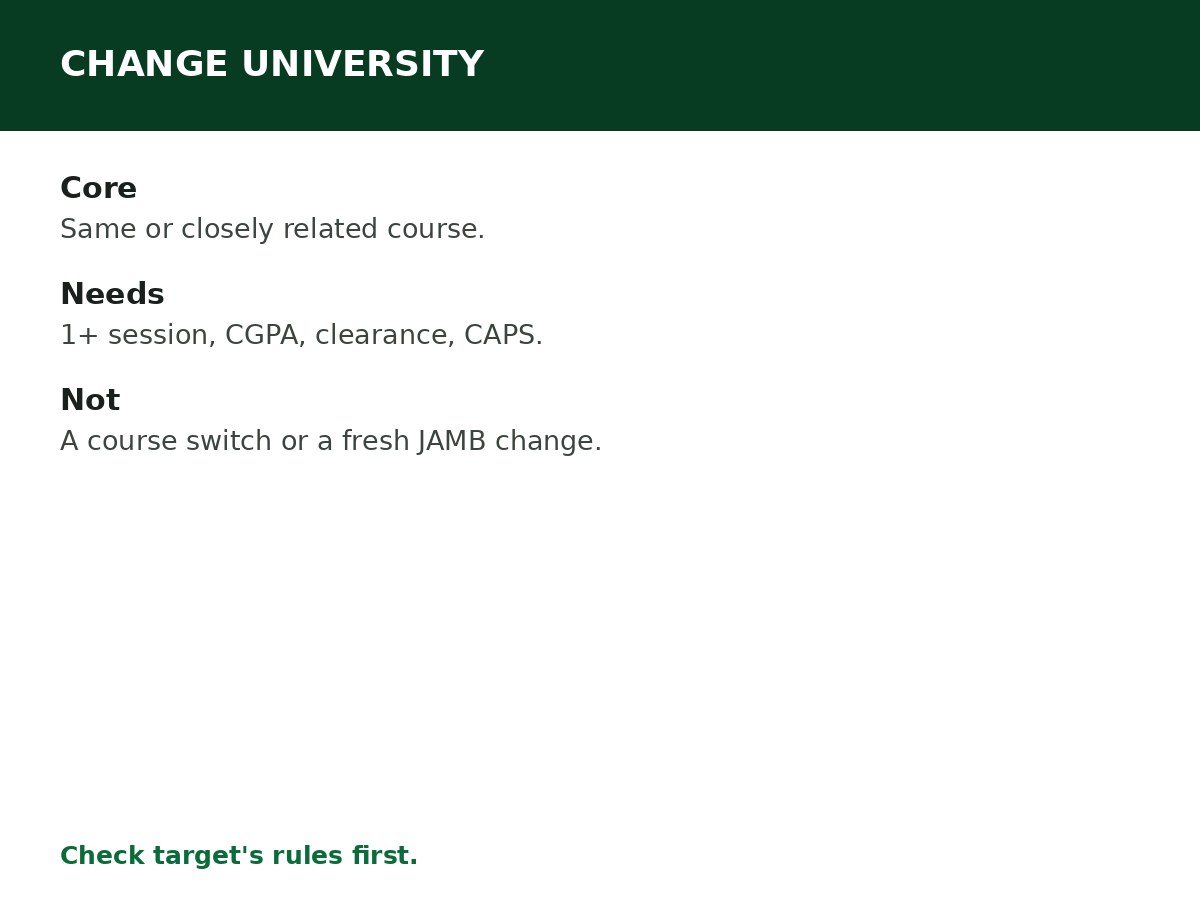
Yes — through inter-university transfer, but it is a narrow route, not a general right. You must have completed at least one academic session (typically to 200-level standing), meet the receiving university’s CGPA threshold for your programme, continue in the same or a closely related course, obtain clearance from your current university, be admitted by the receiving university, and have that admission processed on JAMB CAPS. It is not a way to switch courses, and it is not available to students who have been advised to withdraw or are facing disciplinary action.
Students often confuse three different moves: JAMB change of institution (pre-admission, for candidates not yet admitted), intra-university transfer (changing course within the same university, after admission), and inter-university transfer (changing university, after admission, in the same course). This article is about the third.
The core constraint: same course
Nearly every Nigerian university requires inter-university transfer applicants to continue in the same course they were studying, or in a very closely related one. This is not a path to switch from Biochemistry at your current university into Law at a different one. If you want to change your actual course, that is handled through intra-university transfer at your current institution, or by reapplying fresh through JAMB — not through inter-university transfer. Building a transfer plan around a course switch will fail at the receiving department’s vetting stage.
Eligibility, generally
- At least one full academic session completed, and typically 200-level standing — you must have progressed beyond your first year before applying. Some institutions cap eligibility at around two academic sessions already spent, since transfers deep into a programme become difficult to accommodate academically.
- Minimum CGPA, set by the receiving university and programme. Reported requirements vary meaningfully: generally around 2.0–3.0 on a 5.0 scale, with highly competitive programmes far higher — for example, the University of Medical Sciences, Ondo, requires 4.50 for Medicine, Dentistry, and Physiotherapy, 4.0 for Nursing and Pharmacy, and 3.50 for other programmes (2026/2027 guidelines, as reported). FUPRE’s inter-university rules cite 4.0 for Technology and 3.5 for Science, as another example. Your receiving programme’s published threshold is the only figure that matters for your case.
- Good standing: no disciplinary action, not advised to withdraw, with clearance from your current university.
- O’Level requirements of the receiving programme, including single-sitting rules where the programme imposes them (UNIMED requires single-sitting O’Level credits for Medicine, Dentistry, and Physiotherapy, as an example).
- Vacancy in the receiving programme — CGPA alone does not complete a transfer.
- Institution-specific exclusions exist. For example, FUPRE’s published rules state that transfer applications from private universities (local or foreign) shall not be considered, while applications from state-owned universities and federal-recognised foreign universities shall be considered. Check whether your current institution type is accepted by your target university before applying.
How to apply, step by step
- Confirm the receiving university allows transfers, for your programme, in the session you are targeting — and confirm its CGPA threshold, level of entry (typically 200 level only), and document list.
- Obtain clearance from your current university — through your course/part adviser, Head of Department, and Students’ Affairs division, with approvals from the relevant principals. This clearance shows you have no outstanding academic or disciplinary issues and have permission to transfer.
- Apply to the receiving university with its transfer form (online or physical, with the institution’s application fee where one applies) and documents: official academic transcript, JAMB admission letter (compulsory for transfers from Nigerian institutions, per UNIMED’s guidelines as an example), O’Level results, transfer clearance, reference letter from your previous institution (Vice-Chancellor, Provost, Registrar, Dean, or Head of Department, per UNIMED), medical fitness report from a government hospital where required, and passport photographs.
- Await vetting and department clearance at the receiving university. If approved, you will receive an admission offer.
- Accept the admission on JAMB CAPS — inter-university transfer admission is processed through CAPS, like other admissions. Print your JAMB admission letter and original result slip for the new programme.
- Complete registration and clearance at the receiving university, including fee payment, and regularise your new programme with JAMB before graduation where required.
What inter-university transfer is not
- Not a JAMB change of institution. JAMB’s change-of-institution service (₦2,500 plus CBT centre service charge, via an accredited CBT centre) is a pre-admission service. After admission and enrolment, your route is the institutional transfer above, with CAPS processing of the new admission.
- Not a transfer from polytechnic or college of education to university. That route does not exist through inter-university transfer; ND/NCE/HND holders enter universities through Direct Entry (JAMB DE form + Post-UTME screening at the receiving institution).
- Not repeatable without limit. Some institutions state that a candidate cannot be transferred more than once. Check the receiving university’s rule before assuming a second transfer is possible.
Related Guides & Next Steps
- Can You Change Your Course After Admission?
- How to Change Institution on JAMB Portal
- JAMB Direct Entry Registration Guide
- How University Admission Works in Nigeria
- 2026/2027 University Admission Guide for Nigerian Students
Frequently asked questions
Can I change university after admission? Yes, through inter-university transfer — same or closely related course, at least one session completed, receiving university’s CGPA threshold met, clearance from your current university, admission on JAMB CAPS.
Can I transfer and change course at the same time? Generally no. Inter-university transfer requires the same or a closely related course. A course change is handled by intra-university transfer or by fresh JAMB application.
What CGPA do I need to transfer? It varies by receiving university and programme — generally around 2.0–3.0, with competitive programmes far higher (4.50 for Medicine at UNIMED, as an example). Check your target programme’s published threshold.
Do I need my current university’s permission? Yes — clearance from your current university, through your adviser, HOD, and Students’ Affairs, is a standard requirement. A transfer without clearance will not be processed.
Can I transfer from a private university to a public university? It depends on the receiving university’s published rules — some (like FUPRE, as an example) do not consider private-university transfers at all. Check the target university’s rules before applying.
Sources and last update
- Inter-university transfer mechanics (same-course constraint, session/200-level standing, CGPA ranges, clearance, transcript, JAMB admission letter, CAPS admission, 200-level entry, regularisation) from institution transfer guidelines (UNIMED 2026/2027, FUPRE, FUOTUOKE) and transfer guides, with institution-specific figures explicitly framed as examples, not national rules.
- Pre-admission JAMB change distinction and polytechnic-to-university exclusion (Direct Entry route instead) from JAMB’s processes as reported.
- No national transfer fee or CGPA is asserted — both vary by institution and programme.
Last updated: 24 October 2026. Guide — review every session and on every institution transfer-policy update.

Written by Olaitan Ilori
Olaitan Ilori is the founder and lead researcher at CareerMedal. He provides verified, practical guides on Nigerian tertiary admissions (JAMB, CAPS, Post-UTME), NELFUND student finance, NYSC service-year survival, and early-career job placement.
View all guides by Olaitan Ilori →