
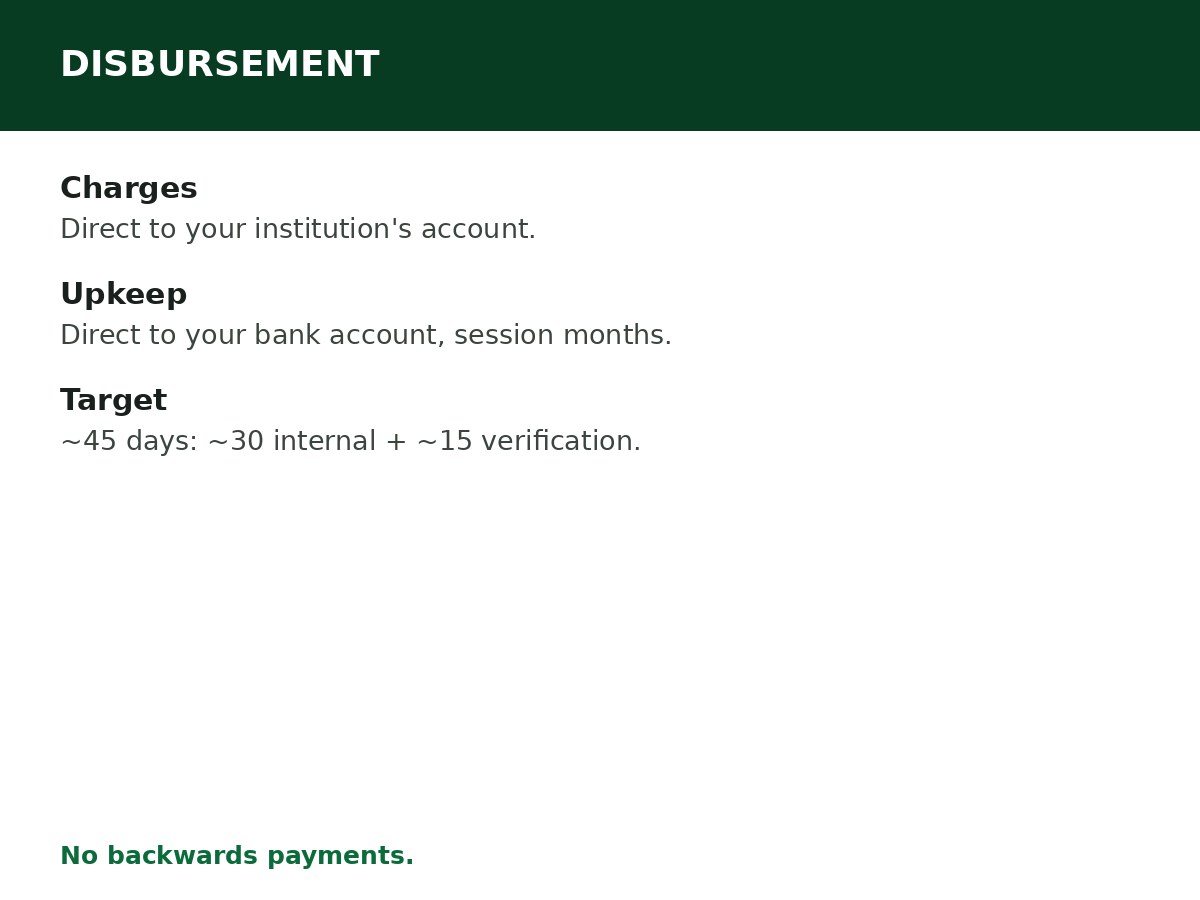
NELFUND disbursement works in two separate streams, after approval: institutional charges are paid directly to your institution’s account, and upkeep is paid directly to your bank account. Approval is not disbursement, the two streams can arrive at different times, and neither stream starts until both verification checks — portal match and institutional confirmation — have passed.
Most disbursement complaints come from treating approval as payment, or from treating one stream’s arrival as proof about the other. A record showing institutional charges paid to your school does not establish that your upkeep reached your bank account, and vice versa.
The disbursement sequence
- Application submitted (verification, profile, loan request, documents, terms).
- Verification: portal match (JAMB + NIN) and institutional confirmation. NELFUND’s stated processing target is about 45 days in total — roughly 30 days of NELFUND internal processing, plus about 15 days for institutional verification. That is a target, not a guarantee.
- Approval: your loan request is approved for the session, shown on your dashboard.
- Disbursement — institutional charges: NELFUND pays your institution directly, into its official account, for the verified charges for the session.
- Disbursement — upkeep: NELFUND pays your bank account directly, in periodic instalments, during your active academic session.
- Confirmation: confirm institutional payment with your institution’s bursary (on your student record), and upkeep with your bank statement — separately, for each stream.
What can delay disbursement
- Institutional verification incomplete. NELFUND depends on institutions to verify student records (matric number, admission status, department, level, session, school fees, academic calendar). If your institution has not verified you, neither stream moves.
- Wrong or mismatched bank details. Wrong account number, name mismatch, inactive account, account not linked properly, or BVN/NIN details not matching the application — all delay upkeep specifically.
- Reconciliation mismatches. When your application, school verification, bank details, and payment records do not align, NELFUND may need to reconcile the transaction before releasing money, even after approval.
- Portal technical issues. A technical glitch on the portal affected upkeep disbursement for some beneficiaries in June 2026, with payments resuming in batches after reconciliation — a reminder that approved does not always mean immediately paid, and that delays can be systemic rather than personal.
- Academic session issues. Upkeep follows your institution’s academic calendar. If you applied for a session that has already ended, the upkeep request may be rejected or delayed — which is why institutions are expected to upload academic calendars and session details on time.
- Fee-schedule disputes. Institutions input their official fee schedules into NELFUND’s verification system. If the uploaded amount differs from your actual course fee, you can challenge it — and NELFUND has warned institutions against unreasonable fee increases, saying payments for charges considered excessive may be withheld. A disputed schedule can hold up the institutional stream.
No backwards payments, and no double payments
Two rules govern the session boundary, both stated by NELFUND’s Managing Director:
- No retrospective payments. If you apply mid-session, you receive only what is left of that session’s entitlement. NELFUND will not pay you backwards for months that passed before your application.
- No double payments across sessions. Once processing for a new session begins, payments from the previous session must stop. Each session is a fresh application with a fresh entitlement — not an accumulation of unpaid previous sessions.
If you are approved but have not been paid
- Check your dashboard’s disbursement information for each component separately — institutional charges and upkeep have separate statuses.
- Confirm with your institution’s bursary whether institutional charges have been received and credited to your student record.
- Confirm with your bank statement whether upkeep has arrived, and whether your bank details on the portal are correct.
- If one stream has arrived and the other has not, treat them as separate issues — do not assume the missing stream will follow automatically on the same day.
- If neither has arrived after the processing target, contact NELFUND through official support channels with your application reference, the exact dashboard wording, and what your institution and bank each confirm. Keep a record of the complaint so you can follow up.
- Do not pay anyone to “release” your payment, and do not submit a duplicate application to speed it up — neither accelerates disbursement.
Related Guides & Next Steps
- How NELFUND Pays Institutional Fees
- How NELFUND Upkeep Payments Work
- How to Check NELFUND Application Status
- NELFUND Student Loan Requirements
- NELFUND Student Loan 2026/2027: Complete Guide
Frequently asked questions
How long does NELFUND disbursement take after approval? NELFUND’s processing target is about 45 days from application (roughly 30 days internal + 15 days institutional verification), as a target, not a guarantee. Disbursement follows approval, and the two streams can arrive at different times.
My school says it received nothing, but my dashboard says approved. What do I do? Save a screenshot of your application status, ask the school to confirm its position, and contact NELFUND through official support with your application reference and the school’s response. Keep a record of the complaint.
Will my upkeep arrive at the same time as my school fees payment? Not necessarily. Tuition support and upkeep are separate components with separate processing, and approval of one does not confirm the payment date of the other.
Can I get upkeep for months before I applied? No. NELFUND does not make retrospective payments. Applying mid-session gives you only what is left of that session.
What if my institution increased its fees after I applied? Institutions input fee schedules into the verification system, and you can see the uploaded amount on your portal and challenge it if it differs from your actual course fee. NELFUND has warned institutions against unreasonable increases and may withhold payments for charges considered excessive.
Sources and last update
- Disbursement streams (charges to institution, upkeep to bank, separate timelines), processing target (45 days: ~30 internal + ~15 institutional verification), no-retrospective and no-double-payment rules, fee-schedule input and challenge right, fee-increase withholding warning, and delay causes (verification, bank mismatch, reconciliation, portal glitch June 2026, session/calendar issues), from NELFUND’s Managing Director’s statements and NELFUND guides as reported by multiple outlets.
- June 2026 glitch is reported as a past event, not asserted as a current fault.
Last updated: 24 October 2026. Guide — review every session and on every NELFUND guideline update.

Written by Olaitan Ilori
Olaitan Ilori is the founder and lead researcher at CareerMedal. He provides verified, practical guides on Nigerian tertiary admissions (JAMB, CAPS, Post-UTME), NELFUND student finance, NYSC service-year survival, and early-career job placement.
View all guides by Olaitan Ilori →