

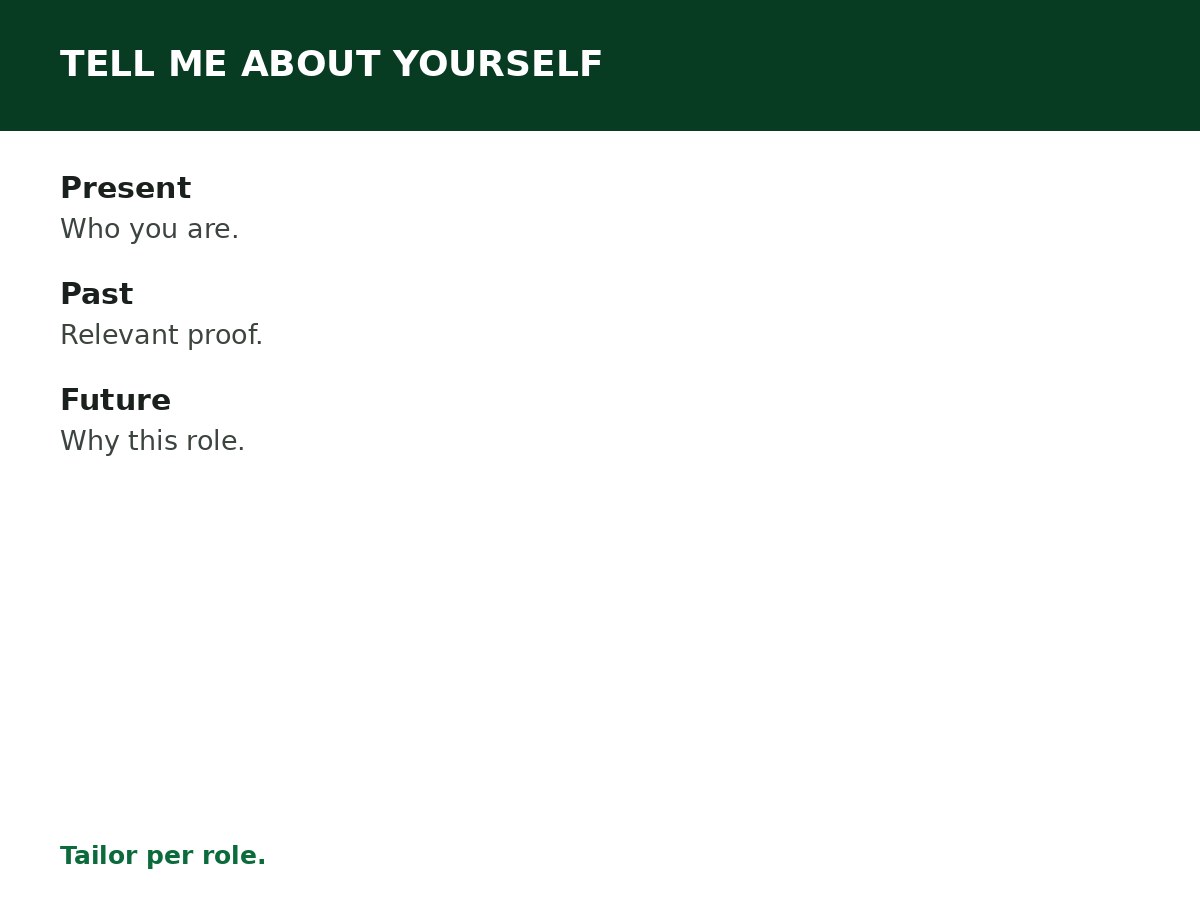
Answering ‘Tell me about yourself’ means giving a 60–90 second summary — present, past, future — linking your background to the role, not reciting your CV. This guide covers this question specifically, distinct from the common-questions guide (which covers interview questions broadly) and the prepare-for-interview guide (which covers preparation).
The present-past-future structure
- Present — who you are now: degree, current role or status, and key skills, in 1–2 sentences.
- Past — relevant background: education, internships, projects, and experience, in 2–3 sentences, with results, where measurable.
- Future — why this role, and how it fits your goals, in 1–2 sentences, linking your background to the employer’s needs.
- 60–90 seconds total — concise, rehearsed, natural, not memorised word-for-word, as interviewers state.
How to tailor the answer
- Match the job description — skills and experience, matching the role’s requirements, highlighted first, for interviewer relevance.
- Lead with strengths — strengths relevant to the role, with evidence, not personal history unrelated to the role.
- End on the role — future section, linking to this employer and role, specifically, not generic career goals.
- Practise aloud — rehearsed aloud, timed, with feedback, before interviews, for natural delivery, not reading or reciting.
Answer example (original, adaptable)
‘I am a [Degree] graduate from [Institution], currently [Status: serving / recent graduate / intern], with skills in [Skill] and [Skill], demonstrated through [Project/Internship]. During [Project/Internship], I [Responsibility with result, where measurable]. I am applying for [Role] because [Specific reason], and I am keen to contribute [Skill/Value] to [Employer/Team].’
Adapt wording to your degree, skills, and target roles, honestly, for every interview. Examples are templates, not text to recite.
Mistakes to avoid
- Reciting your CV — reading CV bullet points, in order, wastes interview time. Summarise, with relevance, not lists.
- Personal history overload — childhood, family, and unrelated personal details, diluting professional relevance.
- Overlong answers — answers over 2 minutes lose interviewer attention, whatever the content. Keep to 60–90 seconds.
- Generic endings — ‘I want to grow’ and similar phrases, without role-specific reasons, wasting the future section.
Related Guides & Next Steps
- How to Write a CV With No Work Experience
- How to Answer What Is Your Expected Salary?
- Common Job Interview Questions in Nigeria
- How to Apply for a Job With No Experience
Frequently asked questions
How should I answer ‘Tell me about yourself’? With a 60–90 second summary — present (who you are now), past (relevant background, with results), future (why this role) — linking your background to the role, not reciting your CV.
How long should my answer be? 60–90 seconds, concise, rehearsed, natural, not memorised word-for-word, as interviewers state.
Should I recite my CV? No — reading CV bullet points, in order, wastes interview time. Summarise, with relevance, not lists.
Can I use an answer template? Yes, as a structure — adapt wording to your degree, skills, and target roles, honestly, for every interview. Templates are structures, not text to recite.
Should I mention personal history? No, beyond relevance — childhood, family, and unrelated personal details dilute professional relevance. Lead with strengths relevant to the role.
Sources and last update
- No salary figure, vacancy count, or hiring outcome is asserted anywhere in this article, deliberately — employer career pages and reputable boards, checked at application time, govern.
- No company is named as currently hiring anywhere in this article, deliberately — hiring windows open and close; employer career pages govern.
- Scam patterns: fees for jobs, payment to personal accounts, guaranteed jobs or shortlisting, and interview coaching selling fake experience are red flags — verify every employer on official channels before applying or paying anything.
- No job, shortlisting, salary, or hiring outcome is promised anywhere in this article.
Last updated: 24 October 2026. Guide — review every 6–12 months, and on every major hiring-platform change.

Written by Olaitan Ilori
Olaitan Ilori is the founder and lead researcher at CareerMedal. He provides verified, practical guides on Nigerian tertiary admissions (JAMB, CAPS, Post-UTME), NELFUND student finance, NYSC service-year survival, and early-career job placement.
View all guides by Olaitan Ilori →