

Answering ‘What is your expected salary?’ means giving a researched, flexible answer — a range, with reasoning, and room to negotiate — without naming a figure you cannot defend, or pricing yourself out. This guide covers this question specifically, distinct from the negotiate-salary guide (which covers negotiation after offers) and the common-questions guide (which covers interview questions broadly).
Before the interview: research
- Role and level research — typical pay, for the role, level, and sector, as the market states, through reputable salary surveys, job boards, and professional contacts, checked at application time.
- No figure asserted here — no specific salary figure is asserted in this guide, deliberately, since pay varies by role, sector, location, and experience. Research, at application time, governs.
- Your minimum and target — minimum acceptable pay (covering needs and costs), and target pay (fair for role and skills), decided privately, before interviews, not on the spot.
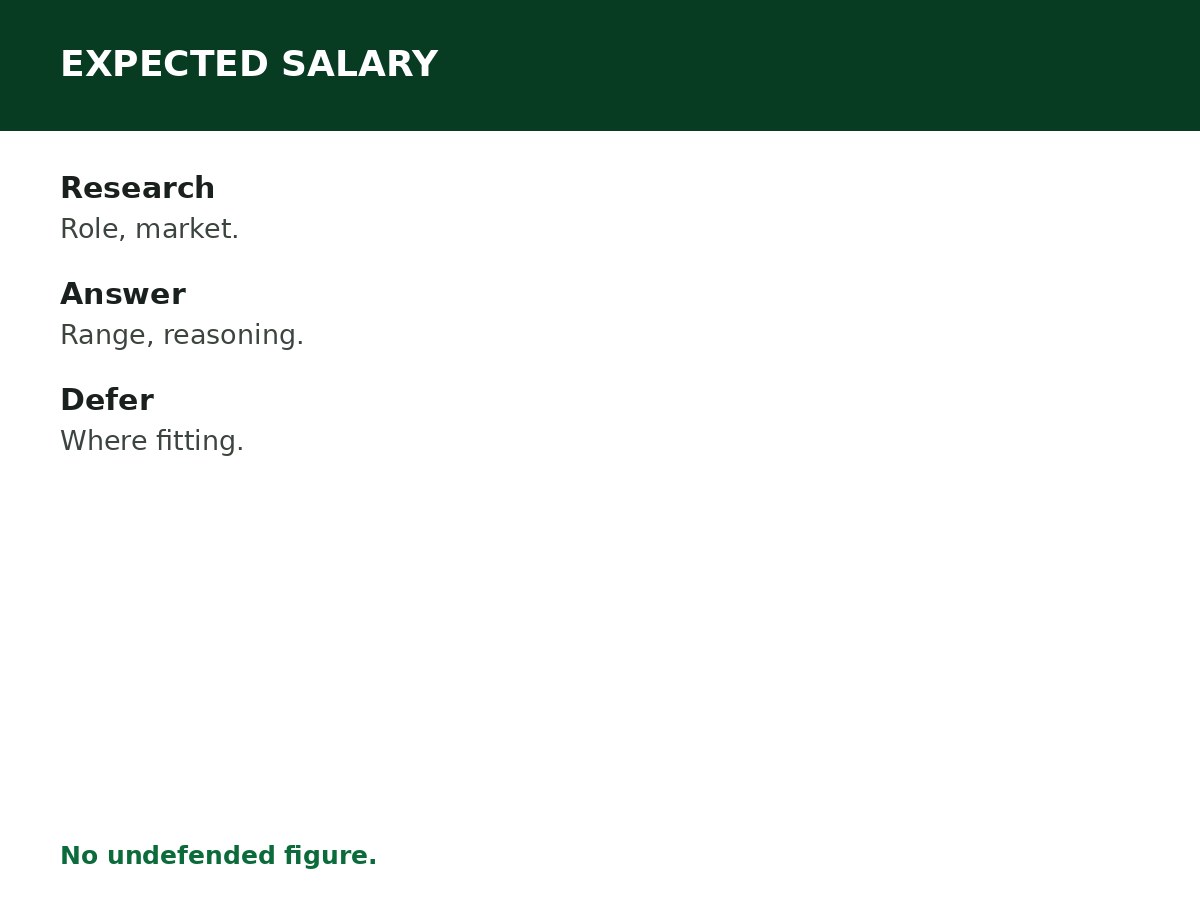
How to answer
- Range, not a single figure — a range, with your target near the top, showing flexibility, as interviewers state, not a single figure that ends negotiation.
- Reasoning, not just numbers — role, skills, and market research, cited briefly, for credibility, not bare figures.
- Flexibility signal — openness to discussion, based on the full package (benefits, growth, training), not salary alone, as employers state.
- Defer where appropriate — where the employer has not stated a range, deferring politely (‘I would like to learn more about the role and package first’) is legitimate, especially early in the process.
Answer examples (original, adaptable)
- Range example — ‘Based on my research for this role and level, and my skills in [Skill], I am looking at a range around [Range, researched], and I am open to discussion based on the full package.’
- Deferral example — ‘I would like to learn more about the role and the full package before discussing figures, and I am flexible for the right opportunity.’
- Adapt honestly — examples are structures, not figures to copy. Research ranges, at application time, for each role, before interviews.
Mistakes to avoid
- Naming an undefended figure — figures without research, or without reasoning, losing credibility or pricing you out.
- Stating a single rigid figure — single figures, without flexibility, ending negotiation before it starts.
- Apologising for asking — salary discussion is normal, professional, and expected, as employers state. Discuss calmly, without apology.
- Lying about current pay — inflated current pay, discovered in background checks, ends offers. State honestly, or decline to disclose, where appropriate.
Related Guides & Next Steps
- How to Write a CV With No Work Experience
- Common Job Interview Questions in Nigeria
- How to Prepare for a Job Interview
- How to Answer Tell Me About Yourself
Frequently asked questions
How should I answer ‘What is your expected salary?’ With a researched, flexible range, with reasoning, and room to negotiate — not a single rigid figure, and not an undefended figure.
Should I give a single salary figure? No — a range, with your target near the top, showing flexibility, as interviewers state, not a single figure that ends negotiation.
Can I defer the salary question? Yes, where appropriate — deferring politely (‘I would like to learn more about the role and package first’) is legitimate, especially early in the process.
What salary figure should I expect? No specific figure is asserted here, deliberately — pay varies by role, sector, location, and experience. Research, at application time, through reputable salary surveys, job boards, and professional contacts, governs.
Should I lie about current pay to get more? No — inflated current pay, discovered in background checks, ends offers. State honestly, or decline to disclose, where appropriate.
Sources and last update
- No salary figure, vacancy count, or hiring outcome is asserted anywhere in this article, deliberately — employer career pages and reputable boards, checked at application time, govern.
- No company is named as currently hiring anywhere in this article, deliberately — hiring windows open and close; employer career pages govern.
- Scam patterns: fees for jobs, payment to personal accounts, guaranteed jobs or shortlisting, and interview coaching selling fake experience are red flags — verify every employer on official channels before applying or paying anything.
- No job, shortlisting, salary, or hiring outcome is promised anywhere in this article.
Last updated: 24 October 2026. Guide — review every 6–12 months, and on every major hiring-platform change.

Written by Olaitan Ilori
Olaitan Ilori is the founder and lead researcher at CareerMedal. He provides verified, practical guides on Nigerian tertiary admissions (JAMB, CAPS, Post-UTME), NELFUND student finance, NYSC service-year survival, and early-career job placement.
View all guides by Olaitan Ilori →