
Graduating with carryovers depends on your institution’s rules — generally, failed compulsory courses must be cleared before graduation, while some institutions allow graduation with limited outstanding electives, per their regulations. This guide explains the general position, distinct from the recover-after-failing guide (which covers restudy) — institution rules govern for each student.
The general position
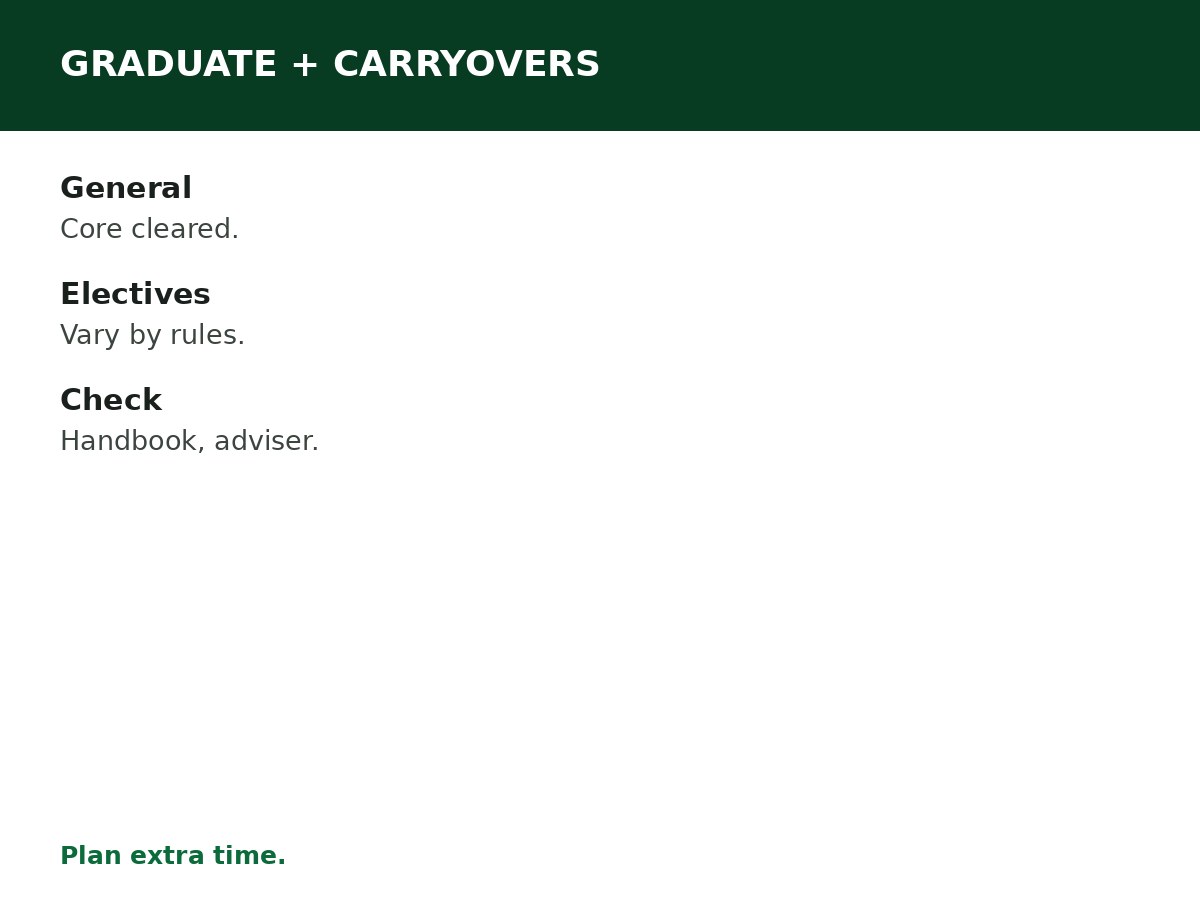
- Compulsory courses must usually be cleared — failed compulsory (core) courses, generally required to be passed, before graduation, as institutions state. Graduation, with uncleared core courses, generally not permitted.
- Electives vary — failed electives, treated differently by institutions, as institutions state. Some allow substitution or waivers, per regulations; others require clearing.
- Institution rules govern — graduation requirements, stated in student handbooks and department notices, as institutions state. This guide, general only, never overrides institution rules.
- Extra time — carryovers, often requiring extra semesters or sessions, as institutions state, extending graduation timelines.
How to check your position
- Read your handbook — student handbook, and department regulations, read, as institutions state, for graduation requirements.
- Ask your adviser — course adviser, or department, consulted, as departments state, for your specific standing.
- Check your transcript — transcript, checked, for outstanding courses, as institutions state, before final year, not at graduation week.
Graduating with carryovers — honest picture
- Clear early — carryovers, cleared early, as the recover-after-failing guide covers, avoiding final-year pile-ups, as students report.
- Plan extra time — extra semesters, planned for, where carryovers require them, as institutions state, rather than assumed away.
- No shortcuts — bought grades, impersonation, or forged clearance, as institutions state, risking severe discipline and revoked degrees. Clear honestly, only.
Related Guides & Next Steps
- Cost of Living for Nigerian University Students
- How University GPA Is Calculated in Nigeria
- CGPA Explained for Nigerian Students
- How to Recover After Failing a Course
Frequently asked questions
Can you graduate with carryovers? It depends on institution rules — generally, failed compulsory courses must be cleared before graduation, while some institutions allow graduation with limited outstanding electives, per their regulations. Institution rules govern for each student.
Must failed compulsory courses be cleared? Generally yes — failed compulsory (core) courses, generally required to be passed, before graduation, as institutions state.
Can failed electives be waived? Sometimes — failed electives, treated differently by institutions, as institutions state. Some allow substitution or waivers, per regulations; others require clearing. Check your handbook.
How do I check my graduation standing? By reading your student handbook and department regulations, consulting your course adviser, and checking your transcript for outstanding courses — before final year, not at graduation week.
Do carryovers extend graduation time? Often yes — carryovers, often requiring extra semesters or sessions, as institutions state, extending graduation timelines. Plan extra time, where required.
Sources and last update
- No grade, graduation, or academic outcome is promised anywhere in this article — results depend on study, department standards, and assessment, as institutions state.
- Grading scales, classifications, and graduation rules vary by institution — department and institution notices govern for each student, not this general guide.
- No paid app, service, or shortcut is recommended anywhere in this article — free tools are named by category, with current terms checked at use time.
Last updated: 24 October 2026. Guide — review every 6–12 months, and at the start of each academic session.

Written by Olaitan Ilori
Olaitan Ilori is the founder and lead researcher at CareerMedal. He provides verified, practical guides on Nigerian tertiary admissions (JAMB, CAPS, Post-UTME), NELFUND student finance, NYSC service-year survival, and early-career job placement.
View all guides by Olaitan Ilori →