

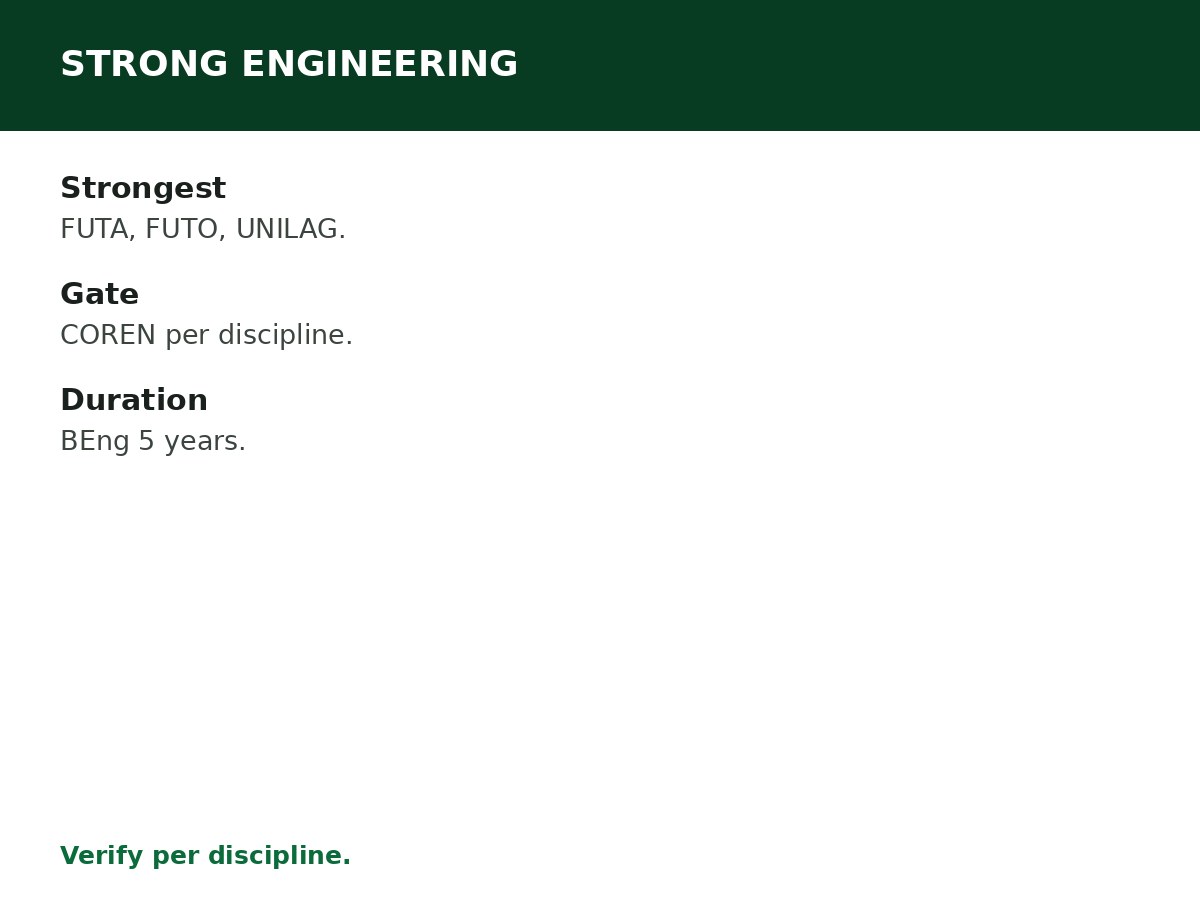
Universities below are grouped by strength — faculty depth, laboratories and workshops, programme breadth, and industry links — not ranked in order. Engineering’s gate is the Council for the Regulation of Engineering in Nigeria (COREN), per discipline: the specific engineering discipline must be COREN-recognised, for the session. A university’s general standing does not recognise its engineering disciplines — verify per discipline, as established for engineering programmes.
Universities with strong Engineering programmes
- Federal University of Technology, Akure (FUTA) — technology specialist, engineering is a core strength, strong workshops and laboratories.
- Federal University of Technology, Owerri (FUTO) — technology specialist, engineering is a core strength.
- University of Lagos (UNILAG) — large engineering faculty, Lagos industry links.
- Obafemi Awolowo University (OAU) — strong engineering faculty, research tradition.
- University of Ibadan (UI) — strong engineering faculty, research tradition.
- University of Nigeria, Nsukka (UNN) — strong engineering faculty, large programme.
- Ahmadu Bello University (ABU) — strong engineering faculty, large programme.
- University of Benin (UNIBEN) — strong engineering faculty.
- University of Ilorin (UNILORIN) — growing engineering faculty, stable calendar.
- Covenant University — strong engineering faculty, modern facilities, stable calendar.
- Babcock University — growing engineering faculty, stable calendar.
What to look for in an Engineering programme
- COREN recognition for the specific discipline, for the session — the single most important check. Civil, Mechanical, Electrical, Chemical, and other disciplines are recognised separately; verify yours.
- Workshops and laboratories — engineering is practical. Working workshops, laboratories, and equipment matter more than any brochure claim. Visit or verify where possible.
- Duration — BEng runs 5 years (as established in the best-universities series). Shorter claims should be checked against the brochure.
- Cut-off — Engineering is a competitive course at most of these universities; aim above the previous session’s departmental cut-off for your discipline, at that university.
- Industry links and internships — Lagos-location universities (UNILAG, Covenant) and technology universities (FUTA, FUTO) have stronger industry links for engineering placements.
Engineering vs related programmes
Engineering (COREN) is distinct from Computer Science (no single licensing body), Architecture (ARCON), and Surveying (SURCON). Do not choose a related programme as a substitute for an engineering discipline — the recognition, curriculum, and career routes differ.
Related Guides & Next Steps
- Admission Requirements for Nigerian Universities
- How to Choose a University in Nigeria
- How University Admission Works in Nigeria
- University of Lagos (UNILAG) Courses, Requirements and School Fees
- Universities With Strong Business Programmes
Frequently asked questions
Which university is best for Engineering in Nigeria? There is no official ranking. FUTA, FUTO, UNILAG, and OAU are the most consistently mentioned, on workshops, faculty, and industry links — but ‘best’ for you depends on COREN recognition for your discipline, for the session, plus your score and budget. Verify recognition for the session.
What body recognises Engineering programmes? The Council for the Regulation of Engineering in Nigeria (COREN), per discipline. Verify COREN recognition for your specific discipline, for the session.
How long is an Engineering degree? BEng runs 5 years (as established in the best-universities series). Shorter claims should be checked against the brochure.
Is Engineering competitive? Yes, at most of these universities — aim above the previous session’s departmental cut-off for your discipline, at that university.
Is Computer Science the same as Engineering? No — Computer Science has no single licensing body, while Engineering disciplines are COREN-recognised per discipline. The curricula and career routes differ.
Sources and last update
- Institution groupings from departmental-history, professional-school, and programme reporting, grouped by strength, NOT ranked. Accreditation (NUC) and professional-body recognition from programme guidance as reported, with per-session verification directed.
- Cut-off context from the cluster’s cut-off guides (Batches 11, 14, 20, and 21), summarised here — the cut-off guides govern where they differ in detail.
- No fee figure, no salary figure, and no placement or employment figure is asserted anywhere in this article, deliberately.
Last updated: 24 October 2026. Guide — review every 3–6 months and on every admission session.

Written by Olaitan Ilori
Olaitan Ilori is the founder and lead researcher at CareerMedal. He provides verified, practical guides on Nigerian tertiary admissions (JAMB, CAPS, Post-UTME), NELFUND student finance, NYSC service-year survival, and early-career job placement.
View all guides by Olaitan Ilori →