

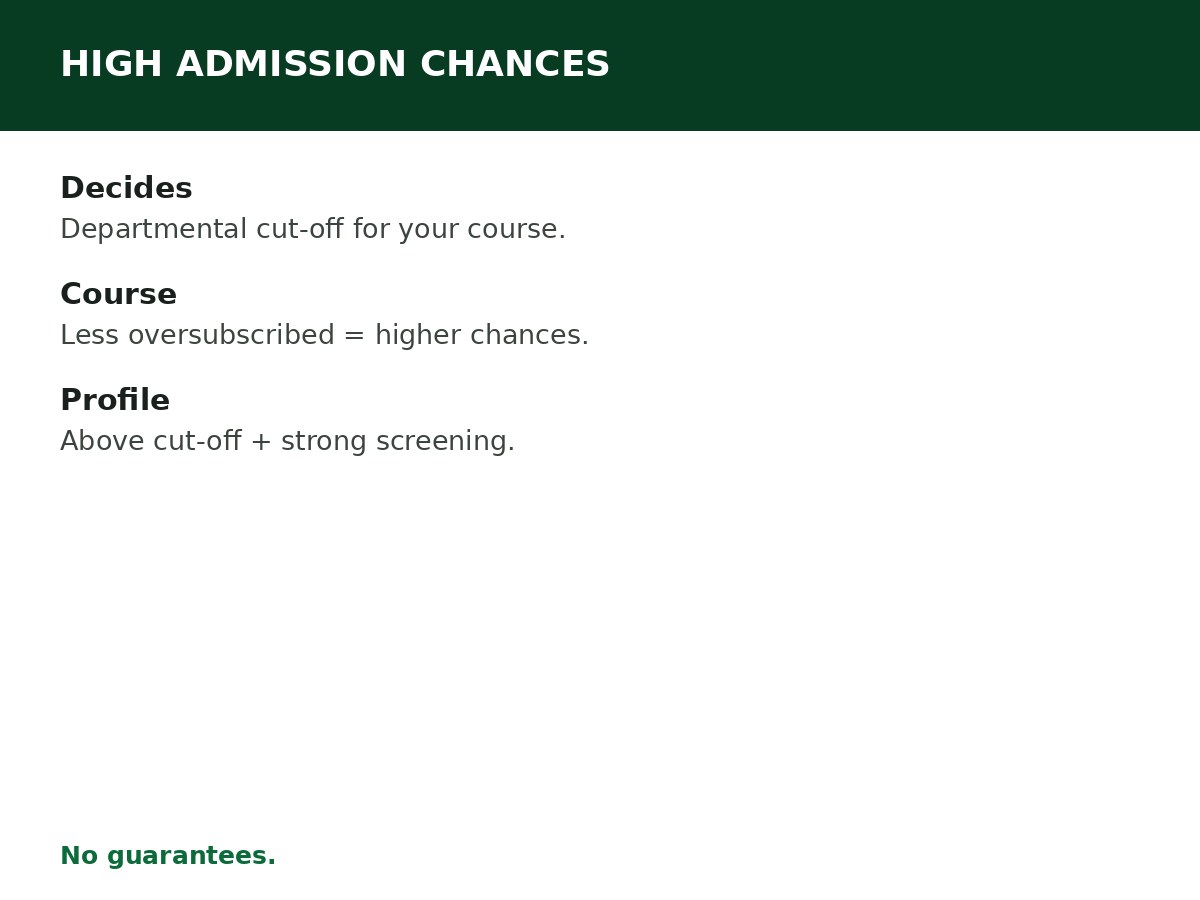
Your admission chances are highest where three things align: an institution with a low screening minimum and low competition for places, a course that is not oversubscribed, and your own profile (UTME score, O’Level grades, screening performance) comfortably above that course’s departmental cut-off. No institution guarantees admission, and any list that promises “high chances” without naming the course is misleading — chances are always course-specific.
This article explains the factors that actually raise your chances, and the institution types where those factors most often align — so you can build a realistic shortlist, not chase a generic list.
The factors that decide your chances
- Institutional minimum vs departmental cut-off. The institutional minimum (150–220 in 2026) only qualifies you to be screened. Your departmental cut-off — set per course, per session, by competition for that department’s places — is what decides admission. A course at a 150-minimum institution can still have a 220 departmental cut-off if it is oversubscribed.
- Course competitiveness. Medicine, Law, Pharmacy, Engineering, Nursing, and popular Management and Social Science courses attract far more applicants than places. Education, Agriculture, Arts, and many less popular Science and Social Science programmes attract fewer applicants per place — and therefore offer higher chances for the same UTME score.
- Institution age and location. Newer federal and state universities, and institutions outside the most competitive regions, typically receive fewer applications per place than long-established institutions in major cities. That lower competition is the main reason low-minimum institutions (FUDMA, FUKASHERE, FUWUKARI, FUGUS, and similar) also offer higher chances — not because their standards are lower, but because fewer candidates compete for their places.
- Your screening performance. At exam-format institutions, a strong screening score lifts a modest UTME aggregate. At screening-only institutions, strong O’Level grades do the same work. Either way, the screening stage is where a borderline candidate becomes an admitted one — or does not.
- First-choice status and catchment. Most institutions screen first-choice candidates first, and some institutions consider catchment area (state of origin) in their merit and catchment lists. Applying as first choice to an institution in your catchment area, where applicable, is a legitimate chance-raiser — not a guarantee, and not a substitute for meeting the cut-off.
- Correct subject combination and complete documents. A wrong UTME subject combination, a missing O’Level upload on CAPS, or a name mismatch between JAMB and O’Level records can disqualify an otherwise competitive candidate. These are the commonest avoidable losses — see the registration-mistakes guide.
Institution types with typically higher chances
- Newer federal universities with 150–160 minimums and lower application volumes (the low-end federal list in the low-scores guide). Higher chances here come from lower competition, not lower standards.
- State universities with 150–160 minimums (ABSU, AAU, CRUTECH, DELSU, IMSU, KSUSTA, ESUT, EKSU, NSUK, KSU, BSU, EBSU, and similar), particularly for less competitive courses and for candidates from the institution’s catchment area.
- Private universities with flexible minimums — but only where their published minimum and departmental cut-off for your course are actually low. Some private institutions (Covenant, reported at 200) are highly competitive; “private” alone does not mean high chances.
- Polytechnics and colleges of education (floor 100) as a safety tier — not universities, but a realistic route to a qualification and, via Direct Entry, to a university degree later.
How to build a high-chance shortlist
- List your courses by competitiveness, not just by preference. Your dream course and your realistic course may be different — apply for both, across institutions, within JAMB’s choice rules.
- Match each course to institutions whose departmental cut-off you meet or exceed, with your O’Level grades and screening format factored in.
- Include one safety institution (low minimum, low competition, less competitive course) as a first-choice option, and a polytechnic or college of education as a second safety tier.
- Apply early in the screening window, complete your documents before the deadline, and track both the institution’s portal and JAMB CAPS.
Related Guides & Next Steps
- How to Choose a University in Nigeria
- Universities That Accept Low JAMB Scores
- Universities With the Lowest Cut-Off Marks
- How University Admission Works in Nigeria
- 2026/2027 University Admission Guide for Nigerian Students
Frequently asked questions
Which university is easiest to gain admission into in Nigeria? There is no single answer — ease depends on your course, your score, and the session’s competition. Newer, low-minimum institutions offer higher chances for less competitive courses, but no institution is “easy” for a competitive course.
Does a low cut-off mean high chances? Only if the departmental cut-off for your course is also low. A 150-minimum institution can have a 220 departmental cut-off for Medicine. Check per course.
Does applying as first choice improve my chances? Yes, in most cases — institutions screen first-choice candidates first, and some require first-choice status to screen at all. Complete any change of institution before the screening window closes.
Do indigenes have higher chances? Some institutions consider catchment area (state of origin) in their admission lists, which can favour candidates from the institution’s catchment states. It is one factor among several — it does not override cut-offs or screening performance.
Should I choose a less competitive course just to gain admission? Only after weighing the four-year cost: a degree in a field you have no interest in is a long commitment. A less competitive course in a related field is a smarter compromise than an unrelated one chosen purely for admission.
Sources and last update
- Chance factors (departmental vs institutional cut-offs, course competitiveness, institution age/location and application volume, screening performance, first-choice and catchment, document correctness) from JAMB’s admission process and institution screening practices, as compiled by CareerMedal.
- Institution examples drawn from the low-scores guide’s verified-reported lists, with the same per-session verification instruction.
- No admission probability figure is asserted for any institution or course — chances are presented as relative factors, not percentages, because no official per-course probability is published.
Last updated: 24 October 2026. Guide — review every admission session and on every JAMB policy update.

Written by Olaitan Ilori
Olaitan Ilori is the founder and lead researcher at CareerMedal. He provides verified, practical guides on Nigerian tertiary admissions (JAMB, CAPS, Post-UTME), NELFUND student finance, NYSC service-year survival, and early-career job placement.
View all guides by Olaitan Ilori →