

A “low” JAMB score is not a dead end: JAMB’s 2026 policy minimum for universities is 150, and many universities set their screening minimum at exactly 150 — but only for certain courses, and only if your O’Level results and screening performance are strong. The realistic path for a low score is not “any university will take me” but “the right institution, the right course, and a strong screening” — and the institutions below are the ones most consistently reported at the 150–160 end of the range.
Read this article with one warning attached: cut-off figures are institution-set minimums for screening consideration, not guarantees of admission, and they change between sessions. Every figure below is reported for the 2026/2027 cycle and must be confirmed on the institution’s official portal for the session you are applying to.
What “low” actually means
- 150 is the national floor for universities (2026 JAMB policy minimum). No university can set a screening minimum below it — so a score below 150 cannot be screened by any university, and the honest next step is a polytechnic or college of education (floor 100), a pre-degree or remedial programme, or a retake.
- 150–160 is the realistic low-score band for federal and state universities. At the top end, institutions like Pan-Atlantic University set 220, and several leading universities (UI, UNILAG, OAU, UNIBEN, UNN, Covenant) set 200 — those are not low-score options.
- Departmental cut-offs run higher than institutional minimums. A university with a 150 minimum may still require 200+ for Medicine, Law, Pharmacy, or Engineering. Low-score strategy means targeting less competitive courses (Education, Agriculture, Arts, and many Social Science and Management programmes) at institutions with low minimums.
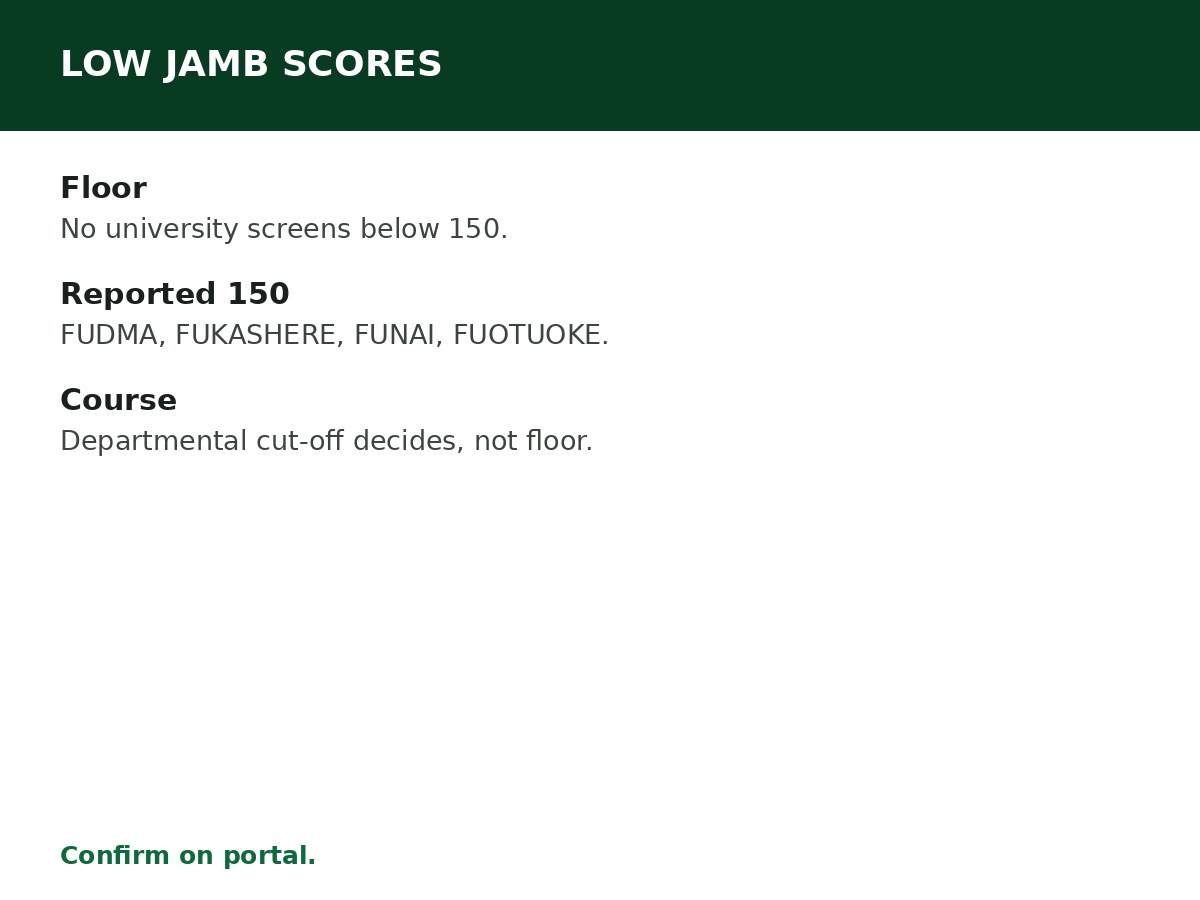
Universities most consistently reported at 150–160 (2026/2027)
These are the institutions that appear across multiple 2026 guides at the low end. Treat each as a lead to verify, not as a confirmed offer:
Federal universities reported at 150: Federal University, Dutsin-Ma (FUDMA); Federal University, Kashere (FUKASHERE); Alex Ekwueme University, Ndufu-Alike (FUNAI); Federal University, Otuoke (FUOTUOKE); Michael Okpara University of Agriculture, Umudike (MOUAU); Federal University of Technology, Minna (FUTMINNA); Federal University, Wukari (FUWUKARI); Federal University, Gusau (FUGUS, reported 150–160).
Federal universities reported at 160: Federal University, Dutse (FUD); Federal University of Technology, Owerri (FUTO, course-dependent — engineering and science programmes may require more).
State universities reported at 150–160: Abia State University (ABSU); Ambrose Alli University (AAU, Ekpoma); Cross River University of Technology (CRUTECH); Delta State University (DELSU); Imo State University (IMSU); Kebbi State University of Science and Technology (KSUSTA); Enugu State University of Science and Technology (ESUT); Ekiti State University (EKSU); Nasarawa State University (NSUK); Kogi State University (KSU); Benue State University (BSU); Ebonyi State University (EBSU).
Other institutions reported at 150 (2026 policy list): Adamawa State University, Adeleke University, African School of Economics, and AbdulRasaq Abubakar Toyin University.
Private universities: private institutions vary widely — some are flexible, but others set high minimums (Covenant University is reported at 200 for 2026). “Private” does not automatically mean “low cut-off”. Check each private institution’s published minimum.
How to use a low score well
- Pick courses, not just institutions. A 150 score with strong O’Level grades in Education or Agriculture at a 150-minimum institution is a realistic application. The same score aimed at Medicine at a 200-minimum institution is not.
- Make your screening count. Where the institution runs an exam, your screening score can lift a low UTME aggregate. Where it runs screening only, your O’Level grades are the lift — distinctions in your five required subjects matter most.
- Apply as first choice to the institution you are targeting, and complete any change of institution before the screening window closes.
- Have a backup tier. Apply to a polytechnic or college of education as well (floor 100), or to a pre-degree programme, so a low UTME score does not cost you a whole year.
- Confirm before you pay. Check the institution’s official portal for its current minimum, its departmental cut-offs, and its screening format — for the session you are applying to, not last session’s blog list.
Related Guides & Next Steps
- How to Change Course on JAMB Portal
- Universities With High Admission Chances
- Universities With the Lowest Cut-Off Marks
- How University Admission Works in Nigeria
- 2026/2027 University Admission Guide for Nigerian Students
Frequently asked questions
Can I gain admission with 150 in JAMB? Yes, at institutions that set 150 as their screening minimum, for courses whose departmental cut-off you meet, with strong O’Level results and screening performance. It is not a guarantee.
What if my score is below 150? No university can screen you below the 150 floor. Consider a polytechnic or college of education (floor 100), a pre-degree or remedial programme, or retaking UTME.
Do low cut-off universities offer quality degrees? A degree from a federal or state university carries the same national recognition regardless of the institution’s cut-off. Cut-off reflects competition for places, not degree validity — though facilities, staffing, and course quality vary by institution and should be checked separately.
Is a private university easier with a low score? Not necessarily. Private institutions set their own minimums, and some (like Covenant, reported at 200 for 2026) are highly competitive. Check each institution’s published minimum.
Should I change my course to a less competitive one? If your score cannot meet your first-choice course’s departmental cut-off, a change of course (on JAMB, within the window) to a less competitive course at a low-minimum institution is a legitimate strategy — see the change-of-course guide. Do not change to a course you have no interest in without weighing the four-year cost of that choice.
Sources and last update
- 2026 policy-meeting minimums (150 floor for universities; 200 for UI/UNILAG/OAU/UNIBEN/UNN/Covenant/AFIT; 220 Pan-Atlantic; 160/170/180/195 bands) from JAMB’s 2026 policy figures as reported.
- Low-end institution lists (150–160 federal and state) from multiple 2026 guides, with cross-guide agreement treated as “reported”, not confirmed — and with the FUOTUOKE 140-vs-150 variation noted as a reason to confirm on the portal.
- Departmental-vs-institutional minimum distinction from JAMB’s own framing (figures are minimum thresholds for consideration; institutions may impose higher requirements for competitive courses).
Last updated: 24 October 2026. Guide — review every admission session and on every JAMB policy update. Institution figures must be re-verified for each new session.

Written by Olaitan Ilori
Olaitan Ilori is the founder and lead researcher at CareerMedal. He provides verified, practical guides on Nigerian tertiary admissions (JAMB, CAPS, Post-UTME), NELFUND student finance, NYSC service-year survival, and early-career job placement.
View all guides by Olaitan Ilori →