

Genuine scholarships rarely charge an application fee — and that single fact is the most useful scam filter available. This guide explains why, names the established no-fee programmes, and tells you how to verify any programme’s fee status for the current cycle. The rule is simple: if a ‘scholarship’ demands a fee to a personal account, or a fee before selection, treat it as a scam until proven otherwise on the programme’s official page.
Why genuine scholarships do not charge fees
Scholarships are funded by governments, companies, and foundations to support students — charging applicants would defeat the purpose, especially for need-based programmes. Application processing is part of the programme’s funded cost, not the applicant’s. The rare exceptions (some university application fees, separate from the scholarship itself) are charged by the university through its official portal, never by an agent or a personal account.
Established no-fee programmes
- Commonwealth Scholarships — no application fee.
- Chevening Scholarships — no application fee.
- DAAD Scholarships — no application fee.
- Erasmus Mundus — no application fee for the scholarship application (university application fees, where they exist, are separate and charged through official portals).
- MEXT Scholarships — no application fee.
- Mastercard Foundation Scholars Programme — no application fee.
- PTDF Scholarships — no application fee.
- MTN Foundation, NLNG, NNPC joint-venture, and Jim Ovia Scholarships — no application fee.
Fee red flags, in order of danger
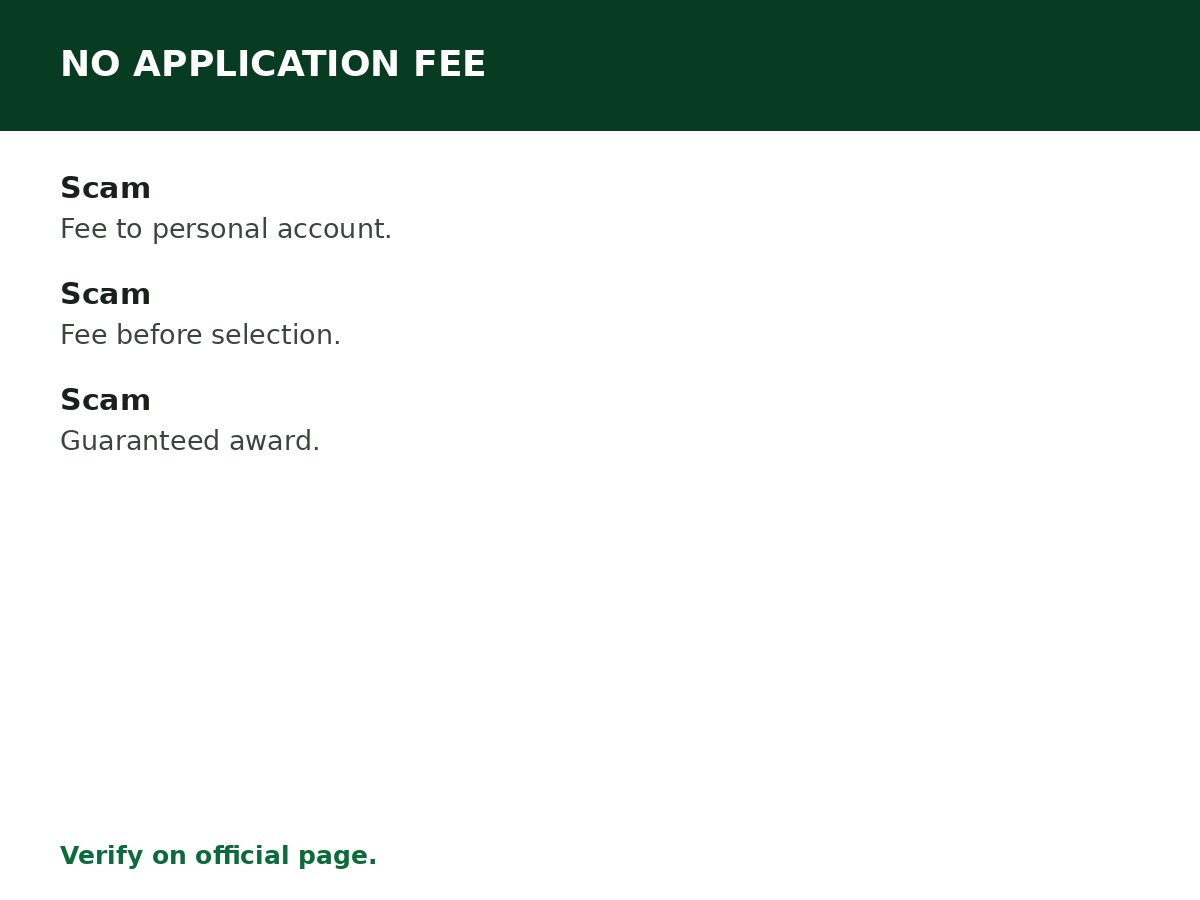
- Fee to a personal account — scam, in almost every case. Genuine programmes never collect fees to personal accounts.
- Fee before selection — scam, in almost every case. Genuine programmes select first, then (if anything) charge official costs through official channels.
- Fee for ‘guaranteed’ selection — scam, always. No genuine scholarship guarantees selection.
- Fee for forms, past questions, or ‘processing’ — scam, in almost every case. Forms are free on official portals.
- Urgency plus fee — ‘pay today or lose the slot’ is a pressure tactic, not a programme rule.
How to verify a programme’s fee status
- Go to the programme’s official page (typed directly, not via a forwarded link).
- Find the application instructions — genuine programmes state ‘no application fee’ or list no fee at all.
- If a fee is mentioned, check who collects it (official portal vs personal account) and when (before vs after selection).
- If in doubt, contact the programme through its official contact page — never through the number in a forwarded message.
Related Guides & Next Steps
- How University Admission Works in Nigeria
- Scholarships for Nigerian Students in 2026/2027
- Scholarships for Students With Low Income
- Scholarships for Female Students in Nigeria
- Scholarships That Pay Monthly Stipends
Frequently asked questions
Do genuine scholarships charge application fees? Rarely — genuine scholarships do not charge application fees. University application fees, where they exist, are separate and charged through official university portals, never by agents or personal accounts.
I was asked to pay a scholarship fee. Is it a scam? Treat it as a scam until proven otherwise on the programme’s official page — especially a fee to a personal account, a fee before selection, or a fee for ‘guaranteed’ selection.
What if a scholarship asks for a ‘processing fee’? Treat it as a scam. Forms are free on official portals; processing is part of the programme’s funded cost, not the applicant’s.
Are past questions for scholarship exams sold legitimately? Past questions, where they exist, are free or provided by the programme itself. Anyone selling ‘past questions’ for a scholarship exam is running a scam, in almost every case.
How do I report a scholarship scam? Report to the programme’s official contact page, and to the relevant authorities (EFCC, NITDA, or the police cybercrime unit, as appropriate). Keep every message and payment record as evidence.
Sources and last update
- Scholarship programmes named here are established programmes as reported; amounts, deadlines, and eligibility change every cycle — the official programme page for the current cycle governs, and no amount or deadline is asserted anywhere in this article, deliberately.
- Scholarship-vs-loan distinction from the NELFUND cluster guides (Batches 6–10): a scholarship is not repaid; NELFUND is a loan, repayable from 2 years after NYSC at 10% of income.
- Scam patterns from the fake-agents guide (Batch 12): application fees, guaranteed awards, and payment to personal accounts are red flags.
- No admission, award, or visa outcome is promised anywhere in this article.
Last updated: 24 October 2026. Guide — review every 3–6 months and on every scholarship-cycle update.

Written by Olaitan Ilori
Olaitan Ilori is the founder and lead researcher at CareerMedal. He provides verified, practical guides on Nigerian tertiary admissions (JAMB, CAPS, Post-UTME), NELFUND student finance, NYSC service-year survival, and early-career job placement.
View all guides by Olaitan Ilori →