
Scholarships for female students in Nigeria exist because girls and women face specific barriers to education — early marriage pressure, household duties, safety concerns, and underrepresentation in science and technology fields. This guide names the established programmes for female students, explains how they select, and tells you how to verify each one for the current cycle — because amounts, deadlines, and eligibility change every year, and no amount or deadline is asserted anywhere in this article, deliberately.
Established programmes for female students
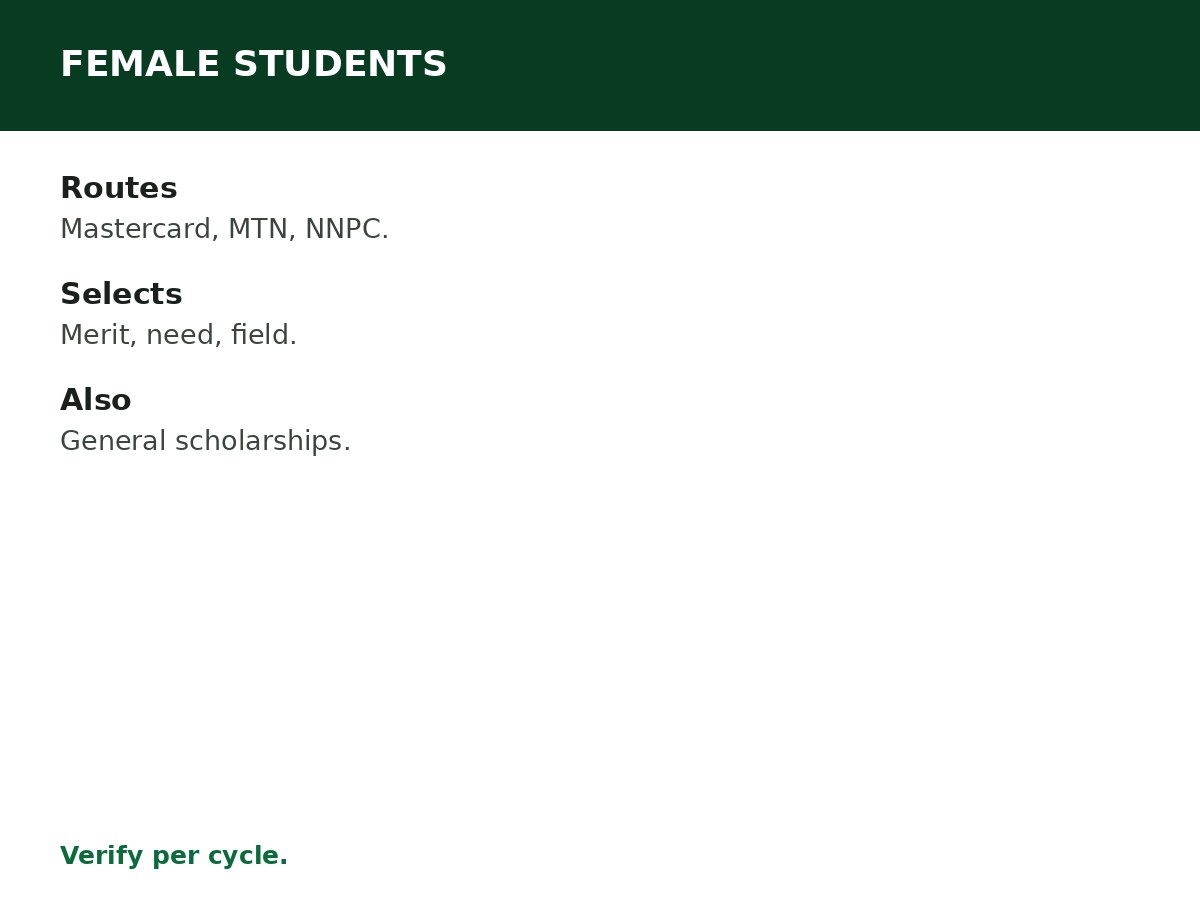
- Mastercard Foundation Scholars Programme — for African students including young women, at partner universities, with mentoring and leadership support alongside funding.
- MTN Foundation Scholarship — includes provisions for female students in science and technology fields, as its terms state.
- NNPC joint-venture scholarships (Shell SPDC, Chevron/Agbami, TotalEnergies, SEPLAT) — undergraduate scholarships that include female students, with some programmes reserving places for girls, as their terms state.
- University scholarships for women — many universities run scholarships and bursaries for female students, especially in STEM fields; check your institution’s student-affairs office.
- State and foundation schemes — several states and foundations run girls’ education schemes; check your state scholarship board and local foundations.
- International programmes for women — Commonwealth, Chevening, and DAAD programmes all fund female Nigerian students; some include women-in-STEM provisions, as their terms state.
How female-student scholarships select
- Merit and need, as the programme states — most programmes combine academic performance with financial need, as in the general scholarship guides.
- Field — several programmes target STEM fields, where women are underrepresented. Your field must match the programme’s list.
- Leadership and community — some programmes weigh leadership, community service, and mentoring of younger girls.
- Barriers overcome — some programmes consider the barriers you have faced (early marriage pressure, household duties, displacement). State them honestly in your application; do not invent them.
How to apply, in order
- Shortlist by level, field, and eligibility.
- Check the official programme page for the current cycle — amounts, deadlines, eligibility, and any women-specific provisions.
- Prepare documents early — results, identification, references, and (where required) need documentation.
- Apply through the official portal only.
- Apply to general scholarships in parallel — female-specific programmes are additional, not the only, options.
Related Guides & Next Steps
- Fully Funded Scholarships for Nigerians
- Scholarships for Nigerian Students in 2026/2027
- Scholarships for Engineering Students
- Scholarships for Computer Science Students
- Scholarships for Students With Low Income
Frequently asked questions
Are there scholarships only for female students? Yes — several programmes target female students, especially in STEM, alongside general programmes open to all. Apply to both.
Do female scholarships require different grades? No — the same academic thresholds apply, as each programme states. Some programmes add leadership or barrier criteria on top, not instead of grades.
Can a female student hold a general scholarship and a female-specific one? Some programmes allow it, others exclude candidates who already hold another award. Check each programme’s terms.
Are female scholarships only for STEM? No — though several target STEM, foundation and university schemes cover Arts, Social Sciences, and other fields. Check each programme’s field list.
How do I avoid female-scholarship scams? Apply through official portals only, never pay an application fee to a personal account, never trust a guaranteed award, and verify every programme on its official page.
Sources and last update
- Scholarship programmes named here are established programmes as reported; amounts, deadlines, and eligibility change every cycle — the official programme page for the current cycle governs, and no amount or deadline is asserted anywhere in this article, deliberately.
- Scholarship-vs-loan distinction from the NELFUND cluster guides (Batches 6–10): a scholarship is not repaid; NELFUND is a loan, repayable from 2 years after NYSC at 10% of income.
- Scam patterns from the fake-agents guide (Batch 12): application fees, guaranteed awards, and payment to personal accounts are red flags.
- No admission, award, or visa outcome is promised anywhere in this article.
Last updated: 24 October 2026. Guide — review every 3–6 months and on every scholarship-cycle update.

Written by Olaitan Ilori
Olaitan Ilori is the founder and lead researcher at CareerMedal. He provides verified, practical guides on Nigerian tertiary admissions (JAMB, CAPS, Post-UTME), NELFUND student finance, NYSC service-year survival, and early-career job placement.
View all guides by Olaitan Ilori →