
Low-income scholarships — need-based awards — are awarded on financial need, not grades alone. They exist because merit-only awards miss talented students who cannot afford to study. This guide names the established need-based routes, explains how need is assessed, and tells you how to verify each programme for the current cycle — because amounts, deadlines, and eligibility change every year, and no amount or deadline is asserted anywhere in this article, deliberately. A need-based scholarship is not a loan: it is not repaid. NELFUND, by contrast, is a loan — do not confuse the two.
Established need-based routes
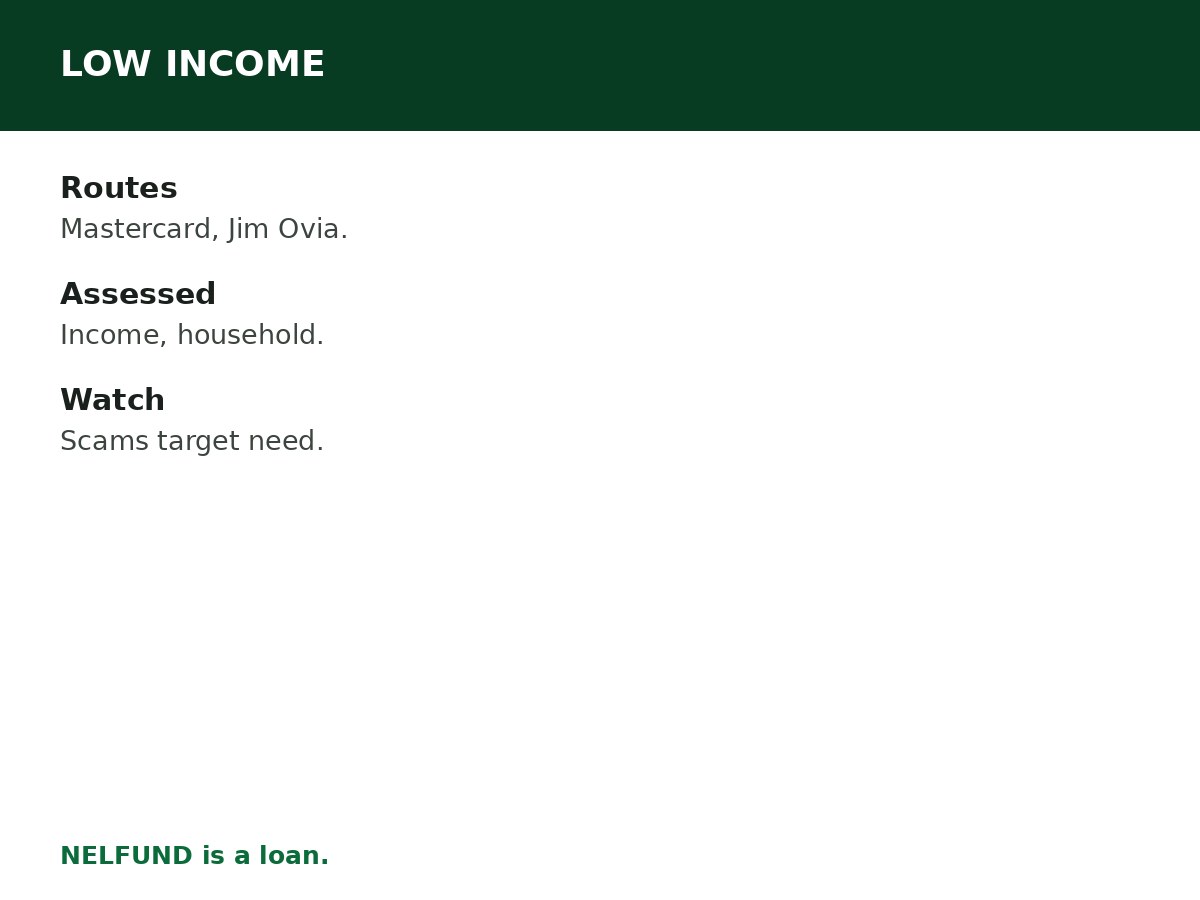
- Mastercard Foundation Scholars Programme — need-based, for African students, at partner universities in Africa and abroad.
- Jim Ovia Scholarship — need-based, for Nigerian undergraduate students.
- University need-based schemes — many universities run need-based scholarships and bursaries for their own students; check your institution’s student-affairs office.
- State scholarship boards — many states run need-based scholarships for indigenes; check your state scholarship board.
- Foundation scholarships — MTN Foundation, NLNG, and other foundation programmes include need-based elements, as their terms state.
- NELFUND (NOT a scholarship) — a loan, repayable from 2 years after NYSC at 10% of income. It is an option for students who cannot get a scholarship, but it is not a scholarship and it is repaid.
How need is assessed
- Family income — the most common criterion, documented as the programme states (income statements, tax records, or employer letters, where required).
- Household size and dependants — some programmes weigh income against household size.
- Orphan or vulnerable status — some programmes prioritise orphans, students with disabilities, or other vulnerable groups, as their terms state.
- Academic threshold — need-based does not mean grades-free: most programmes still set a minimum academic threshold (admission, pass grades, or a CGPA floor, as the programme states).
- Documentation — prepare income proof early; programmes reject undocumented need claims, and forged documents disqualify you permanently.
How to apply, in order
- Shortlist need-based programmes by level, field, and eligibility.
- Check the official programme page for the current cycle — amounts, deadlines, eligibility, documentation.
- Prepare documents early — admission letter, results, identification, and income proof as the programme states.
- Apply through the official portal only.
- Apply for NELFUND in parallel if you need it — but understand it is a loan, repayable, not a scholarship.
Red flags for low-income applicants
Low-income students are the most targeted by scholarship scams — fee demands, guaranteed awards, and ‘processing’ charges hit hardest where money is tightest. The rule is absolute: never pay for a scholarship application, never pay to a personal account, never trust a guaranteed award. Genuine need-based programmes are free to apply for.
Related Guides & Next Steps
- How University Admission Works in Nigeria
- Scholarships for Nigerian Students in 2026/2027
- Scholarships for Female Students in Nigeria
- Scholarships for Engineering Students
- Scholarships With No Application Fee
Frequently asked questions
What is a need-based scholarship? A scholarship awarded on financial need, not grades alone — though most programmes still set a minimum academic threshold. It is not repaid.
Is NELFUND a scholarship for low-income students? No. NELFUND is a loan, repayable from 2 years after NYSC at 10% of income. It is an option for students who cannot get a scholarship, but it is not a scholarship.
What documents prove low income? As the programme states — commonly income statements, tax records, or employer letters, where required. Prepare them early; undocumented need claims are rejected, and forged documents disqualify you permanently.
Can I get a need-based scholarship with average grades? Possibly — need-based programmes weigh need first, but most still set a minimum academic threshold (admission, pass grades, or a CGPA floor). Check each programme’s terms.
How do I avoid low-income scholarship scams? Never pay for a scholarship application, never pay to a personal account, never trust a guaranteed award. Genuine need-based programmes are free to apply for, through official portals only.
Sources and last update
- Scholarship programmes named here are established programmes as reported; amounts, deadlines, and eligibility change every cycle — the official programme page for the current cycle governs, and no amount or deadline is asserted anywhere in this article, deliberately.
- Scholarship-vs-loan distinction from the NELFUND cluster guides (Batches 6–10): a scholarship is not repaid; NELFUND is a loan, repayable from 2 years after NYSC at 10% of income.
- Scam patterns from the fake-agents guide (Batch 12): application fees, guaranteed awards, and payment to personal accounts are red flags.
- No admission, award, or visa outcome is promised anywhere in this article.
Last updated: 24 October 2026. Guide — review every 3–6 months and on every scholarship-cycle update.

Written by Olaitan Ilori
Olaitan Ilori is the founder and lead researcher at CareerMedal. He provides verified, practical guides on Nigerian tertiary admissions (JAMB, CAPS, Post-UTME), NELFUND student finance, NYSC service-year survival, and early-career job placement.
View all guides by Olaitan Ilori →