

Bayero University, Kano (BUK) is a Federal university in Kano, Kano State, founded in 1960. This guide covers its schools and faculties, its admission requirements, its screening, and how its fees work — with the same honesty rule as the other profiles: no fee figure is asserted anywhere in this article, because charges vary by course, faculty, and session, and fee schedules change between sessions. What is stated is the process, the requirements, and exactly how to verify the numbers that matter.
Schools and faculties
BUK’s schools and faculties include: Agriculture, Arts and Islamic Studies, Basic Medical Sciences, Clinical Sciences, Communication, Computer Science and Information Technology, Dentistry, Education, Engineering, Law, Life Sciences, Management Sciences, Pharmaceutical Sciences, Physical Sciences, and Social Sciences.
That list is indicative, not exhaustive — programmes open, close, and restructure. Before applying, check the current JAMB brochure entry for BUK and your course: the brochure for the session governs the programme list, the O’Level requirements, and the UTME subjects.
Admission requirements
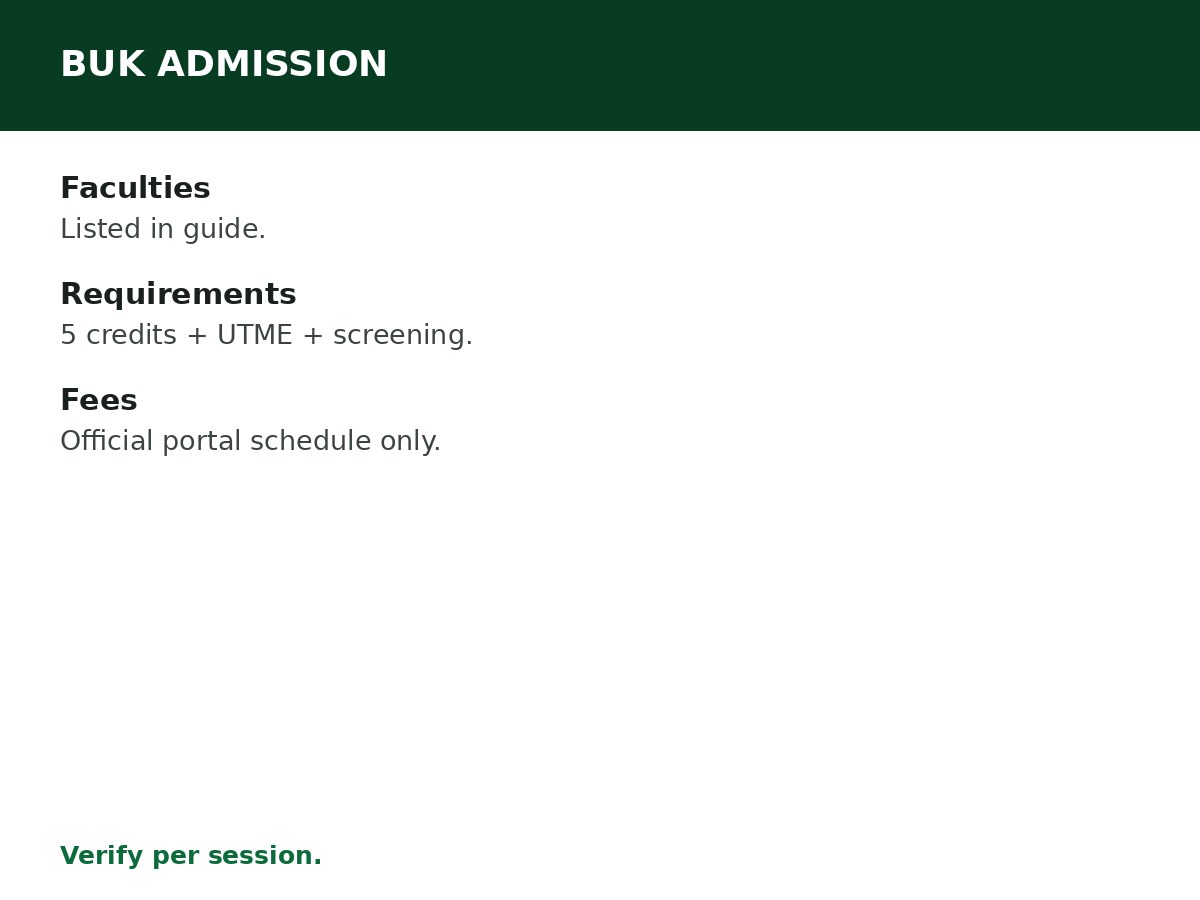
- O’Level: five credits including English Language and Mathematics for most courses, in not more than two sittings (course-specific subjects as the brochure states).
- UTME: correct subject combination for your course (as the brochure states for BUK), with BUK as first choice (first-choice rule applies at most institutions — check BUK’s screening notice for the session).
- Screening: BUK screens candidates after UTME (exam, aggregate, or verification, as the session’s notice states). Prepare for the format the notice actually describes.
- Age: minimum age 16 (JAMB policy, as established in the requirements guide).
- Cut-off context: BUK’s departmental cut-offs were reported around the 150–160 range in the low-scores guide, with competitive courses higher. Treat that as a guide, not a guarantee: departmental cut-offs move every session. The institution minimum for universities is 150 (JAMB policy floor) — but that floor is not BUK’s departmental cut-off for any specific course.
School fees: how they work (and why no figure is quoted here)
BUK’s session charges typically comprise school charges (varying by course and faculty), a one-off acceptance fee after admission (via the official portal only), accommodation where you take a hostel place (allocation not guaranteed), and other session charges as the fee schedule lists them. No figure is quoted for any component, deliberately: a figure from a previous session or a different programme would mislead you. Find your exact course and level on BUK’s official fee schedule for the session, add the components that apply to you, pay only through the official portal, and keep every receipt. As a public university, BUK’s students may be covered by the NELFUND loan where the portal lists the institution — check the portal list for the session; do not assume coverage or an amount.
Campus and living costs
BUK traces its origins to 1960 (as Ahmadu Bello College, becoming a university college in 1964). Its Kano location is the North’s largest commercial centre: business and trade exposure are strong, and living costs run lower than Lagos or Abuja.
Budget the full session, not just school charges: school charges + accommodation + feeding + transport + books and materials + personal costs. The full-session total is what determines whether a university is affordable for you.
Related Guides & Next Steps
- Admission Requirements for Nigerian Universities
- How to Choose a University in Nigeria
- How University Admission Works in Nigeria
- University of Lagos (UNILAG) Courses, Requirements and School Fees
- Federal University of Agriculture, Abeokuta (FUNAAB) Admission Guide
Frequently asked questions
What courses does BUK offer? Schools and faculties include: Agriculture, Arts and Islamic Studies, Basic Medical Sciences, Clinical Sciences, Communication, Computer Science and Information Technology, Dentistry, Education, Engineering, Law, Life Sciences, Management Sciences, Pharmaceutical Sciences, Physical Sciences, and Social Sciences. Check the current JAMB brochure entry for BUK and your course for the definitive, session-current list.
What are the requirements for admission into BUK? Five O’Level credits including English and Mathematics for most courses (course-specific subjects as the brochure states), the correct UTME combination, BUK as first choice, and screening as the session’s notice states. Departmental cut-offs apply on top of the institution minimum.
What is BUK’s cut-off mark? There is no single number: an institution minimum (150 floor for universities) plus a departmental cut-off per course, per session. BUK’s departmental cut-offs were reported around the 150–160 range in the low-scores guide, with competitive courses higher. Treat that as a guide, not a guarantee: departmental cut-offs move every session.
How much are BUK school fees? This guide deliberately quotes no figure: charges vary by course, faculty, and session. Find your exact course and level on BUK’s official fee schedule for the session and pay only through the official portal.
Does BUK accept NELFUND? As a public university, BUK may be covered where the NELFUND portal lists it for the session — check the portal list. Institutional charges are paid directly to the institution; upkeep, where requested, goes to the student’s bank account.
Sources and last update
- Institution facts (location, ownership, founding year, schools/faculties) from institution and NUC reporting as established, stated indicatively — the current JAMB brochure and the university’s official notices govern for the session.
- Cut-off context from the cluster’s cut-off guides (Batches 11 and 14), summarised here — the cut-off guides govern where they differ in detail, and per-session verification is directed throughout.
- Fee guidance from the acceptance-fee, NELFUND, and fake-agents guides — no fee figure is asserted anywhere in this article, deliberately.
Last updated: 24 October 2026. Guide — review every 3–6 months and on every fee-schedule or admission-session update.

Written by Olaitan Ilori
Olaitan Ilori is the founder and lead researcher at CareerMedal. He provides verified, practical guides on Nigerian tertiary admissions (JAMB, CAPS, Post-UTME), NELFUND student finance, NYSC service-year survival, and early-career job placement.
View all guides by Olaitan Ilori →